Gulf War
2 August 1990
The Gulf War was a short, sharply bounded conflict defined by UN authorisation, phased military execution, and unprecedented media access — but the record says nothing about its aftermath, costs, or contested legacies.
The first draft, written under deadline and increasingly without funding.
The Gulf War was a short, sharply bounded conflict defined by UN authorisation, phased military execution, and unprecedented media access — but the record says nothing about its aftermath, costs, or contested legacies.

Samarkand at -800 BC is archaeologically verifiable, institutionally attested, and geographically explicable — but its ‘founding’ remains a scholarly estimate, not a recorded event.
The atomic bombings of Hiroshima and Nagasaki were deliberate, authorised, and executed military operations using newly developed nuclear weapons. Their scale, method, and human impact are well-documented in the source. Their causal relationship to Japan’s surrender is asserted only as ‘precipitation’—not proof of necessity or sufficiency. No claim about motives, alternatives, or internal Japanese decision-making appears in the material.
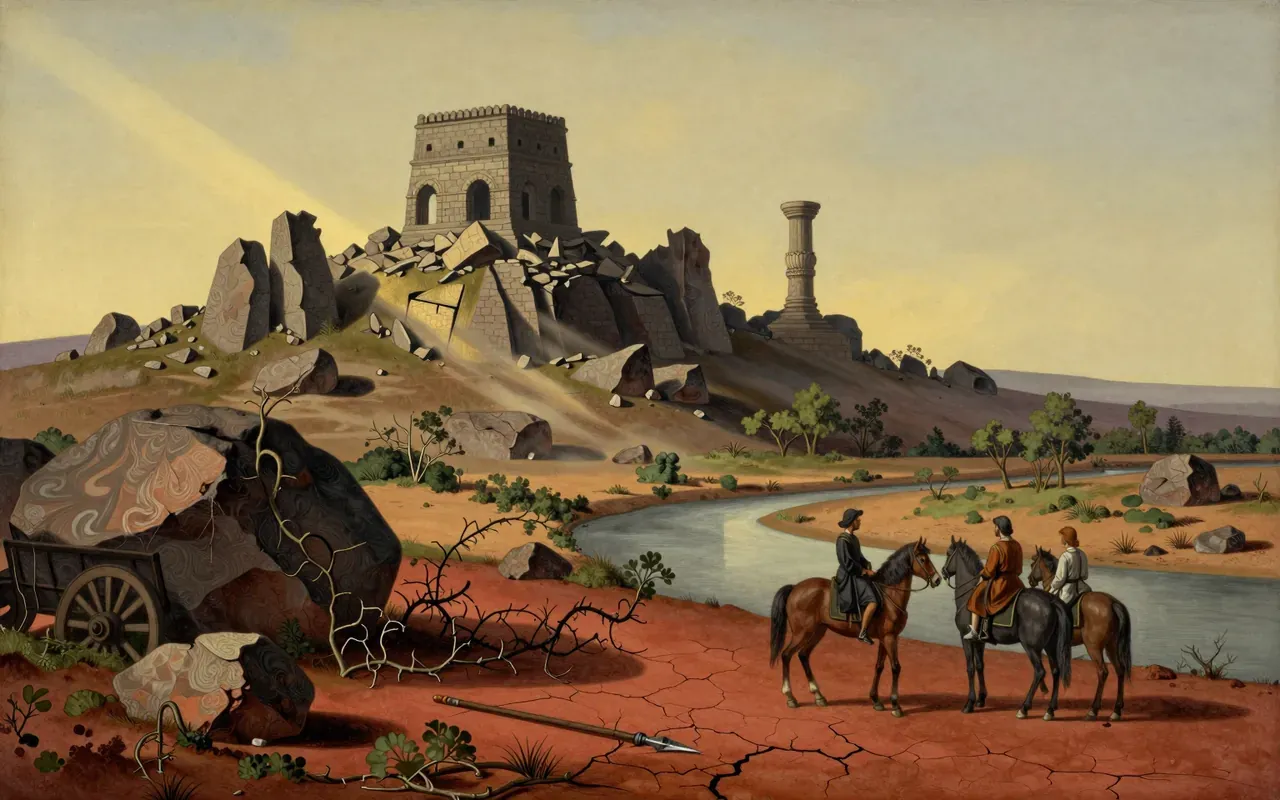
The Battle of Talikota was a decisive military defeat for Vijayanagara, caused by coalition warfare and military asymmetry — not civilizational conflict. Its legacy lies in how early-modern South Asian states negotiated power, not in mythic binaries.