historybriefs
Topic

The interwar years

Twenty years of unfinished business between two wars.

4
in history
11:47
average
47 min
in total
135
across the network
The interwar years across the network →
All briefs4
10:18

Reichstag fire

27 February 1933

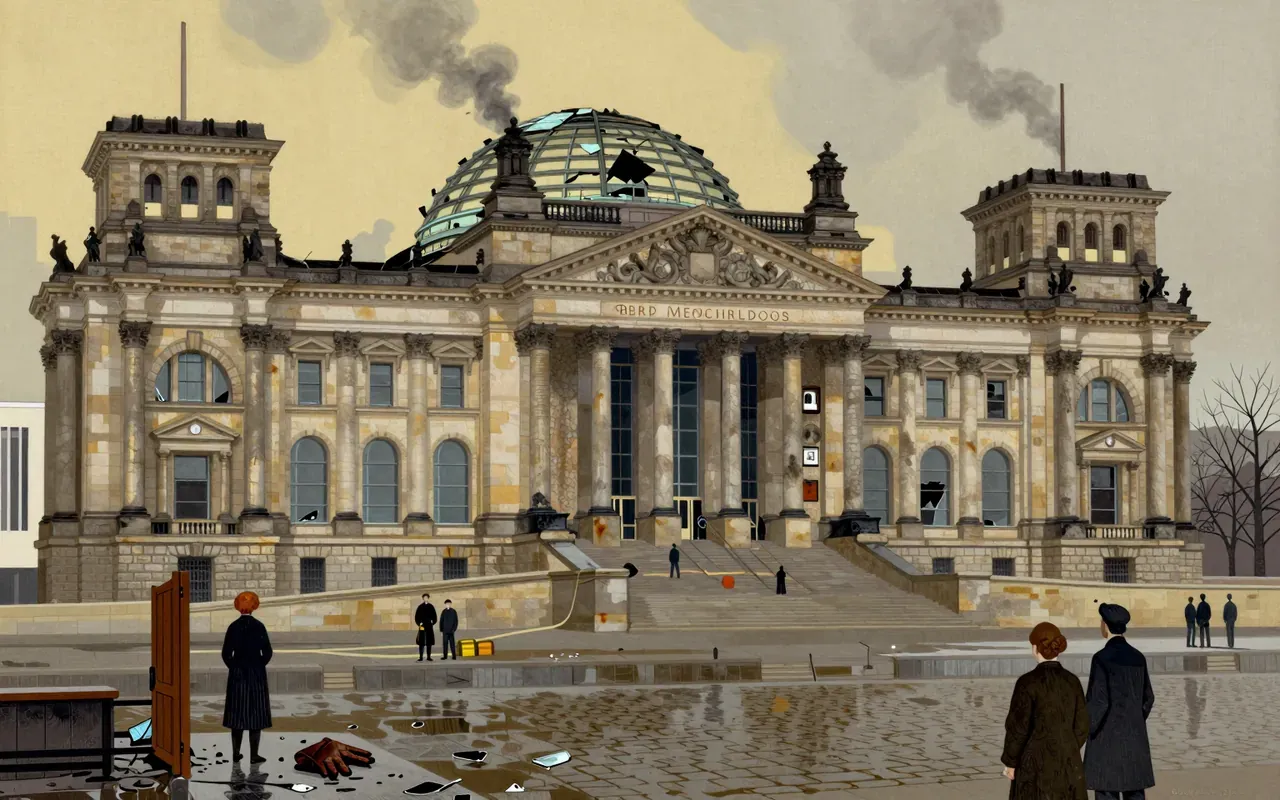
The Reichstag fire was an arson attack on 27 February 1933 in Berlin. It was reported at 9:00 p.m., extinguished by 11:30 p.m., and gutted most of the building. Van der Lubbe was arrested inside. Twenty unburned firelighters were found. The Nazi government used it within 24 hours to suspend civil liberties. Who started it remains contested. The record proves method and consequence — not motive, conspiracy or sole agency.

10:48

Spanish Civil War

1936 to 1939

The Spanish Civil War was a domestically rooted civil conflict (1936–1939) between Republicans defending the Popular Front government and Nationalists launching a failed coup. It ended with Nationalist victory and Franco’s authoritarian regime — lasting until 1975. Evidence confirms militia mobilisation, Franco’s October 1936 appointment as supreme leader, organised purges in conquered zones, and Casado’s March 1939 coup fracturing Republican resistance. What remains contested includes the scale, coordination and motives behind Republican executions — the source only states local authority involvement 'varied by location'. The war changed Spain’s constitutional order permanently and demonstrated how foreign powers weaponise civil wars as ideological proxies.

13:00

Great Depression

1929–1941

The Great Depression began with the October 1929 Wall Street crash and, over the following years, produced a roughly 46 per cent drop in American industrial production, unemployment reaching a quarter of the workforce, and a worldwide contraction in trade and output that lasted until the outbreak of the Second World War. Economists have proposed several overlapping explanations, monetary contraction, insufficient aggregate demand, and a debt-deflation spiral among them, and continue to debate how much credit each deserves alongside factors including the Smoot-Hawley Tariff and the rigidity of the gold standard.

13:00

Roaring Twenties

1920–1929

The 1920s brought rapid economic growth, mass consumer goods, jazz and a new pace of urban life to the United States and, more unevenly, to parts of Europe. The prosperity behind the name was real but badly distributed: rural industries stagnated, and Prohibition, in force for most of the decade, produced a black market and thousands of poisoning deaths alongside whatever gains it made against drinking. The Wall Street crash of 1929 ended the boom abruptly, and the arguments the decade started, about excess, exclusion and the wisdom of Prohibition, ran on well past the crash.