A decade of new machines and new music
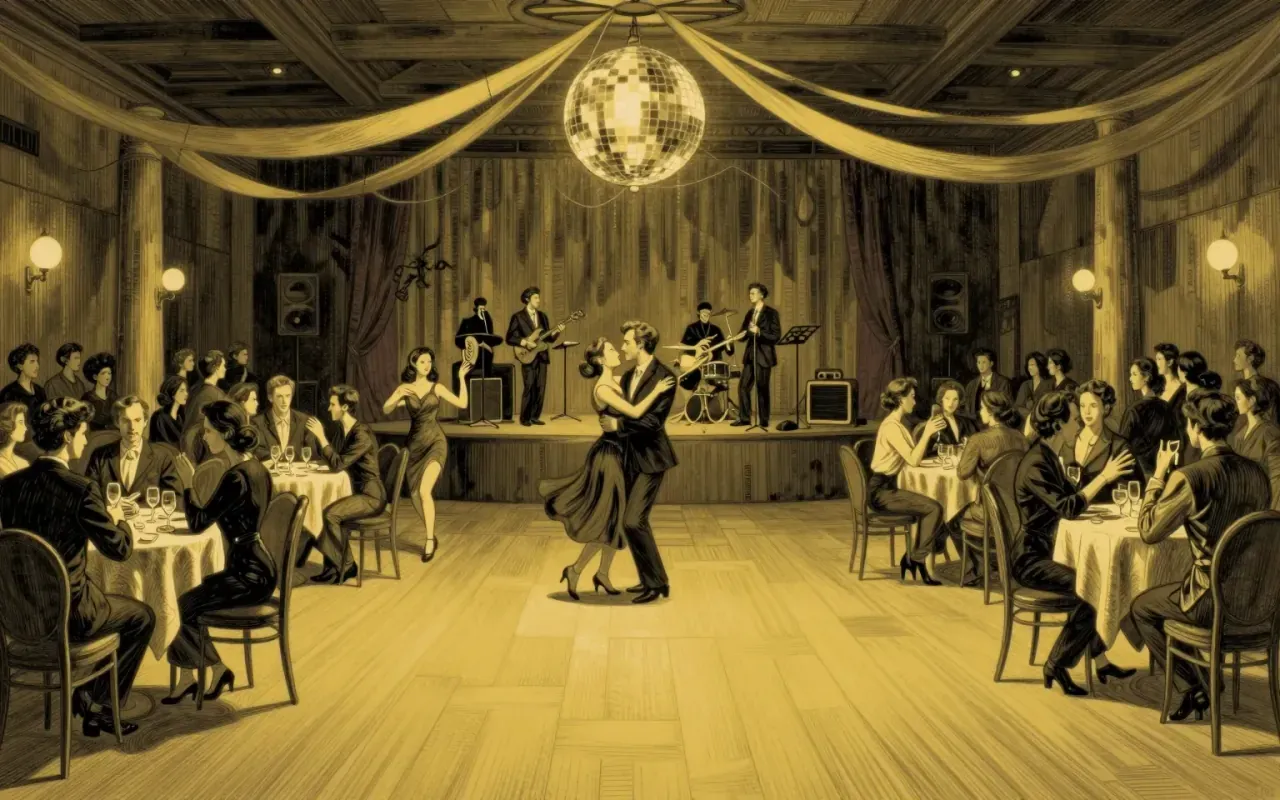
Across the 1920s, and above all in the United States, the decade later called the Roaring Twenties brought rapid economic growth, mass-produced consumer goods and a visible break with prewar habits. Nearly 27 million motor vehicles were registered in the United States by 1929, radios and household appliances reached middle-class homes for the first time, and cities from Chicago and New York to Berlin and Paris shared, unevenly and on their own timetables, a similar mood of novelty. Jazz, the flapper style of dress, and new dances such as the Charleston spread through a growing mass media and advertising industry. France called its version the annees folles and Germany, once its mid-decade recovery took hold, the Golden Twenties. The era ended abruptly with the Wall Street crash of 1929, which tipped much of the world into the Depression that followed.
A label applied after the party
Much of what is remembered as the decade’s mood comes from contemporaries who were already uneasy about it. Novelists such as Sinclair Lewis, in “Babbitt” and “Main Street”, satirised the conformity and materialism they saw in the new prosperity even as it was happening, rather than in hindsight. Writers grouped later as the Lost Generation, including Ernest Hemingway, wrote from a similar disillusionment after the First World War. Statistical records of vehicle ownership, radio sales and women’s employment in clerical work supply the economic picture, while suffrage dates, 1920 in the United States and 1928 in Britain, mark the era’s political change directly. The name Roaring Twenties itself is a retrospective label, applied after the decade closed, and it flattens a period that many living through it experienced as considerably more anxious than the name now suggests.
Why the boom landed where it did
The prosperity rested on techniques of mass production that had matured during and after the First World War, making cars and household goods affordable to a much wider public, and on an advertising industry that grew alongside them to create demand for what factories could now supply cheaply. The United States, spared the physical destruction of the war fought largely on European soil, became the richest country in the world measured per person, while European economies, more disrupted by the war and its aftermath, did not generally begin to recover until around 1924. That gap in timing and in scale of loss explains much of why the same decade could be remembered so differently on either side of the Atlantic, and why prosperity inside the United States itself still moved at different speeds in different places.
A boom that skipped the farm and the mine
Historians are clear that the decade’s prosperity was not shared evenly. Farming and coal mining stagnated even as urban industries boomed, leaving a rural population that experienced the twenties as something closer to hardship. The Harlem Renaissance produced a real flowering of Black artistic and literary life, yet venues such as the Cotton Club employed Black performers for audiences that were kept white, a contradiction historians treat as characteristic rather than incidental. Suffrage extended the vote to women without extending equal standing at work. A related and more heavily disputed argument concerns Prohibition, in force for most of the decade: whether it measurably reduced alcohol consumption and its harms, as some evidence on liver disease suggests, or whether that gain was undone by a black market and by thousands of deaths from deliberately poisoned industrial alcohol, is a question on which historians have not converged.
Ended by the crash, not settled by it
The crash of 1929 closed the period as sharply as any date can close a decade, converting a story of prosperity into one of bank failures and mass unemployment within a matter of months. Prohibition itself outlasted the boom by several years, ending only with the ratification of the Twenty-first Amendment in December 1933, the sole instance in American history of one constitutional amendment being used to repeal another. That neither experiment resolved as its proponents expected is suggested by a detail from a few years after repeal: as late as the end of the 1930s, a substantial share of Americans still told pollsters they wanted national Prohibition brought back, evidence that the argument over the decade’s excesses had not been settled by the crash or by repeal alone.
Reading the decade against its own myth
The Roaring Twenties rewards a reader mainly for the distance it opens between the decade’s popular image and the unevenness underneath it: a prosperity real enough to be measured in vehicles and radios, but one that left farmers, miners and most Black Americans largely outside it, and a temperance experiment whose costs and benefits historians still cannot fully reconcile. It is less useful to a reader wanting a single verdict, liberation or excess, boom or warning, than to one willing to hold the economic statistics and the social exclusions in view at once. Read this way, the decade is less a party that ended badly than a set of overlapping, unevenly distributed changes whose full accounting took much longer than the ten years usually given to it.