Thirty-seven seconds, seventeen thousand dead
The Izmit earthquake struck Kocaeli province at 3:01 a.m. local time on 17 August 1999, a magnitude 7.6 event along the North Anatolian Fault that lasted 37 seconds and killed, by official Turkish count from that October, between 17,127 and 18,373 people, with 43,953 to 48,901 injured and 5,840 reported missing; some independent estimates suggest the true toll may have approached 45,000. The worst-hit province, Kocaeli, recorded 8,644 deaths, and roughly a thousand people died in Istanbul’s Avcilar district alone despite sitting some seventy kilometres from the epicentre, a toll seismologists attributed partly to the district’s soft underlying sedimentary rock.
A death toll built from collapsed buildings more than shaking alone
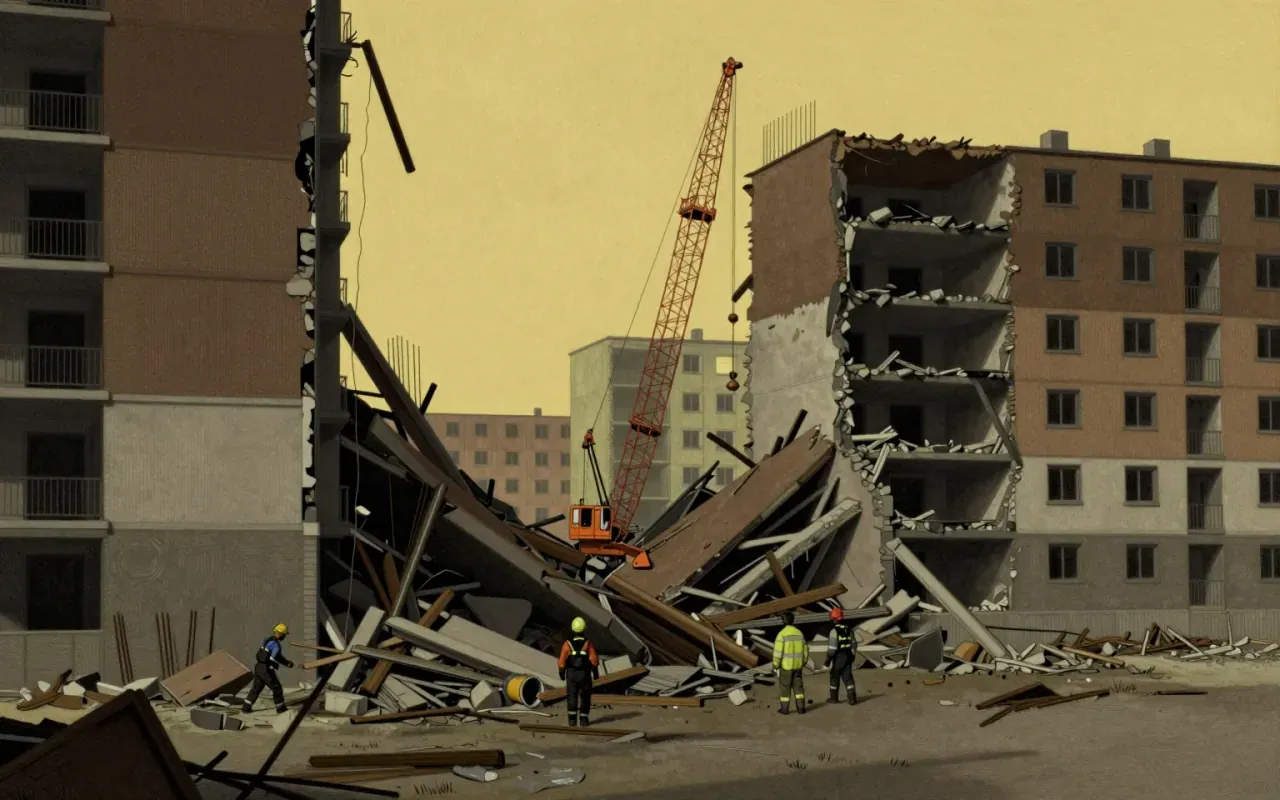
Investigators identified widespread substandard construction as the central reason for the disaster’s scale, with at least 60,434 buildings collapsing outright and a further 127,251 damaged to varying degrees, some estimates putting total destroyed or severely damaged structures as high as 320,000. Private contractors faced sustained criticism for using inferior materials, while government officials were criticised for failing to enforce existing earthquake-resistant building codes, a combination that meant the earthquake’s death toll reflected regulatory and construction failures at least as much as it reflected the raw seismic force of the event itself.
A fault already known to be working its way west
The earthquake fit into a well-documented, decades-long pattern: it was the seventh in a sequence of major earthquakes migrating progressively westward along the North Anatolian Fault since 1939, a supershear rupture in which the fault broke over roughly 125 kilometres with displacement reaching 5.2 metres. This established sequence meant seismologists already understood the fault’s general behaviour and westward progression before 1999, even though the specific timing and severity of the Izmit quake could not be predicted with precision, and it directly informs current concern about the fault’s next likely rupture point.
Contractors convicted, a rare outcome in earthquake disasters
In an unusually direct instance of legal accountability, developers Veli Gocer and Hamza Cebeci were tried, convicted of negligent homicide, and imprisoned for their roles in building collapses that killed residents, a rare case of individual contractors facing criminal punishment rather than the responsibility diffusing entirely into government or corporate liability. This outcome stood out because such prosecutions following earthquake disasters are uncommon internationally, and it reflected the scale of public anger in Turkey over how clearly avoidable construction shortcuts had been shown to be once investigators examined the collapsed buildings.
A second quake within three months, in buildings already weakened
A second earthquake, magnitude 7.2, struck Duzce on 12 November 1999, its epicentre roughly a hundred kilometres east of Izmit’s, killing 845 to 894 people and injuring 4,948 more. Because Duzce and the surrounding area had already been significantly weakened by the August earthquake, many structures that might otherwise have withstood the November quake had already been compromised, meaning the two events functioned less as entirely separate disasters than as a single extended sequence whose second half struck a population and building stock still recovering from the first, less than three months on from the original shock.
Worth reading for the risk that hasn’t gone away
The two earthquakes together prompted the Ecevit government to create an earthquake tax, establish a National Disaster Insurance Institution mandating earthquake coverage, and pursue building retrofits with World Bank support, reforms whose lasting adequacy is tested by continuing seismic monitoring showing quiescence in a roughly 150-kilometre gap beneath the Sea of Marmara, near Istanbul, that scientists regard as capable of producing a comparably destructive future event. Readers drawn to the scale of the 1999 death toll gain the most from recognising that the underlying fault risk to a much larger, more densely built city remains an open and actively monitored question rather than a closed chapter.