From a small Anatolian principality to three continents
The Ottoman state began around 1299 as a small principality in northwestern Anatolia under the Turkoman leader Osman I, expanding steadily through the fourteenth century, helped in part by demographic collapse across the neighbouring Byzantine Empire following the Black Death. Mehmed II’s capture of Constantinople in 1453 ended Byzantine rule and gave the Ottomans a capital at the crossroads of Europe and Asia, and further expansion under Selim I and Suleiman the Magnificent brought Egypt, the Levant and much of Hungary under Ottoman control, with the empire reaching its greatest territorial extent, close to 900,000 square miles across three continents, during Suleiman’s reign in the mid-sixteenth century.
Miniatures, millet records, and European observers
Evidence for Ottoman history includes administrative documents establishing the empire’s system of religiously organised communities, or millets, illustrated manuscripts recording battles and court life, and accounts by contemporary European observers, including the writers Francesco Sansovino and Jean Bodin, who compared Ottoman political and military organisation favourably to that of ancient Rome. The empire’s own bureaucracy, operating chiefly in Ottoman Turkish alongside Arabic, Persian and other languages depending on region and purpose, generated extensive records of an absolute monarchy administered through a Grand Vizier and a broader military-administrative elite, offering historians an unusually detailed official record even where non-elite and non-Muslim perspectives remain thinner.
Suleiman’s law code and the Sultanate of Women
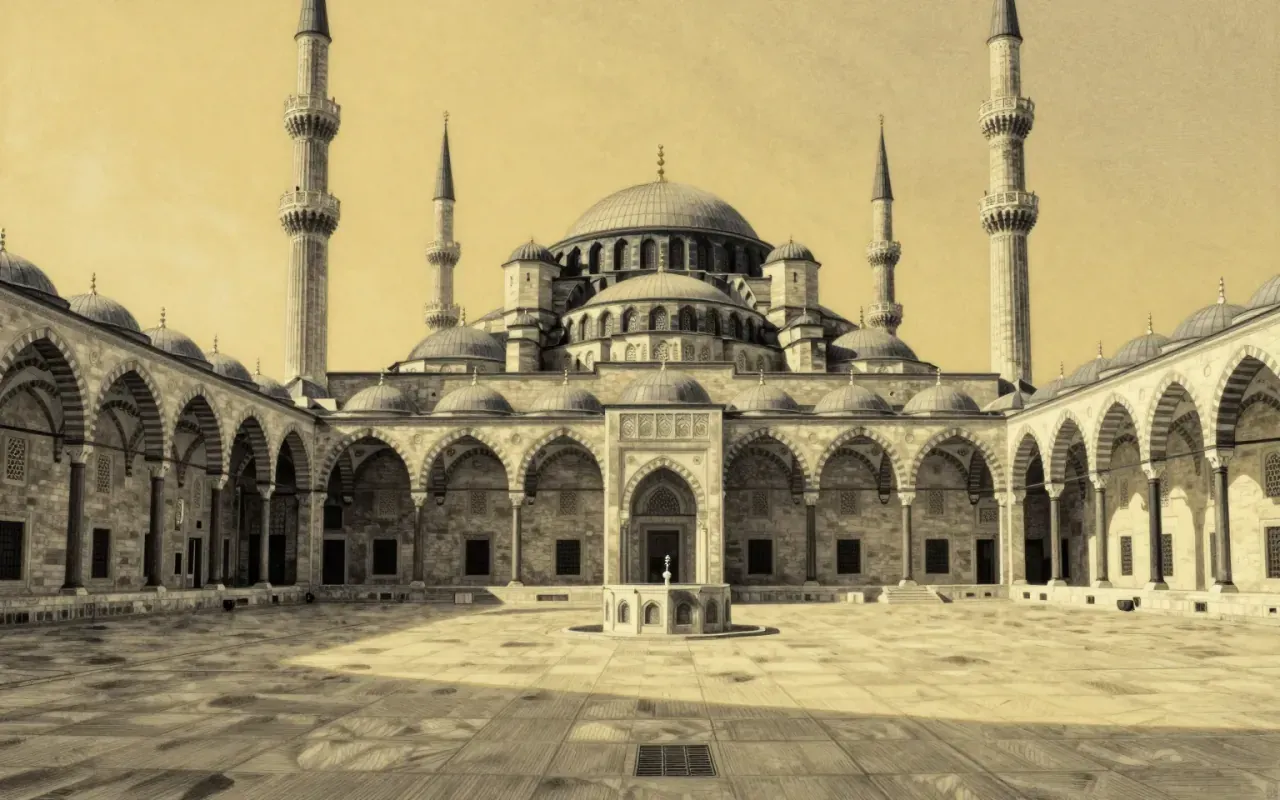
Suleiman I, who ruled from 1520 to 1566, the longest reign of any Ottoman sultan, earned the title the Lawgiver for compiling and harmonising the judgments of his nine predecessors into a unified legal code that remained in use for more than three centuries, developed jointly with his chief religious official, the Grand Mufti Ebussuud. His reign also saw extensive architectural patronage, including work by the architect Mimar Sinan, and a notable break from precedent in his legal marriage to Hurrem Sultan, which opened a period, later called the Sultanate of Women, in which royal consorts including Hurrem and later Kosem Sultan exercised substantial political influence within the court.
The decline thesis most historians now reject
Mid-twentieth-century historians commonly characterised the roughly two and a half centuries following Suleiman’s death in 1566 as a period of stagnation and decline, but this framework, known as the Ottoman decline thesis, is now rejected by most specialists in the field. Current scholarship instead describes a series of genuine institutional and military transformations that allowed the empire to adapt to changing seventeenth-century conditions, with historians increasingly dating any meaningful downturn to the empire’s defeat at the Second Siege of Vienna in 1683 rather than to events immediately after Suleiman, and noting that the Ottoman economy and military remained flexible and effective through much of the eighteenth century. A related debate concerns the so-called Ghaza thesis, once used to explain early Ottoman success through religious warrior zeal, which is likewise no longer generally accepted among historians.
War, genocide, and the end of six centuries
The empire’s final decades combined periods of constitutional reform with authoritarian reversal, and its participation in the First World War ended in military defeat accompanied by genocide against its Armenian, Assyrian and Greek populations. The Turkish War of Independence, led by Mustafa Kemal Ataturk against occupying Allied forces, brought the formal end of the Ottoman sultanate in 1922, followed by the abolition of the caliphate in 1924 and the establishment of the Turkish Republic the previous year, closing a state that had lasted, in one form or another, for more than six centuries.
An empire best read past its own decline myth
The Ottoman Empire is best approached with its own decline story treated as an artefact of later historiography rather than a fact about the empire itself, since the period once dismissed as centuries of stagnation is now understood by most specialists as one of genuine adaptation and continued strength. Readers interested in how a long-lived multi-ethnic, multi-religious state actually administered its diversity through the millet system will find real institutional substance; readers who arrive expecting a straightforward story of rise, peak and inevitable decline should be prepared to find that the decline itself is the part of the story historians have most thoroughly revised.