historybriefs
10:07in productionCh. 1 · Who Called It, Where, When/ 10:07 · ceiling 15 min
Religion · Empires & states

First Council of Nicaea

325

The First Council of Nicaea did not define Christianity — it invented the machinery to define it.

The First Council of Nicaea was the first empire-backed attempt to standardise Christian doctrine by assembly. It succeeded procedurally — nearly all bishops signed — but the record reveals nothing about internal debate, enforcement, or theological nuance. Its legacy is structural, not doctrinal.

Chapters & takeaways4
  1. 1:05
    Who Called It, Where, When

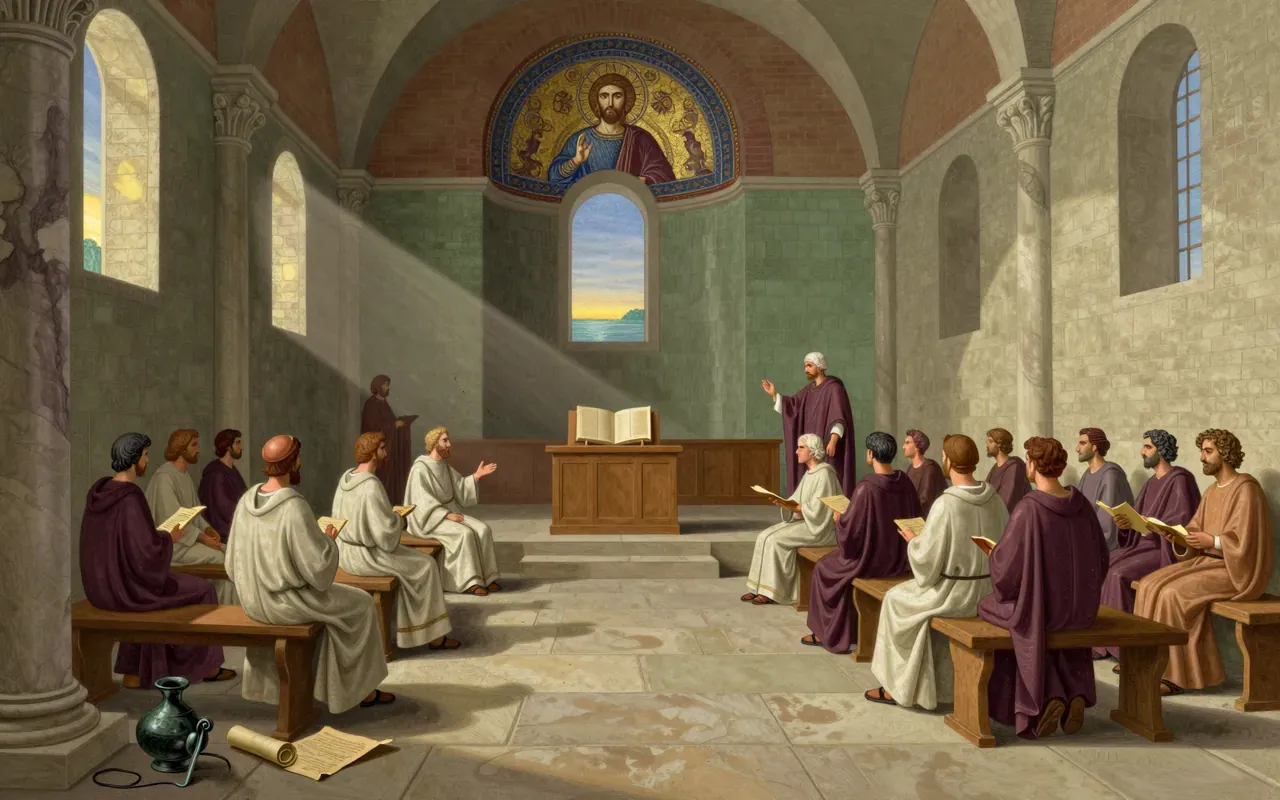
    Constantine I called the council in Nicaea, May–July 325 — the first time imperial power convened bishops as representatives of all Christendom.

  2. 2:36
    The First Consensus Machine

    It was explicitly experimental: the first attempt to forge unity through a representative assembly — not precedent, but prototype.

  3. 4:24
    What It Actually Decreed

    It produced four concrete outputs: a Christological settlement, the first part of the Nicene Creed, a unified Easter date, and early canon law.

  4. 5:58
    The Two Who Refused

    All but two bishops signed — evidence of near-unanimity, but silence on dissenters’ identities or arguments.

Worth your time?

Yes. Study the whole thing.

4.5/ 5
What works
  • as evidence of imperial ecclesiastical method
  • as a benchmark for later ecumenical councils
  • as proof that consensus was prioritised over unanimity
What does not
  • establish motives
  • name participants
  • define terms like 'divine nature'
  • report dissenting arguments
Study it if
  • students of institutional formation
  • readers tracking how authority becomes codified
Skip it if
  • those seeking theological exposition
  • biographers of early church figures
The written brief1 min read

What happened

Constantine I convened bishops in Nicaea from May to the end of July 325. They settled the divine nature of God the Son relative to God the Father. They constructed the first part of the Nicene Creed. They mandated uniform observance of Easter. They promulgated early canon law. All but two bishops subscribed to the final creed.

How we know it

The record comes from a single descriptive source: a modern encyclopaedic entry titled ‘First Council of Nicaea’. It names Constantine I, Nicaea, the dates (May to end of July 325), and lists outcomes. No primary sources — no letters, canons, or creedal texts — are cited in the material.

Why it went that way

Constantine convened it to attain consensus ‘through an assembly representing all Christendom’. The material gives no motive beyond that aim. It does not say he sought political stability, suppressed dissent, or acted on theological conviction.

What is still contested

The material does not say what the contested Christological positions were, who held them, or how the settlement was enforced. It does not name Arius, Alexander, or any bishop. It gives no detail on the creed’s wording, the Easter calculation, or the content of the canon law.

What it changed

It changed how theological authority was exercised: from local episcopal judgment to empire-backed collective ratification. It created a precedent that orthodoxy could be defined by majority vote under imperial auspices — not scripture alone, nor tradition alone.

Is it worth your time

Yes. It established the first institutional mechanism for binding doctrinal consensus across Christendom — a template later replicated seventeen times. Its method, not just its decisions, became durable.
Same strand · Religion4 of 24
11:09
Raja Ram Mohan RoyRaja Ram Mohan Roy was a systematic institution-builder whose verified actions — founding discussion circles, schools, colleges, and a reform society — produced one unambiguous legal outcome: the 1829 abolition of sati. His work laid groundwork for modern Hindu reform and colonial critique, but the source records no dissent, no implementation details beyond founding dates, and no measure of wider influence beyond those institutions and the ban.
9:52
Albigensian CrusadeThe Albigensian Crusade was a 1209–1229 papally initiated, French royally executed campaign against Catharism in Languedoc. It succeeded militarily in phases, realigned Toulouse with the French crown, diminished regional culture, and aided the institutional rise of the Dominicans and Inquisition. Its record is coherent but narrow: no dissent, no numbers, no motives beyond those stated.
12:02
Spanish Inquisition1478The Spanish Inquisition was a centrally directed, royally staffed, financially incentivised tribunal targeting converted Jews and Muslims. It operated from 1480 to 1834. Its first fifty years saw the highest execution rate—3,000–5,000 people burned—and systematic property confiscation. It replaced Papal oversight with Crown control. It enforced post-1492 and 1502 conversion decrees. It prosecuted ~150,000 people. Its methods included torture, public shaming, and lifelong penalties. Its legacy is administrative, not spiritual.
13:00
Ahmad Baba al-TimbuktiAhmad Baba became one of Timbuktu's most prominent Islamic jurists before Moroccan forces invading the Songhai empire deported him to Marrakesh in 1594, where he remained until 1608. He continued writing throughout his exile and after his return, authoring more than forty works, including a nuanced treatment of slavery that historians still interpret differently. His career and library form part of the much larger Timbuktu manuscript tradition, whose survival was tested again in 2012 when local families and archivists evacuated the bulk of the collection ahead of an armed conflict.
Up next in History

Dissolution of the Soviet Union

1991 · 10:32

The Soviet Union did not collapse — it was abolished by three republics, then erased by paperwork and a flagpole.

10:32