From village to regional power
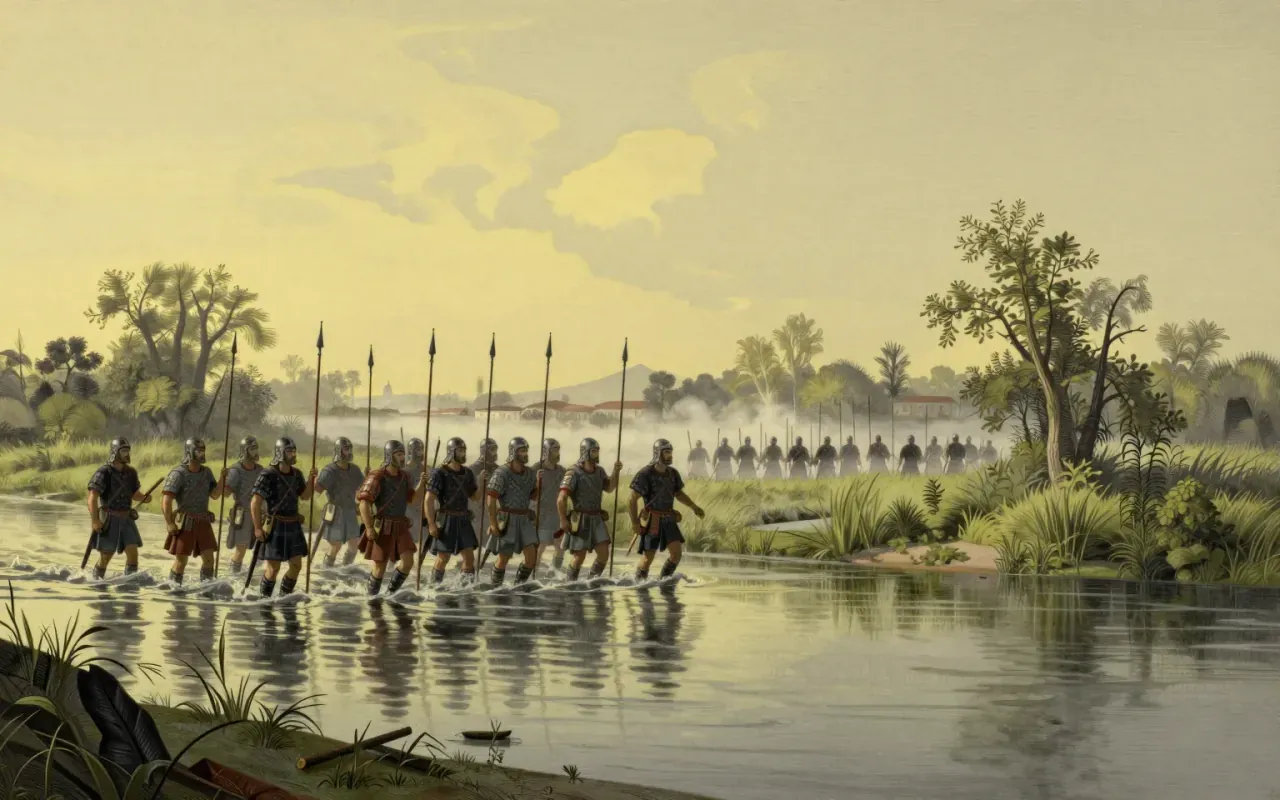
Roman tradition dated the city’s founding to 753 BC, and by the fourth century BC Rome had expanded across Latium and eliminated its main Etruscan rival, Veii, in 396 BC. A Gallic raiding force is said to have sacked the city in 390 BC, a setback from which Rome recovered to fight three wars against the Samnites between 343 and 290 BC and a war against the Latin League in the 340s BC that ended with Rome’s allies formally subordinated. Roman power then extended south through the Pyrrhic War of the 280s and 270s BC, in which the Greek king Pyrrhus of Epirus intervened on behalf of Tarentum and eventually withdrew, leaving Rome the effective master of the Italian peninsula from the Alps to the toe of Italy by the middle of the third century BC.
Livy, writing seven centuries later
Almost everything known about Rome’s earliest wars comes from historians writing centuries afterward, chiefly Livy, composing his history under Augustus around the turn of the millennium, working from earlier annals and traditions that are themselves largely lost. The period’s own record acknowledges that the story of Rome’s first kings is almost certainly invented, and that reliability improves only gradually moving forward from the fourth and third centuries BC, when events start to correspond more closely with archaeological evidence and with fragments of independent Greek sources. Supplementary detail comes from Strabo, Suetonius and imperial-era inscriptions such as Augustus’s own account of his reign, none of which were written close enough to the early conquests to serve as direct testimony.
Manpower as the deciding factor
Roman armies were not obviously superior in equipment or tactics to their Italian neighbours for much of this period; what set Rome apart over time was its approach to defeated enemies. Rather than simply subjugating conquered peoples, Rome extended varying grades of citizenship and alliance obligation, binding former enemies into a growing pool of manpower liable for future Roman wars. This produced, by the time of the wars with Carthage, a reserve of soldiers unmatched by any Mediterranean rival, since every conquest added potential recruits rather than simply territory. Roman institutions built for a single city state, a Senate, annually elected magistrates, proved adaptable enough to administer this coalition, though the strain of governing a state that had outgrown its city-sized origins would surface later, in the political crises of the late Republic.
Where the archaeology and the legend part ways
Archaeologists have found no destruction layer at Rome corresponding to the traditional date of the Gallic sack in 390 BC, which has led some historians to argue that the episode, and other early set-piece disasters and triumphs in the literary tradition, were less severe than later writers described, or reshaped to fit a narrative of Roman resilience. The reliability of Roman tribal and ethnic names is separately disputed, since many appear to be later scholarly labels or names assigned by outside Greek writers rather than terms the peoples themselves used. Historians also disagree about how far Rome’s control over the Greek cities of southern Italy after the Pyrrhic War amounted to direct domination as opposed to negotiated treaty relationships that left considerable local autonomy in place.
An army the rest of the Mediterranean would meet
Control of Italy gave Rome the manpower base it used to fight and win three wars against Carthage and to defeat the Hellenistic kingdoms of the eastern Mediterranean over the following two centuries. It also created the underlying tension between an expanding, wealth-generating state and institutions designed for a much smaller city, a mismatch that fed into land disputes, slave-worked estates displacing small farmers, and eventually the political violence of the first century BC. The extension of citizenship, culminating in the enfranchisement of Rome’s Italian allies after the Social War of 91 to 87 BC, gradually turned a coalition of conquered peoples into something closer to a single political and cultural community, laying groundwork for the administrative model the later empire would apply across the Mediterranean.
A slow story that still explains a fast empire
The rise of Rome in Italy rewards attention chiefly for the gap it exposes between story and evidence: readers get an origin narrative written centuries after the events it describes, checked increasingly against archaeology that does not always agree with it. That makes it a useful case for thinking about how any state’s founding history gets written retrospectively to explain a later success. The military and political mechanics, citizenship as a tool of expansion rather than an obstacle to it, are also genuinely instructive for understanding how Rome later absorbed far larger and more distant territories. It is not, on its own, a dramatic narrative; its interest lies in the method as much as the material.