A century of pressure, then a deposition in 476
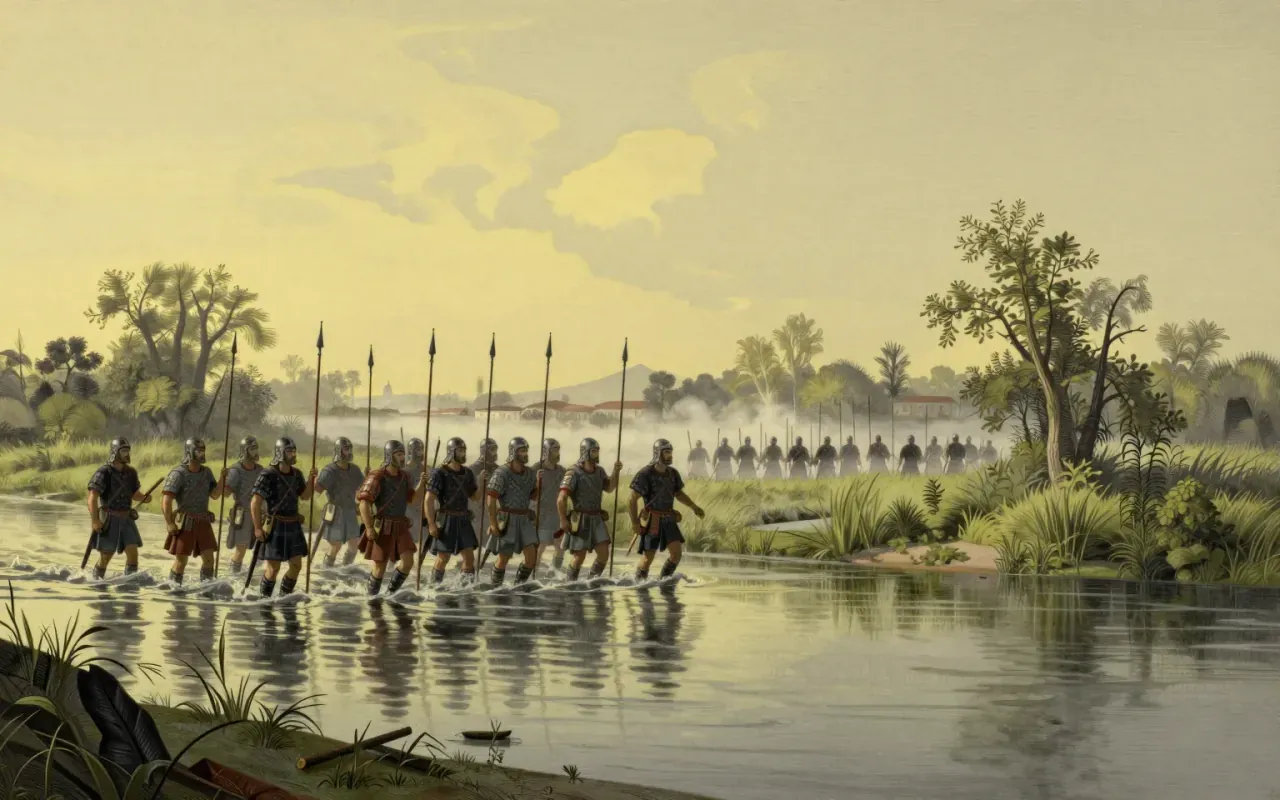
Pressure on the Western Roman Empire intensified from 376 AD, when large numbers of Goths crossed the Danube fleeing the advancing Huns, and worsened after a Roman army was defeated and its emperor Valens killed at Adrianople in 378. The Visigoth leader Alaric sacked Rome itself in 410, an event that shocked contemporaries even though the city was no longer the empire’s administrative capital by then. Further Germanic groups crossed the Rhine in 405 and 406 and established their own kingdoms within former Roman territory over the following decades. The conventional end point came in 476, when the Germanic general Odoacer deposed the child emperor Romulus Augustulus in Italy and did not replace him with another emperor, leaving the western provinces under a patchwork of barbarian kingdoms.
Panegyrists, chroniclers and later exaggerators
Contemporary evidence comes from a mixture of chroniclers, churchmen and imperial panegyrists, several of whom openly admitted that Germanic groups settled within the empire’s borders could not be expelled or destroyed by Roman arms, an unusually candid admission given panegyric’s usual role of praising the emperor’s power. Later writers sometimes inflated details for effect: the sixth-century official John the Lydian, writing well over two centuries after Diocletian, gave an army size of nearly 390,000 men that modern historians treat with caution as likely exaggerated. Archaeological and climatic evidence, unavailable to any ancient writer, has become an increasingly important supplement in recent decades, offering independent checks on written accounts of famine, plague and settlement change that literary sources describe unevenly or not at all.
Five kinds of explanation, no settled winner
Modern scholarship groups proposed explanations for Rome’s collapse into roughly five categories: climatic deterioration following a long warm and stable period; recurring epidemic disease, including the second-century Antonine plague and a further outbreak in the mid-third century; sustained migration pressure from peoples displaced by the Huns; political dysfunction, including rapid emperor turnover and failed succession arrangements; and financial strain caused by decades of civil war, currency debasement and shrinking tax bases. None of these is treated by historians as sufficient on its own, and most current accounts combine several factors rather than naming a single decisive cause, reflecting a broader shift away from monocausal explanations toward more layered ones.
Gibbon’s four causes and what replaced them
Edward Gibbon’s eighteenth-century history attributed the fall to a combination of time’s ordinary wear, external attack by barbarians and internal weakening tied partly to Christianity’s rise, plus internal misuse of imperial resources and authority, and his framing dominated how the subject was discussed for roughly two centuries afterward. The historian Alexander Demandt later catalogued over two hundred distinct theories that had been proposed by different scholars, illustrating how contested the question remains. A significant strand of more recent scholarship, associated with historians such as Henri Pirenne, argues against treating 476 as a sharp break at all, preferring to describe a longer late antique transformation in which many Roman institutions and cultural forms persisted well past the deposition of the last western emperor.
What actually stopped, and what carried on
What ended in 476 was a single imperial office in the West, not Roman civilisation itself: Latin remained the administrative and religious language across most of the former western provinces, Roman law provided the basis for successor kingdoms’ legal codes, and the Christian church retained an organisational structure inherited directly from late Roman administration. What did not survive was centralised taxation and a unified standing army capable of defending the whole western territory, which fragmented instead into a set of Germanic kingdoms of varying strength and durability. The Eastern Roman Empire, centred on the more defensible city of Constantinople, avoided a comparable collapse and persisted for close to another thousand years, eventually attempting a partial reconquest of Italy under Justinian in the sixth century.
A case study in how empires are said to end
The fall of Rome is worth studying less for any single agreed cause than for what it reveals about how historians build and revise big explanatory frameworks over time, Gibbon’s moral narrative of decline, followed by a modern preference for multi-causal and even anti-catastrophic accounts. Readers looking for a decisive answer to why Rome fell will not find one, because the current scholarly consensus is that there isn’t one; readers interested in watching a major historical question evolve across two and a half centuries of changing evidence and method will find the subject unusually rewarding on those terms.