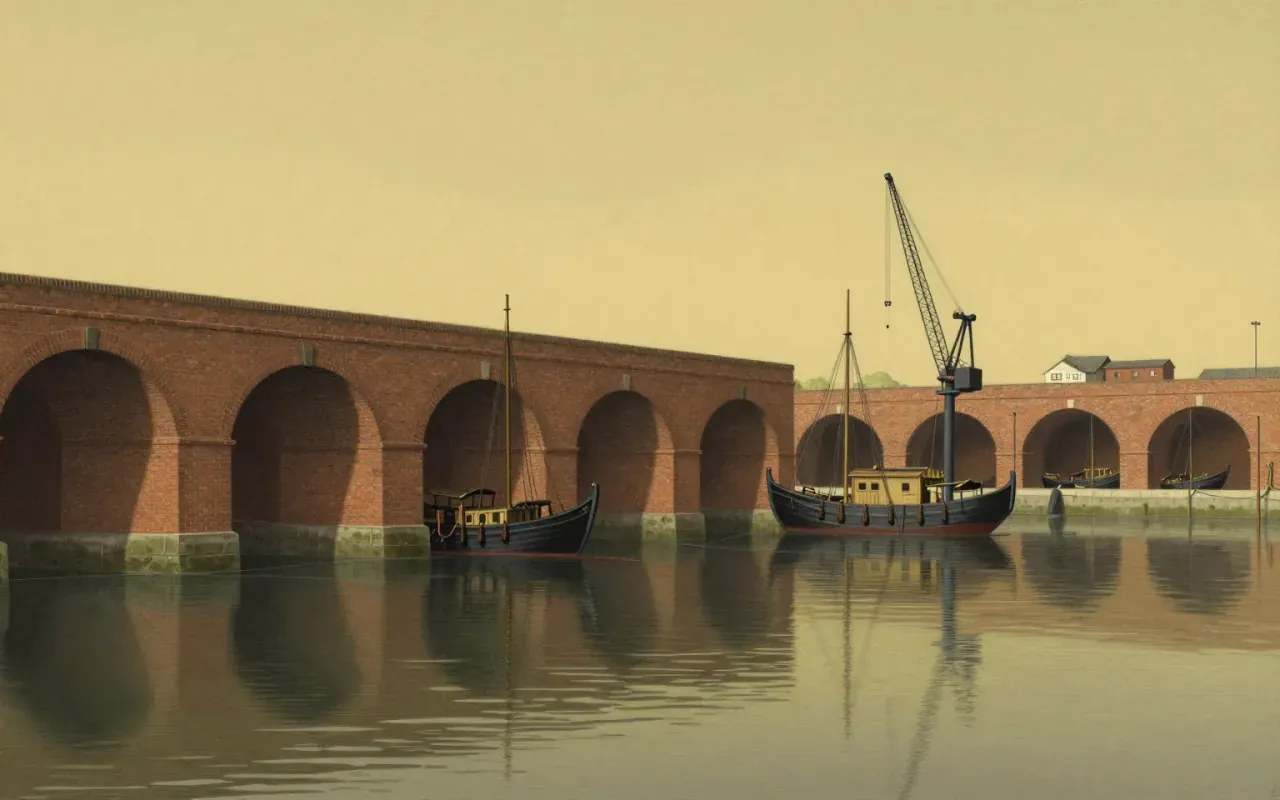
A shipyard begun around 1104
Construction of the Venetian Arsenal began around 1104, during the period of the Venetian Republic’s early consolidation as a maritime power, though some evidence suggests a Byzantine-style shipbuilding establishment may have existed on or near the site as early as the eighth century. The yard’s purpose from the outset was to give Venice a dedicated, state-controlled facility for building and repairing the warships on which its growing naval and commercial power depended, rather than relying on privately owned yards whose capacity and loyalty the state could not directly control. This state ownership distinguished the Arsenal from most shipbuilding operations elsewhere in medieval Europe, where private builders more commonly supplied both merchant and naval vessels.
A much bigger yard in 1320
The original yard was substantially expanded in 1320 with the construction of the Arsenale Nuovo, or New Arsenal, a much larger facility that reflected Venice’s growing naval ambitions as its Mediterranean trading empire expanded. The complex’s most recognisable architectural feature, the monumental gate known as the Porta Magna, was added around 1460, giving the Arsenal a ceremonial as well as functional entrance appropriate to an institution the Republic regarded as central to its identity and security. By the time of this later expansion, the Arsenal occupied roughly forty-five hectares, close to fifteen percent of the entire city of Venice, an extraordinary proportion of urban land dedicated to a single industrial and military purpose.
Nearly a ship a day
At its early sixteenth-century peak, the Arsenal employed an estimated sixteen thousand workers and achieved a rate of production described as nearly one ship completed each day, an output that would have been extraordinary by the standards of any pre-industrial economy. This scale of shipbuilding directly supported Venice’s naval and commercial reach: by 1450 the Republic had more than three thousand merchant ships in simultaneous operation, and the Venetian government allocated close to a tenth of its total revenue to maintaining and outfitting the fleet, a level of sustained state investment in naval capacity that few contemporary powers could match and that depended entirely on the Arsenal’s productive capacity to be worthwhile.
Frames first, parts standardised
What made this output possible was a set of production methods that anticipated much later industrial practices. The Arsenal adopted frame-first hull construction, in which a vessel’s skeleton was built before its outer planking was attached, replacing older hull-first methods that were slower and less standardised. Parts were made interchangeable wherever possible, and the workforce was organised into specialised divisions, shipwrights, caulkers, blacksmiths, and rope makers among them, each responsible for a distinct stage of construction. Vessels moved through the complex along an internal canal system in a sequence that functioned, in effect, as a moving assembly line centuries before that term or concept existed in industrial manufacturing elsewhere in Europe.
A poet puts the workshop in Hell
The Arsenal’s reputation extended into literature during its own working lifetime. Dante Alighieri referenced the yard directly in Canto XXI of the Inferno, describing labourers occupied with tasks including recaulking the ribs of ships that had made many voyages, using the ceaseless, specialised activity of the real Arsenal as an image for the relentless labour he assigned to the damned in that section of Hell. This literary reference indicates how well known the Arsenal’s working methods and constant activity already were beyond Venice itself by the early fourteenth century, since Dante could expect readers to recognise the reference to a functioning shipyard rather than needing to explain the comparison at length.
Decline with the Republic, survival as a base
The Arsenal’s fortunes declined alongside those of the Venetian Republic more broadly, particularly after Napoleon’s conquest of Venice in 1797 ended thirteen centuries of independent Venetian statehood and, with it, the strategic need for a shipyard of this scale under Venetian control. The complex nonetheless survived into the modern era with new functions: today it serves as a naval base, a research and historic-boat preservation centre, and a major exhibition venue during the Venice Biennale, while portions of the site have also been adapted to support the MOSE flood-barrier project protecting the modern city from the same lagoon waters the Arsenal’s ships once sailed out into.