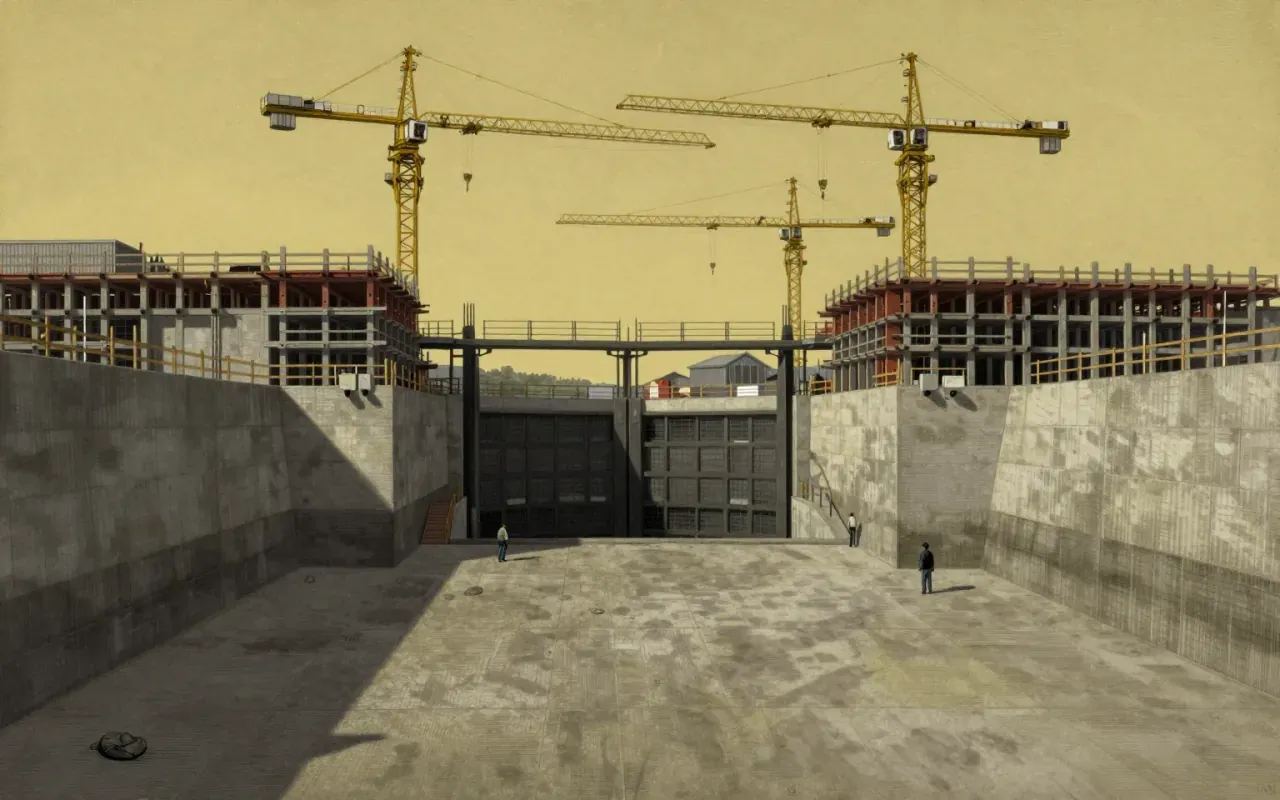
A Suez engineer’s overreach
Ferdinand de Lesseps, fresh from his success building the Suez Canal, began excavation across the Isthmus of Panama on 1 January 1881, applying the same sea-level canal design that had worked in Egypt’s flat desert terrain to Panama’s mountainous and disease-ridden jungle. The approach proved unworkable: engineering difficulties compounded with financial mismanagement, and the company collapsed into bankruptcy in May 1889 after spending roughly $287 million and completing perhaps two-fifths of the excavation. The French Panama affair that followed involved criminal prosecutions over the company’s finances, and an estimated 800,000 ordinary French investors lost their savings when the venture failed, a scandal significant enough in French public life to shape political trust in large infrastructure schemes for years afterward.
Twenty-two thousand deaths, roughly
Mortality figures from the French period are drawn from company records, hospital logs and later historical estimation rather than any single definitive count, with historians generally citing a toll exceeding 22,000 deaths, of whom perhaps 5,000 were French citizens, the remainder largely West Indian and other labourers recruited for the work. These deaths resulted overwhelmingly from malaria and yellow fever, diseases whose mosquito-borne transmission was not scientifically understood at the time, meaning the extraordinarily high toll reflected a genuine gap in contemporary medical knowledge rather than mere negligence, even as the French company’s own promotional material downplayed conditions to sustain worker recruitment, a discrepancy historians note complicates any assessment based solely on the company’s own contemporary accounts.
Bankruptcy and eight hundred thousand ruined investors
The United States acquired French canal assets in 1904 after resolving a political obstacle first: Colombia, which then held sovereignty over Panama, had rejected an earlier treaty granting America canal rights, prompting President Theodore Roosevelt to tacitly support a Panamanian separatist movement. On 2 and 3 November 1903, the USS Nashville prevented Colombian troops from reinforcing their position in Panama, and the resulting declaration of independence proceeded with only one recorded casualty, a Chinese shopkeeper killed in the disturbance. The Hay-Bunau-Varilla Treaty, signed days later on 6 November, granted the United States perpetual rights to build and administer a canal zone, and contemporary newspapers, including some in the United States itself, described the manoeuvre bluntly as an act of sordid conquest.
A revolution timed to a warship
American construction, beginning formally in May 1904 under engineers John Findley Wallace, then John Frank Stevens and finally George Washington Goethals, abandoned de Lesseps’s sea-level design in favour of a lock-and-lake system better suited to Panama’s terrain. The decisive difference from the French effort, however, was public health rather than engineering: sanitation officer William Gorgas applied the recently established link between mosquitoes and disease transmission to implement aggressive vector-control measures, dramatically reducing worker mortality compared to the French period, even though roughly 5,600 workers still died during American construction, including about 350 Americans among a workforce drawn substantially from Barbados and other Caribbean islands.
Mosquitoes, finally understood
The canal opened commercially on 15 August 1914 with the transit of the SS Ancon, a completion historians attribute to the combination of Gorgas’s public health measures, the redesigned lock system, and American willingness to commit sustained federal resources the French private company had lacked. Sovereignty over the canal itself remained a live political issue for decades afterward: the Torrijos-Carter Treaties, signed in 1977, began a phased transfer of control that concluded with full Panamanian sovereignty on 31 December 1999, ending nearly a century of American administration over the canal zone that the 1903 treaty had originally granted in perpetuity.
A century later, still contested
The canal’s history rewards attention precisely because the widely remembered 1914 triumph depended on lessons, particularly around disease, learned at a cost of tens of thousands of French and Caribbean lives in the preceding failed attempt. Its political afterlife has also proven unexpectedly durable: sovereignty disputes resurfaced as recently as 2024 and 2026, with American proposals to reassert control over canal operations and a Panamanian court ruling against a foreign port operator’s concession, showing that questions about who ultimately controls this strip of land have never been permanently settled by any single treaty, whether signed in 1903, 1977 or since.