Spinning jennies, water frames, and a cascade of British inventions
Britain’s Industrial Revolution ran roughly from 1760 to 1840, built on a sequence of textile and power innovations: James Hargreaves’s spinning jenny in 1764, Richard Arkwright’s water frame in 1769, and James Watt’s substantially improved steam engine, patented in 1782, which together turned hand and cottage production into mechanised factory work. Iron production advanced through Henry Cort’s puddling and rolling processes in the 1780s, and by the 1830s mechanised cotton spinning produced roughly five hundred times the output per worker of earlier hand methods, according to period estimates, a scale of productivity increase with no clear historical precedent.
A term coined in 1799, popularised eighty years later
The term Industrial Revolution was first used in 1799 by the French envoy Louis-Guillaume Otto, but it entered wide historical use only after the economic historian Arnold Toynbee’s lectures in 1881 popularised the label for English-speaking audiences roughly a century after the changes it described had begun. This gap between the events and their settled name is itself instructive: contemporaries living through the 1760s and 1770s had no equivalent single term for what they were experiencing, and historians reconstructing the period rely on a mixture of patent records, business archives, and later retrospective accounts written once the transformation’s scale had become clearer.
Coal, capital, and a labour force freed up by farming
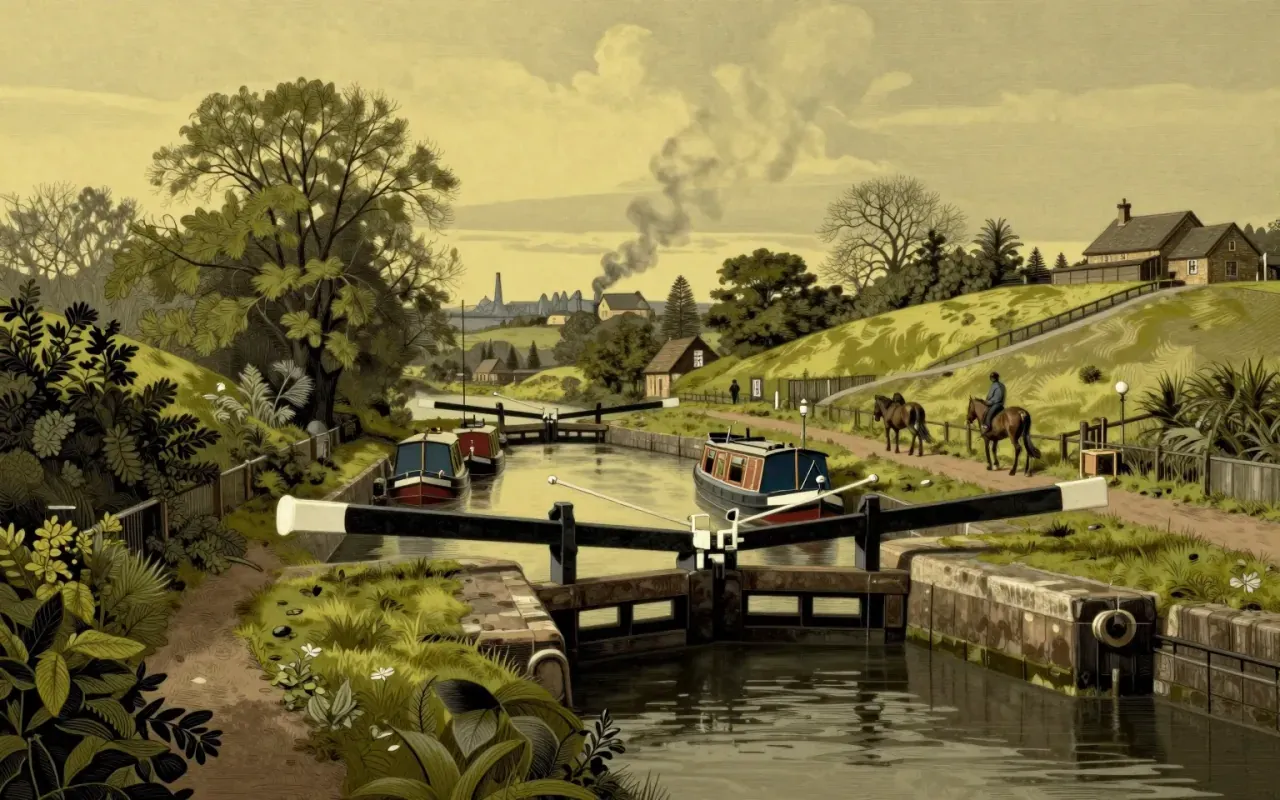
Several conditions combined to make Britain the starting point rather than any single cause: an earlier agricultural revolution had raised farm productivity enough to free up labour and guarantee food surpluses, the country held abundant coal, iron and water power resources, and an extensive network of ports, rivers, canals and roads moved goods cheaply across the country. Political stability, a legal system favourable to business and access to financial capital rounded out the conditions, and historians note that earlier proto-industrial development in parts of continental Europe, the Islamic world, Mughal India and China had already created social and economic groundwork on which Britain’s later, more concentrated transformation built.
Revolution or slow change: a genuine argument over the word
Historians disagree over whether revolution is even the right word for a process some argue unfolded gradually enough, over many decades and across uneven regions and industries, to better be described as accelerated evolution than sudden rupture. The precise start and end dates remain debated for the same reason: different historians emphasise different indicators, whether the first key inventions, the point at which factory production became dominant, or the moment population growth and urbanisation accelerated sharply, and these indicators do not all move together on the same timeline. Even within Britain itself, different regions and industries mechanised at noticeably different speeds, which further complicates any attempt to draw a single clean line marking the revolution’s start.
The standard-of-living debate that still has no settled answer
A separate and more consequential debate concerns when ordinary workers actually benefited from industrialisation. Output and population both rose sharply during the period, but historians are divided over whether living standards for most working people improved meaningfully during the Industrial Revolution itself or whether genuine improvement was delayed until the twentieth century, after decades in which factory workers, including child labourers, endured long hours and dangerous conditions, illustrated by the observation that puddlers in ironworks rarely lived past forty. Resistance to mechanisation, most famously the Luddite movement, reflected the immediate disruption many workers experienced even as aggregate economic output rose.
A transformation worth reading past its own textbook version
The Industrial Revolution is worth studying past its familiar textbook sequence of inventors and machines precisely because the two liveliest debates about it, whether it was really a revolution and whether it actually helped the people living through it, remain genuinely open rather than settled facts waiting to be recited. Readers interested in technological history will find a well-documented sequence of specific, dateable inventions; readers interested in economic and social history will find a harder and more important question about who actually benefited, and when, that the aggregate growth figures alone do not answer.