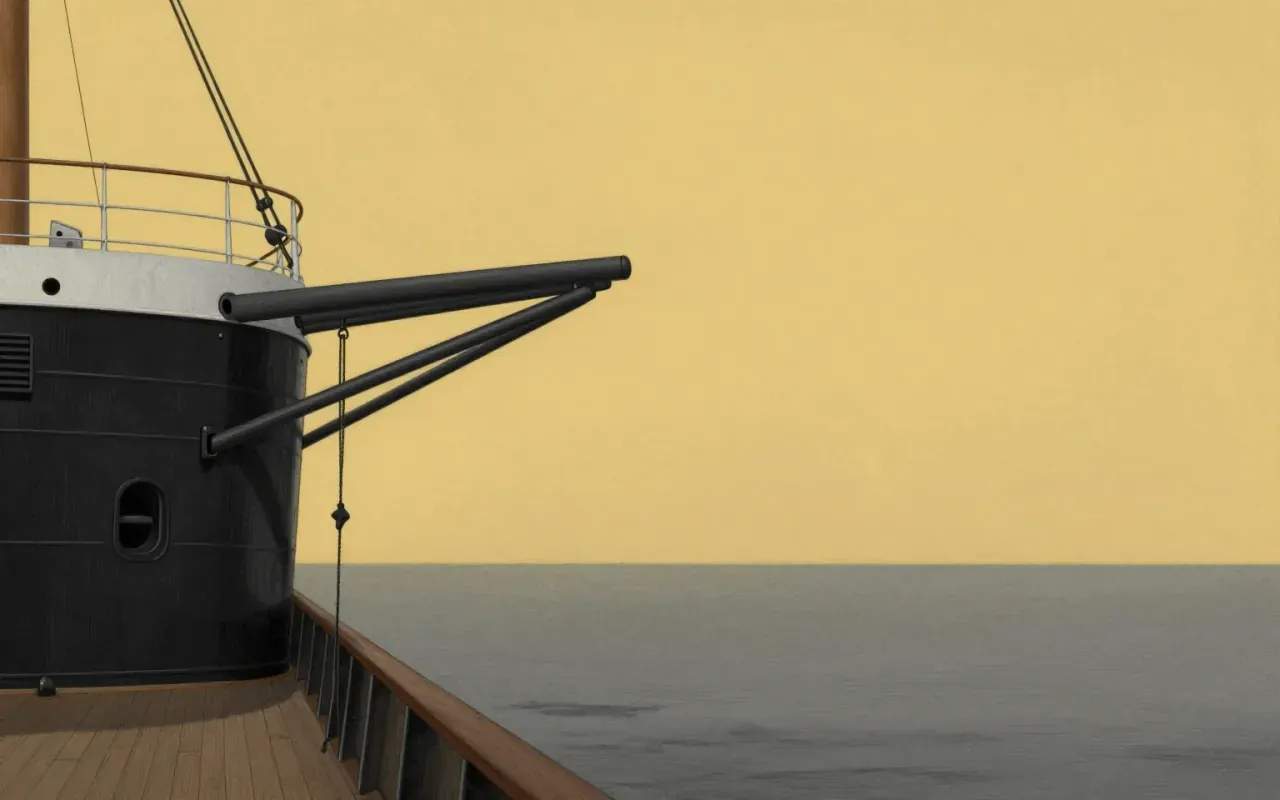
A torpedo off the Irish coast
On the afternoon of 7 May 1915, the German submarine U-20, under Kapitanleutnant Walther Schwieger, fired a single torpedo into the Cunard liner Lusitania roughly eleven nautical miles off the Old Head of Kinsale, on the south coast of Ireland. The ship went down in eighteen minutes. Of the 1,960 people aboard, the two main sources give slightly different tallies, one putting the dead at 1,197 and survivors at 763, the other at 1,199 dead and 767 survivors, a small but telling gap between two respectable counts. Many aboard were passengers on a transatlantic crossing from New York that had begun on 1 May. The liner also carried a substantial quantity of small-arms ammunition and shell components, declared on a supplementary manifest, a detail that would shape everything argued about the sinking afterward.
Three inquiries, three purposes
What is known comes chiefly from three inquiries held soon after the event: a coroner’s inquest in Cork within days, a British Board of Trade investigation under Lord Mersey that ran through June and July 1915 and heard three dozen witnesses in sessions partly closed to the public, and American court proceedings in 1918 weighing compensation claims. Schwieger’s own log, corroborated by wireless signals German naval intelligence sent before any account could have been altered, records a single torpedo. Survivor testimony, including from a crew member who recalled two explosions, sits alongside Captain William Turner’s navigational fix taken shortly before the attack, which later let researchers locate the wreck precisely. Each inquiry had reasons to shape its findings a particular way, which is itself part of what a later reader has to weigh against the documents.
A war zone and a captain’s choice
Germany had declared the waters around Britain a war zone in February 1915 and authorised its submarines to sink merchant and passenger shipping there without warning, a departure from the older practice of stopping a ship and letting its people take to boats first. The Admiralty had warned shipping, Turner included, to steer a mid-channel course, avoid headlands and pass danger areas at speed; Turner instead altered course toward the coast in response to an earlier submarine sighting, believing it left him in safer water. The Lusitania was also travelling at a reduced speed to save coal, though even that speed comfortably outran a submarine on the surface. Fog had kept U-20 from finding a target all morning; it lifted around midday, and Schwieger surfaced into clear visibility with a large liner in view, at a range close enough to hit it.
The second explosion nobody can place
The cause of a second, larger explosion that several survivors described has never been settled. Schwieger’s log and the corroborating wireless traffic mention only one torpedo, while the Mersey inquiry concluded that ammunition cases stored many yards from the point of impact could not have been responsible, leaving the second blast unexplained rather than resolved. Separately, Germany argued that the ship’s cargo and its construction to Admiralty specifications made it a legitimate target, a position the British and American proceedings did not accept and which historians still weigh differently depending on how much of the ambiguity they think decisive. Whether Turner was at fault for not zigzagging is argued over too, complicated by the fact that no merchant captain seems to have adopted the practice before this sinking. A theory that the Admiralty deliberately exposed the ship to draw America into the war persists in some accounts; mainstream historians treat it as unsupported.
A cause enlisted for a later war
The sinking hardened opinion against Germany in the United States and elsewhere and was afterward put to heavy use in British and American recruiting and propaganda material. Washington warned Berlin over the deaths of American citizens aboard, and Germany, wary of provoking the still-neutral United States further, eased its unrestricted submarine campaign for a period afterward. The often-repeated claim that the Lusitania brought America into the war does not fit the timeline: the United States did not declare war until April 1917, nearly two years later, after further escalation of submarine warfare and other pressures entirely. The sinking is better understood as one early entry in a long accumulation of grievance than as its cause, however useful the images proved afterward to those making the case for war in Washington and London.
What the record still argues about
The case for spending time on the Lusitania is that it sits at the join between a naval incident and the propaganda machine that processed it, and the surviving record, inquiry transcripts, intercepted signals, a captain’s log, lets a reader watch that processing happen close up rather than take the finished story on trust. It rewards patience with primary material and a willingness to sit with unresolved questions, particularly around the second explosion and the ship’s cargo, rather than a wish for a tidy villain. Readers wanting a clean narrative of atrocity and response should expect instead a set of inquiries each shaped by what its sponsors needed to find, and a death toll that even the two main sources cannot quite agree on to the last body.