An illegitimate son who trained under Verrocchio
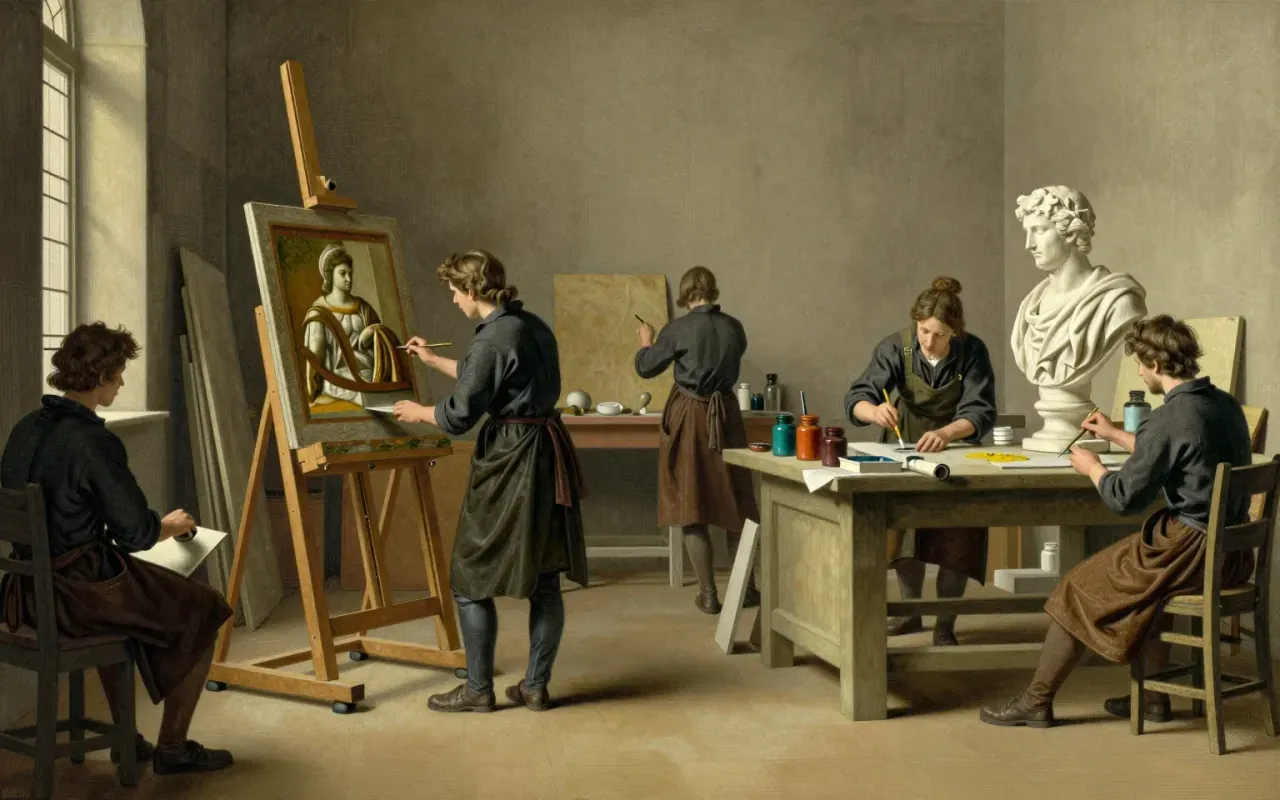
Leonardo was born in 1452 near the Tuscan town of Vinci, the illegitimate son of a Florentine notary and a lower-status woman, and around age fourteen entered the Florence workshop of the painter and sculptor Andrea del Verrocchio, training there for roughly seven years before qualifying as a master. His career took him between Florence, Milan, Venice and Rome over the following decades, working for patrons including the Duke of Milan, Ludovico Sforza, for whom he produced the Last Supper, and Cesare Borgia, for whom he worked as a military engineer, before spending his final years in France under the patronage of King Francis I. He died in 1519 at Clos Lucé near Amboise, aged sixty-seven, leaving behind fewer than twenty-five attributed paintings, several unfinished, alongside extensive notebooks of scientific and technical observation that remained unpublished.
Vasari, writing thirty years later
The fullest early account of Leonardo’s life comes from Giorgio Vasari’s Lives of the Most Excellent Painters, Sculptors, and Architects, published in 1550, more than three decades after Leonardo’s death, and modern scholars regard several of its most memorable episodes as unreliable. Vasari’s claim that Verrocchio was so struck by young Leonardo’s superior work on a shared painting that he abandoned painting entirely is now considered probably apocryphal, and his widely repeated account of King Francis cradling the dying Leonardo in his arms is treated the same way, since Vasari was not present and other evidence does not confirm it. Tax records, contracts and surviving correspondence provide a more reliable, if less colourful, framework for Leonardo’s documented movements and commissions.
Fewer than twenty-five paintings, and notebooks nobody read
Leonardo’s surviving output is strikingly small for someone of his later reputation: fewer than twenty-five paintings are confidently attributed to him, several left incomplete, including a Florentine altarpiece from 1478 and the Adoration of the Magi from 1481. His far larger body of notebooks recorded observations and design concepts across anatomy, hydrodynamics, optics, botany, cartography and mechanical engineering, including studies for flying machines and armoured vehicles, but he published almost none of this material during his lifetime, which limited its direct influence on the scientific developments of the following century compared with contemporaries who did publish. A drawing and a 1517 visitor’s account both point to partial paralysis of his right hand later in life, a detail some historians connect to the unfinished state of several late works, including the Mona Lisa.
The deathbed scene that is probably legend
Several specific claims about Leonardo remain genuinely uncertain rather than simply legendary. His exact birthplace, traditionally given as the hamlet of Anchiano, is disputed by some evidence pointing to Florence itself. Very little is documented about his childhood at all, a gap Vasari’s account fills with material modern historians treat cautiously. A wax sculpture sometimes attributed to Leonardo does not have widely accepted authorship. These uncertainties sit alongside better-documented facts, such as the dates of his residence in Florence, Milan, Venice, Rome and France, drawn from tax and patronage records rather than later narrative accounts.
A reputation built on unfinished work
Leonardo’s reputation as one of the defining figures of the High Renaissance rests on a body of work that is both small and, in several key cases, unfinished, which makes the gap between his historical output and his cultural stature unusually wide. His paintings influenced subsequent European art directly, and his notebooks, once studied by later scholars, are now credited with anticipating observations and mechanical ideas that other fields would not formally develop for centuries, even though Leonardo himself did not publish or apparently seek to have this material widely read during his own life. This combination, real but limited surviving output and a much larger private record of unpublished thought, together with a biographical tradition inherited from a writer working decades after his death, has left Leonardo unusually open to being remade in whatever image later admirers wanted.
Worth separating the documented Leonardo from Vasari’s Leonardo
Leonardo is worth studying carefully specifically because his reputation and his documented record do not line up neatly: the paintings and notebooks that survive are real and remarkable, but many of the vivid personal anecdotes attached to his name come from Vasari, writing decades later with an evident taste for a good story. Readers interested in Renaissance art and engineering will find the documented Leonardo, patchy, unfinished, working mostly in private notebooks, still substantial enough to justify his reputation; readers who arrive expecting the polished legend of effortless universal genius should be prepared to find a more fragmentary and human figure underneath it.