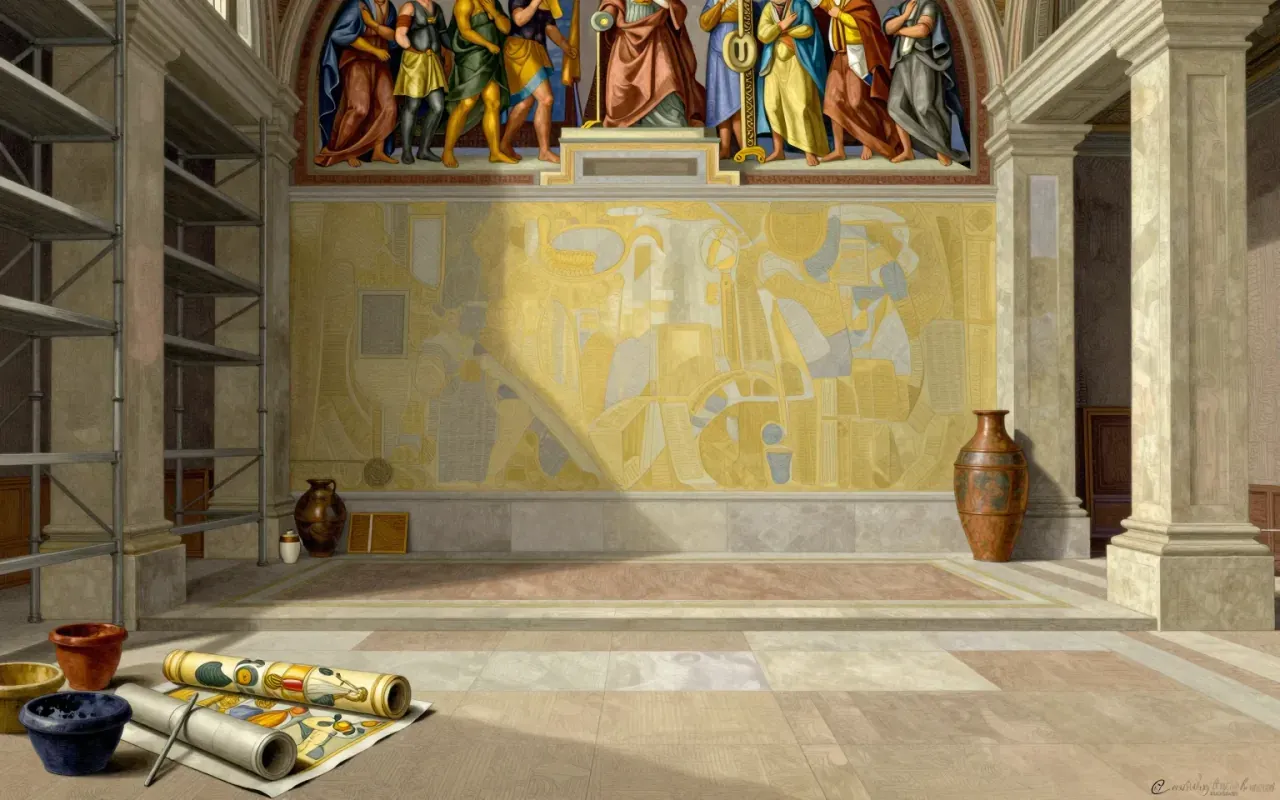
From Urbino apprentice to papal painter
Raphael was born in Urbino in 1483, the son of a court painter, and was orphaned by eleven after both his parents died. He trained under the painter Perugino, and by his late teens was already producing independent commissions; after periods of work in Perugia and Florence, Pope Julius II summoned him to Rome in 1508. There he spent his final twelve years painting a series of rooms in the papal apartments, including the fresco known as the School of Athens, and later worked for Julius’s successor Leo X on projects including tapestry designs for the Sistine Chapel and, alongside the architect Bramante, on the ongoing construction of St Peter’s Basilica. He died in Rome on his thirty-seventh birthday in 1520, leaving his final painting, the Transfiguration, unfinished, and was buried in the Pantheon.
A biography resting on one later biographer
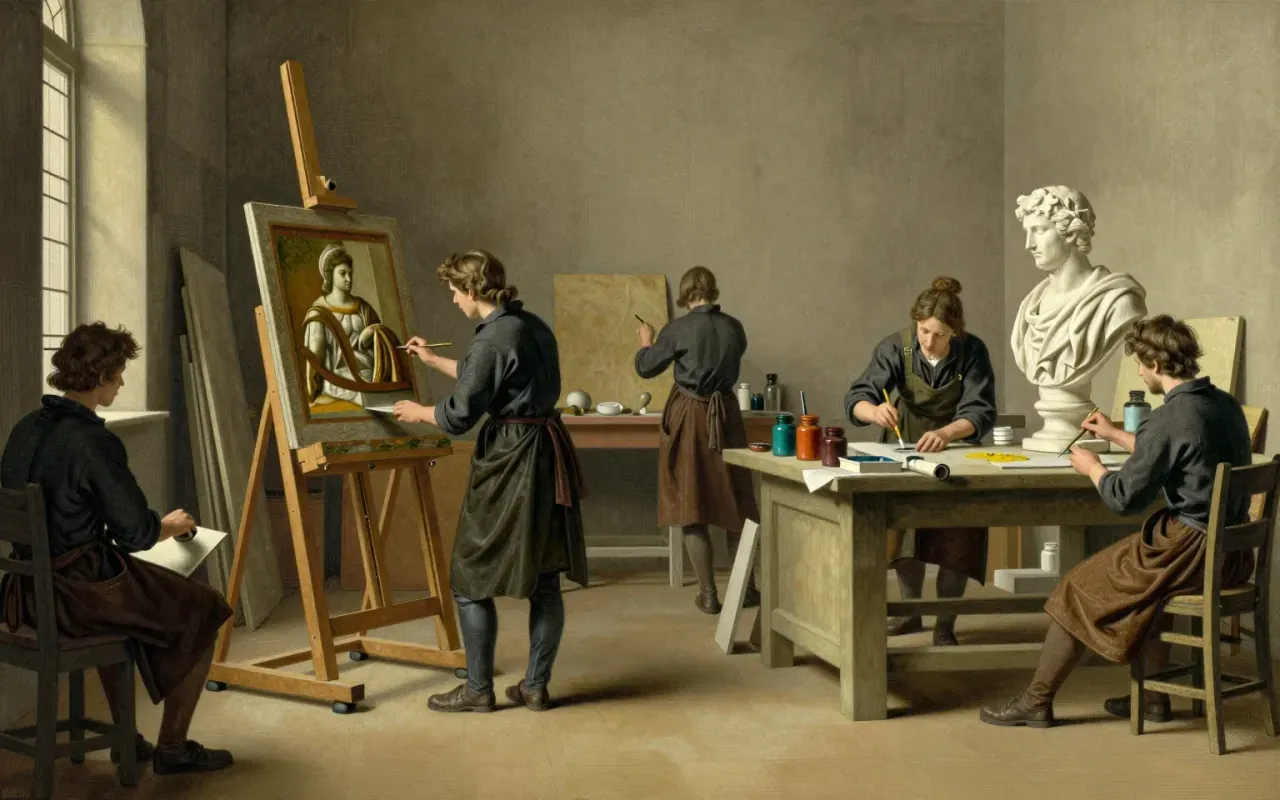
The main early account of Raphael’s life comes from Giorgio Vasari, writing decades after his death, and historians treat several of its details, including the age at which Raphael supposedly began training under Perugino, as difficult to verify since Vasari is effectively the only source for them. Contemporary letters, including Raphael’s own correspondence with Pope Leo about protecting ancient Roman ruins, and accounts from other observers of the period, supply some independent detail, but much of what is known about his personality and working methods still rests on Vasari’s account specifically. Raphael also ran the largest workshop of any painter of his generation, reportedly numbering around fifty assistants, which means later paintings attributed to him are not always entirely his own work, complicating any biography based on the paintings alone.
Borrowed brilliance, blended into something new
Raphael’s style is generally described as marked by clarity, balanced composition and an appearance of effortlessness that his own contemporaries named, using a term coined for a different context, a kind of practised nonchalance that concealed the work behind it. He drew heavily on both of his more famous contemporaries: from Perugino he took a soft, clear approach to light, and after Leonardo returned to Florence during Raphael’s own formative years there, Raphael adopted elements of Leonardo’s pyramidal compositions and modelling technique while giving his own figures a steadier, more legible quality than Leonardo’s more ambiguous ones. His relationship with Michelangelo was considerably more strained, with Michelangelo reportedly accusing him of taking everything he knew about art from him.
Whose hand actually painted it
Because Raphael’s later output depended so heavily on a large workshop staffed by capable assistants including Giulio Romano, distinguishing which parts of a given late painting are actually by Raphael’s own hand rather than a trusted assistant’s remains genuinely difficult, and art historians still debate individual attributions rather than treating the question as settled. Whether he received the age eleven start under Perugino that Vasari describes, or trained instead under another Urbino court painter, is disputed for lack of any corroborating source beyond Vasari’s own account. His formal humanist education is also questioned: despite growing up in a cultured court environment, it remains unclear how comfortably he actually read Latin, complicating the popular image of him as an effortlessly universal Renaissance figure.
Eclipsed, then revived
Raphael’s approach to composition and figure painting shaped Italian art for decades, though his reputation was eclipsed by Michelangelo’s for much of the following two centuries until eighteenth-century critics revived interest in his particular clarity and balance, qualities that made him a formative influence on later Neoclassical painting. Because so few people could see his Vatican frescoes in person, engravings made from his designs by printmakers including Marcantonio Raimondi became, for centuries, the main way audiences outside Italy encountered his work at all. The 1527 sack of Rome scattered members of his former workshop across Italy and beyond, spreading his stylistic influence further even as it dispersed the community that had originally produced his later work.
A name bigger than any single hand
Raphael is worth attention for how much of his later reputation rests on work substantially completed by others under his direction, a workshop arrangement that complicates any simple idea of a single artist’s individual achievement even for one of the era’s most celebrated painters. Readers interested in Renaissance workshop practice, and in the rivalry and stylistic borrowing between Raphael, Michelangelo and Leonardo, will find real substance here worth exploring. Readers wanting confident, settled attribution for every painting associated with his name should expect disappointment, since art historians themselves continue to disagree about where Raphael’s own hand ends and his assistants’ begins.