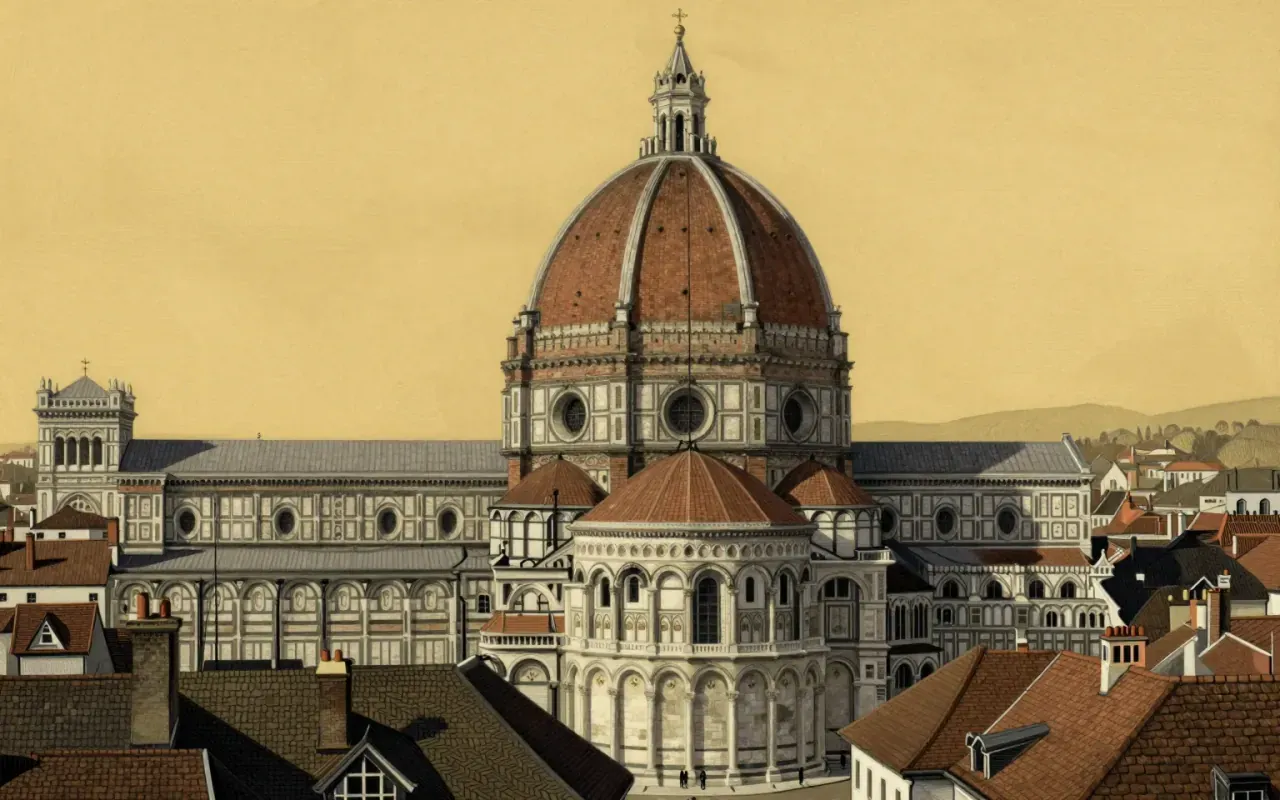
Florence, Petrarch, and a return to classical texts
The Renaissance is generally dated from the fourteenth century, with early signs as far back as the thirteenth, through the sixteenth or, in some regions, into the seventeenth century, and its earliest and most concentrated expression is placed in Florence, associated with figures including Dante, Petrarch and the painter Giotto. Humanist scholars in this period sought out and studied classical Latin and, from the early fifteenth century onward, Greek texts, an interest that spread from Florence to other Italian cities and eventually across the rest of Europe. Alongside literary and artistic developments, the period saw advances in perspective painting, printing technology, navigation and natural philosophy, with figures such as Copernicus and later Galileo building on humanist textual methods to question inherited classical authorities including Ptolemy.
Chroniclers, humanists, and a period named centuries later
The term Renaissance itself did not come into wide use until the nineteenth century, popularised by historians including Jules Michelet and Jacob Burckhardt, who retrospectively framed the period as a distinct age of rebirth separate from what they characterised as a less enlightened Middle Ages. Contemporary evidence for the period comes from humanist writings themselves, from the surviving output of the early printing industry, which by the century’s end had produced tens of millions of volumes from a single Mainz print shop’s origins around 1440, and from records of artistic and architectural patronage. The historian Erwin Panofsky later observed that the Renaissance and the medieval period it supposedly followed were, in his words, linked by countless ties, complicating any sharp before-and-after division.
Printing, patronage, and a genuine change of intellectual habit
Concrete institutional and technological changes did accompany the intellectual shift. The Medici family in Florence, and later a range of Italian courts and popes, funded artists and scholars on a scale that shaped the period’s output directly, while the spread of movable-type printing from a single German workshop to roughly 270 European cities within decades transformed how classical and contemporary texts circulated, moving scholarship away from manuscript copying and toward wider, faster distribution. Voyages of exploration undertaken during the same period, including Columbus’s 1492 Atlantic crossing and Magellan’s circumnavigation completed in 1522, fed directly back into European natural philosophy by undermining inherited classical geography, connecting what might otherwise look like separate artistic, religious and scientific developments into a single broader intellectual shift.
Rupture from the Middle Ages, or a continuation of it
Historians disagree over how sharp a break the Renaissance actually represented from the medieval period that preceded it. An older tradition, following Burckhardt, treated it as a genuine rupture, a rediscovery of classical values after centuries of supposed stagnation; more recent scholarship stresses continuities, noting that scholastic learning, artistic technique and even some classical scholarship had never entirely disappeared during the Middle Ages, and treating the Renaissance instead as an intensification or extension of trends already under way. Scholars also dispute how far the changes associated with the period actually reached beyond a narrow elite, since the large majority of the European population remained rural peasants largely untouched by humanist scholarship or elite artistic patronage during these same centuries.
From Florentine workshops to a continental movement
Renaissance ideas and practices spread outward from Florence to other Italian centres, including Venice, Milan and Rome, before crossing the Alps into France, the German states, England and elsewhere during the sixteenth century, developing distinct regional characteristics as they went, in some northern European cases persisting well into the seventeenth century. Italian humanist textual criticism of religious texts also fed directly into the Protestant Reformation, with Martin Luther’s 1517 challenge to Catholic Church practice emerging from a broader climate of scholarly and religious re-examination that the Renaissance had helped establish, connecting a movement usually associated with art and classical scholarship to one of the most consequential religious upheavals in European history.
A period worth separating from its own legend
The Renaissance is worth engaging with critically precisely because so much of its popular image, a sudden rebirth of light after medieval darkness, was constructed by nineteenth-century historians working with their own agenda about historical progress, rather than by the people who actually lived through the period. Readers interested in art, science or the history of ideas will find real and well-documented achievement across these centuries; readers interested in historiography will find, in the ongoing argument over whether the period constitutes rupture or continuity, a useful demonstration of how much any given period’s identity depends on when, and by whom, its history gets written.