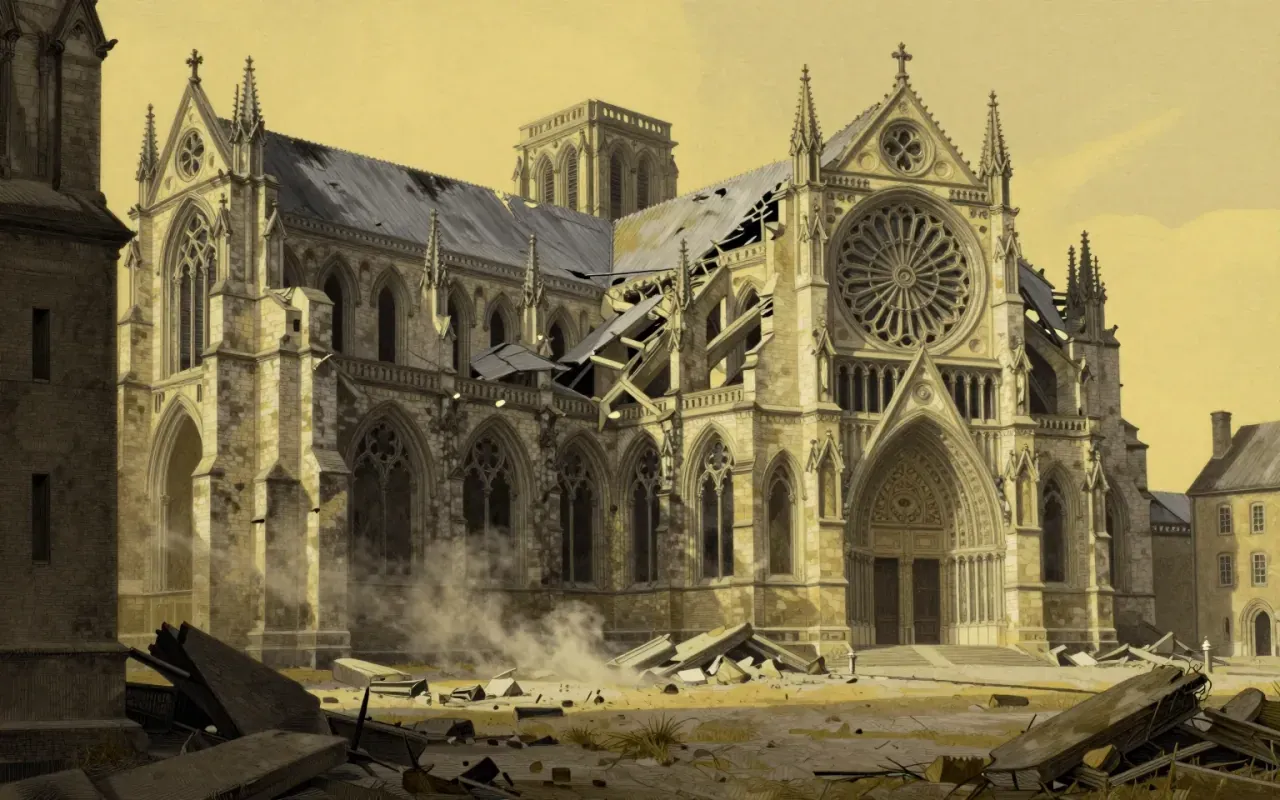
All Saints’ Day, 1755
The earthquake struck Lisbon at approximately 9:40 in the morning on 1 November 1755, All Saints’ Day, a timing that meant many residents were in churches at the moment the shaking began. Its epicentre lay in the Atlantic Ocean, roughly two hundred kilometres west-southwest of Cape St. Vincent and about 290 kilometres southwest of Lisbon itself, and the earthquake’s magnitude is generally estimated at 7.7 or greater on the moment magnitude scale, though some estimates run considerably higher, as far as 9.0. The earthquake opened fissures reported to be as wide as five metres in parts of the city, an indication of the sheer force involved even before the tsunami and fires that followed compounded the damage further.
Shaking, then water, then fire
Destruction did not end with the initial shaking. A tsunami arrived roughly forty minutes after the earthquake, followed by two additional waves that struck the already devastated waterfront district. Fires broke out separately, sparked in many cases by candles knocked over during the earthquake itself, particularly significant given the religious observances underway that morning, and these fires proved lethal even at a distance, asphyxiating people as far as thirty metres from the actual flames through smoke and reduced oxygen. This combination of earthquake, tsunami, and fire striking in sequence rather than as a single event is a pattern that recurs across many of history’s most destructive urban earthquakes, and Lisbon stands as one of the earliest well-documented examples of it.
Forty to fifty thousand dead across two countries
The human and material cost of the disaster was severe by any measure. An estimated thirty to forty thousand people died in Lisbon itself, a substantial share of the city’s population of roughly two hundred thousand, while a further ten thousand deaths are estimated to have occurred across the Strait of Gibraltar in Morocco, giving a combined total generally placed between forty and fifty thousand deaths. Roughly eighty-five percent of Lisbon’s buildings were destroyed, including the Royal Ribeira Palace, numerous churches, and a newly opened opera house, alongside irreplaceable cultural losses including a royal library of some seventy thousand volumes, paintings by Titian and Rubens, and royal archives documenting earlier Portuguese exploration, including records connected to Vasco da Gama’s voyages.
A disaster that reshaped European philosophy
The earthquake’s intellectual impact extended across Europe well beyond Portugal’s own borders. Voltaire drew directly on the disaster in his novel Candide, using it to challenge the philosophical position, associated with thinkers like Leibniz, that the world as it exists represents the best of all possible arrangements, a claim the scale of Lisbon’s suffering seemed to Voltaire to make difficult to sustain. Jean-Jacques Rousseau offered a different reading, attributing the disaster’s severity partly to the density and unnatural concentration of urban life itself. Immanuel Kant took yet another approach, publishing three separate texts in 1756 that attempted to explain earthquakes through natural geological causes rather than supernatural or divine ones, an early contribution to what would become modern seismological thinking.
Bury the dead, feed the living
Responsibility for the immediate response fell to Sebastião José de Carvalho e Melo, later ennobled as the Marquis of Pombal, who as chief minister took direct charge of relief efforts in the earthquake’s aftermath. He is credited with the terse directive, reported afterward, to bury the dead and feed the living, a statement of priorities that shaped his practical response: organising debris removal, deploying firefighters and military forces to restore order, and constructing gallows to deter looting amid the widespread destruction and displacement. Despite the catastrophe’s scale, Lisbon avoided any major epidemic in the disaster’s wake, and significant rebuilding was already underway within less than a year, a notably rapid recovery given the extent of the destruction described elsewhere in contemporary accounts.
A cage built to survive the next one
Pombal’s reconstruction of central Lisbon introduced genuinely innovative building techniques for the period. Chief engineer Manuel da Maia presented four reconstruction options on 4 December 1755, and the most ambitious was adopted: a wholesale rebuilding of the Baixa quarter along new, planned streets rather than a simple restoration of the earlier medieval layout. The new buildings incorporated a flexible wooden framework known as the gaiola pombalina, or pombaline cage, among the earliest deliberately earthquake-resistant construction techniques used in Europe, with models tested by having troops march around them to simulate seismic shaking. Pombal separately commissioned a nationwide parish survey asking about animal behaviour and water-level changes before the earthquake, data not properly analysed at the time but later used by modern researchers to reconstruct the event, work that has retrospectively marked Pombal as an unwitting forerunner of modern seismology.