Nineteen hours, coded songs, and a regime that gave way
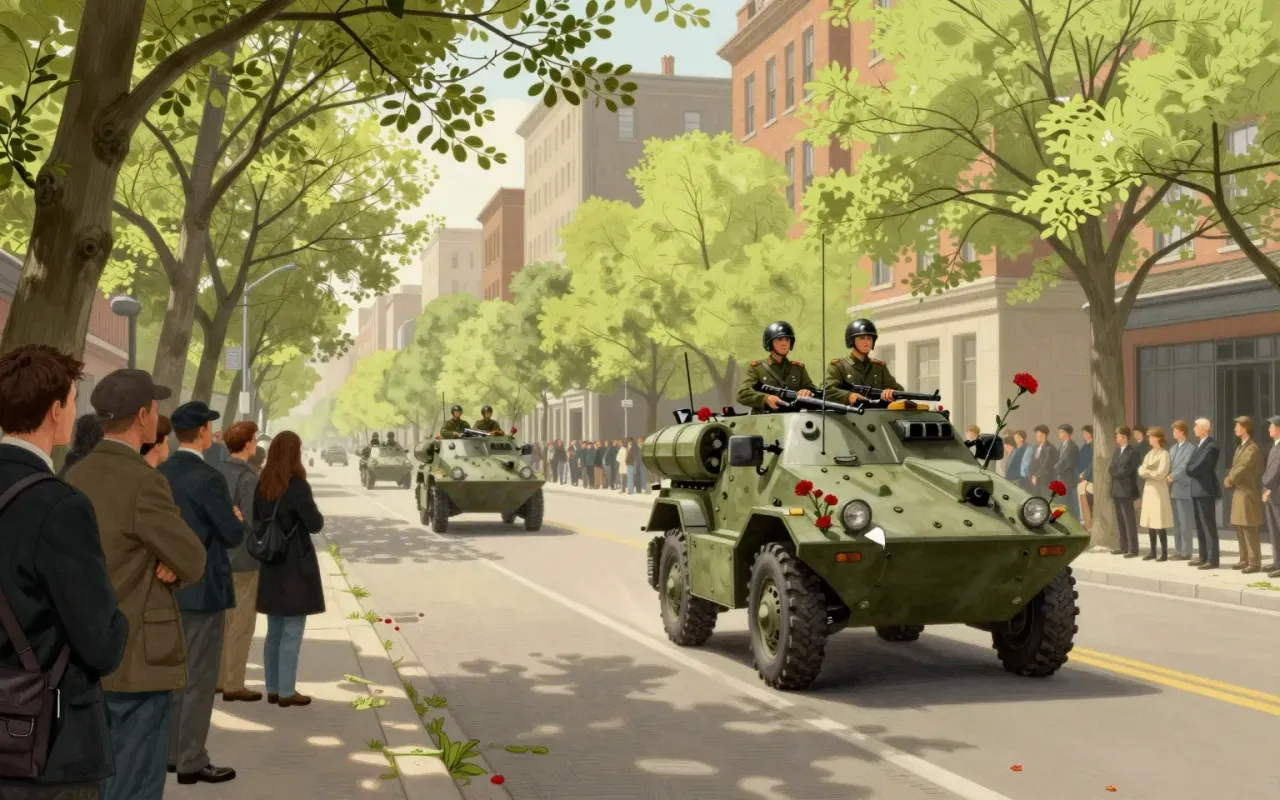
Just before eleven at night on 24 April 1974, a coded radio broadcast signalled Armed Forces Movement units to begin seizing strategic positions across Lisbon. By six the next morning a second coded song confirmed the operation was underway, and within nineteen hours, by six that evening, the military had secured the capital, though a standoff at the secret police headquarters continued into the following morning. Prime Minister Marcelo Caetano, who had led the Estado Novo regime since replacing an incapacitated Antonio Salazar in 1968, was removed and exiled to Brazil, and President Americo Tomas was likewise sent into exile, ending a regime that had governed Portugal since 1933.
Six confirmed deaths and a name that still overstates the peace
The coup is documented through military records, contemporary government decrees, and the recollections of officers involved in planning it, including Otelo Saraiva de Carvalho and Vitor Alves, who had begun organising after concluding by late 1973 that the colonial war could not be won. A failed earlier coup attempt in March 1974, involving around two hundred soldiers, is recorded as having supplied planning lessons for the successful operation weeks later. Later scholarship, including work examining the deaths that occurred that day, has pushed back against the simplest retellings, arguing that the label bloodless has sometimes obscured documented killings by the political police during the standoff at their Lisbon headquarters.
An army exhausted by an unwinnable colonial war
By the early 1970s the Portuguese Colonial War, fought since 1961 against independence movements in Angola, Mozambique and Guinea-Bissau, was consuming as much as forty percent of the national budget and had produced international isolation and arms embargoes. Military decrees in 1973 that cut budgets and allowed militia officers to attain academy-graduate rank without full training deepened resentment among career officers. A planning group of junior officers concluded the war was unsustainable and organised the Armed Forces Movement to remove the government they blamed for prolonging it, timing their operation for a period when Caetano’s own limited reforms had already been curtailed by hardliners within the regime.
Military coup or popular revolution, and whether the difference matters
Historians differ on how to characterise the day itself. It is generally described as a military coup that was then joined, unexpectedly, by large civilian crowds who defied the Movement’s own advice to stay indoors, a combination scholars still debate how to weigh: was this fundamentally a military operation with popular decoration, or did the crowds’ presence make it something closer to a genuine popular revolution. A related dispute concerns the bloodless label itself. Official counts record six deaths, four civilians shot by the political police and two police or security personnel killed by Movement forces, alongside forty-five injuries, figures that some historians argue have been minimised in the revolution’s popular memory.
Independence for the colonies, exodus for a million settlers
Decolonisation followed rapidly: Guinea-Bissau gained independence by the end of 1974, and Mozambique, Cape Verde and Sao Tome and Principe followed in 1975, with Angola’s independence that same year followed immediately by civil war. More than a million Portuguese settlers, known as retornados, left the former colonies for Portugal within about two years, straining housing and employment. The economy, which had grown at nearly seven percent annually before the revolution, slowed sharply, and Portugal’s per capita output relative to the future European Community average fell in the years immediately afterward, a period of political instability that lasted until a further attempted coup was defeated in November 1975.
Worth reading past the flowers in the rifle barrels
The revolution earns its lasting image, soldiers with carnations in their rifle barrels, handed out by a Lisbon restaurant worker named Celeste Caeiro, but that image sits uneasily beside a documented death toll and a colonial war whose end sent a million people across the Mediterranean in less than two years. Readers who already know the flowers deserve the harder context underneath them: an army that had concluded a war could not be won, a government removed in under a day, and an empire dismantled almost as quickly. The distance between the gentle nickname and the disruption that followed is exactly what makes the episode worth a closer look.