Two decades of war, one empire, one new capital
Constantine was born around 272 in the Balkans and was proclaimed emperor by his father’s troops at York in 306, a claim that took him nearly two decades of war against rival claimants to make good. His decisive victory over Maxentius at the Milvian Bridge outside Rome in 312 left him master of the western empire, and by 324, after defeating his eastern co-emperor Licinius, he ruled the whole Roman world alone. He founded a new capital on the site of the old Greek city of Byzantium, renamed Constantinople, which would serve as an imperial seat for over a thousand years, and in 325 he convened bishops from across the empire at Nicaea to settle a dispute then dividing the Christian church. He died in 337, having been baptised only shortly before his death.
A life told mostly by admirers
No account of Constantine’s life survives from anyone writing during his reign as a neutral observer. The bishop Eusebius of Caesarea, who knew him personally, wrote a biography soon after his death that is frankly celebratory, closer to a saint’s life than a historian’s account, and modern scholars read it with considerable caution for that reason. Christian writers of the following century added further detail, much of it shaped by the theological disputes of their own time rather than by independent knowledge of Constantine’s actual life. Pagan writers, working from a different set of assumptions, described his political and military career favourably while largely ignoring or downplaying his religious policy. Between hagiography on one side and selective silence on the other, historians have very little contemporary material free of an obvious agenda to work from.
A vision two sources describe differently
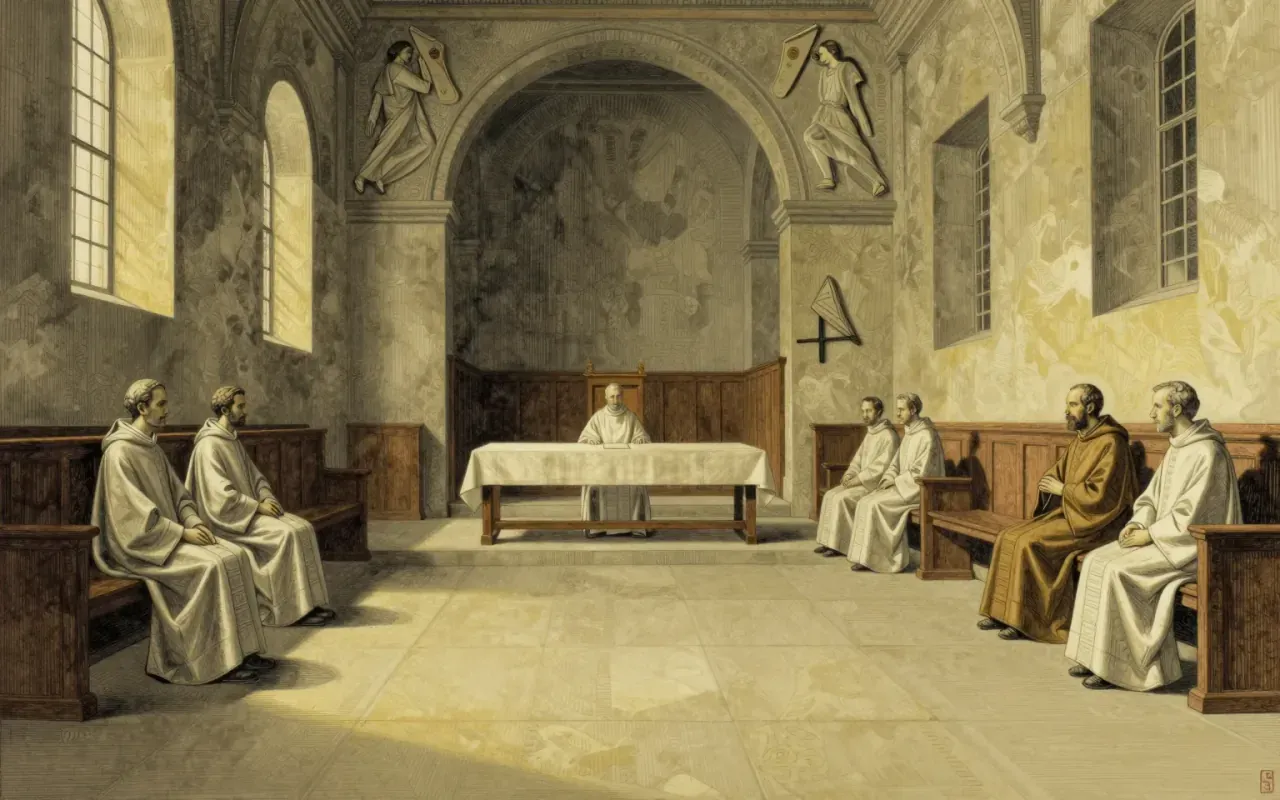
Constantine’s turn toward Christianity is generally dated to the campaign against Maxentius in 312, when he is said to have experienced some kind of vision or dream directing him to mark his soldiers’ shields with a Christian symbol before the battle at the Milvian Bridge; the two earliest accounts of this episode, one describing a dream and one a waking vision seen by the whole army, do not agree with each other on basic details. Whatever exactly happened, Constantine favoured Christianity for the rest of his reign without abandoning all pagan practice, and he postponed his own baptism until he was dying, a common enough practice at the time but one that leaves his personal convictions during most of his rule difficult to pin down precisely. When a dispute over the nature of Christ split Christian bishops in Alexandria, he called them together at Nicaea in 325 to settle it by consensus.
Sincere believer or careful unifier
Historians remain divided over how sincerely Constantine held his Christian beliefs against how far his patronage of the church served the practical goal of unifying an empire under a single, increasingly influential religious authority; the delayed baptism and his continued use of pagan imagery on official coinage for years afterward are cited on both sides of that argument. The vision before the Milvian Bridge is generally treated by historians as a later, useful story rather than a verifiable event, given the discrepancies between the two earliest tellings and the absence of any contemporary corroboration. At Nicaea itself, no full record of the debates survives, so exactly how the council reached its central formula describing Christ as of one substance with God the Father, and how much Constantine personally shaped that wording rather than the bishops present, is still argued over by historians of the early church.
A capital and a creed that outlasted him
Constantinople remained an imperial capital for over eleven centuries, first Roman and then Byzantine, long after Rome itself had ceased to be an imperial seat at all. His favour toward Christianity, formalised earlier at Milan and then extended through his reign, set the direction that led within the century to Christianity becoming the empire’s established religion, even though that final step came after his own death. The Council of Nicaea produced a creed that, revised slightly later in the fourth century, remains recited in most Christian traditions today, and it established the practice of settling major doctrinal disputes through councils convened under imperial sponsorship, a model that structured how the church resolved controversy for centuries afterward.
A reign best read against its own praise
Constantine rewards attention as a case where a wildly celebratory ancient biography, Eusebius’s life of him, has to be read almost in reverse, treating its praise as a signal of what needed defending rather than as settled fact. Readers interested in how a single reign can reshape both an empire’s geography, through the new capital, and a religion’s institutions, through Nicaea, will find the material genuinely substantial to work through. Readers wanting a clear window into Constantine’s actual private beliefs should expect disappointment, since the sources closest to him were also the most invested in presenting a particular version of who he was.