A widow becomes a movement’s figurehead
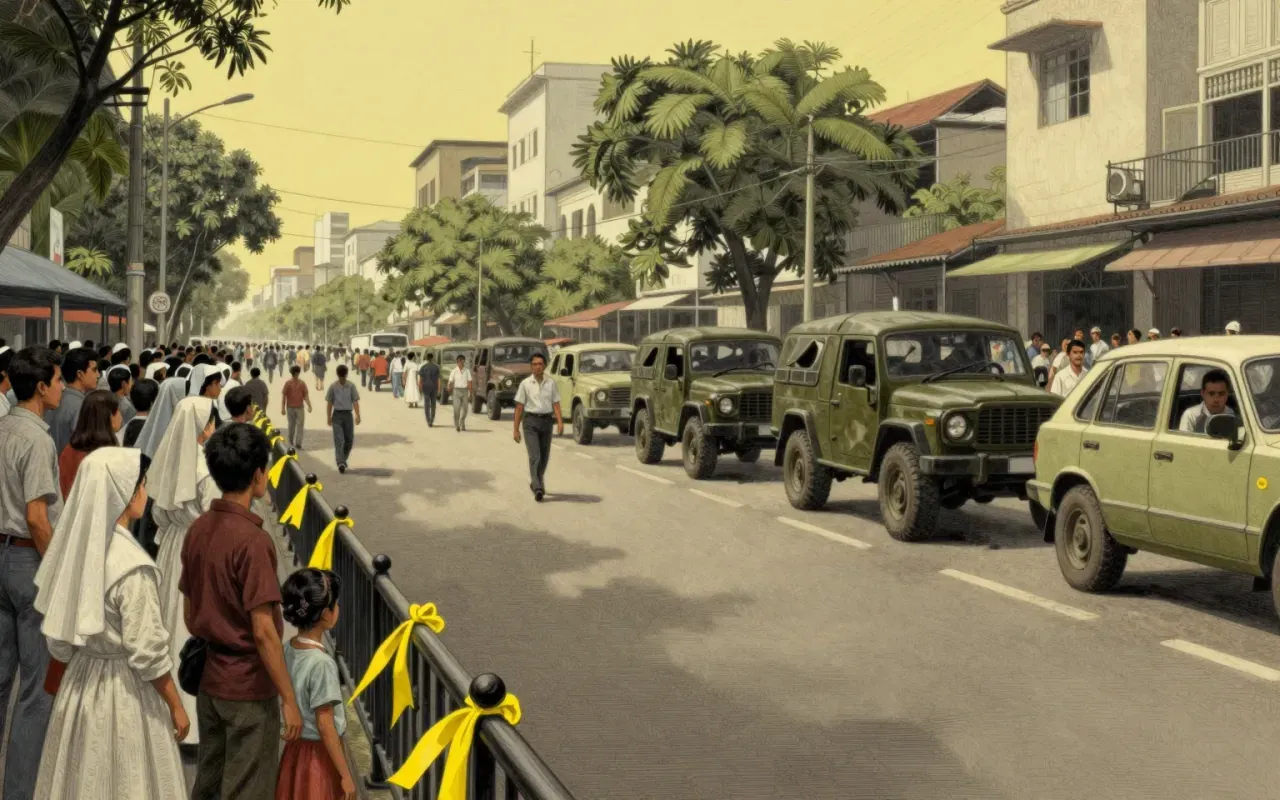
Corazon Aquino, born María Corazón Sumulong Cojuangco in 1933 to prominent Philippine political families, married Senator Benigno Ninoy Aquino Jr. in 1954, and the couple raised five children while he became one of President Ferdinand Marcos’s most prominent critics. After Marcos declared martial law in 1972, Ninoy was arrested and sentenced to death, and the family went into American exile in 1980 for his medical treatment, only for him to be assassinated on the tarmac of Manila International Airport upon his return on 21 August 1983, an event that drew over two million people to his funeral procession and established Corazon as the opposition movement’s central figurehead almost overnight.
A fraudulent election forces her hand
When Marcos unexpectedly called a snap presidential election for February 1986, Aquino declared her candidacy, and the vote that followed was marred by what independent observers documented as massive electoral fraud, violence, intimidation and disenfranchisement. When official results favoured Marcos despite independent counts suggesting otherwise, Aquino claimed victory and called for civil disobedience, a stance that gained decisive momentum on 22 February when Defense Minister Juan Ponce Enrile and General Fidel Ramos defected from the government, positioning themselves at the EDSA highway junction as Cardinal Jaime Sin’s radio broadcast summoned civilians to protect them, bringing millions onto the streets in what became known as the People Power Revolution.
A revolution without a single shot
Aquino was sworn in as the Philippines’ eleventh president on 25 February 1986, hours before Marcos held a competing inauguration ceremony and then fled into exile in Hawaii, ending over two decades of his rule. Her government issued a provisional Freedom Constitution and appointed a Constitutional Commission that produced the 1987 Constitution, ratified by plebiscite and restoring a bicameral Congress along with civil liberties protections, while economically she made the unpopular but internationally consequential decision to honour Marcos’s roughly $28 billion foreign debt and pay off $4 billion of it early, a move credited with restoring the country’s international credit standing even as it drew domestic criticism for prioritising creditors over immediate domestic needs.
An unpopular decision that paid off internationally
Aquino’s agrarian reform agenda produced the Comprehensive Agrarian Reform Law of 1988, redistributing agricultural land nationally to tenant farmers following the Mendiola Massacre, in which Marines fired on agrarian protesters on 22 January 1987, killing at least twelve and injuring 51. Her own family’s Hacienda Luisita estate, however, underwent a stock-redistribution scheme rather than direct land division, an arrangement that persisted until the scheme’s revocation in 2006, and this discrepancy between the reform’s national application and its treatment of her own family’s holdings drew sustained accusations of hypocrisy that followed her presidency for years, a documented contradiction rather than a resolved defence of her land reform legacy.
Land reform that spared her own family
Aquino’s presidency faced repeated destabilisation attempts, with numerous coup attempts between 1986 and 1990 launched mainly by the Reform the Armed Forces Movement, alongside a string of catastrophic natural disasters including the 1987 Doña Paz maritime disaster killing over 4,300 people, a 1990 earthquake killing 1,621, and the 1991 Mount Pinatubo eruption, which alongside her deactivation of the Bataan Nuclear Power Plant contributed to severe power shortages that cost Manila businesses an estimated $800 million by mid-1992. She also negotiated the 1989 creation of the Autonomous Region in Muslim Mindanao and, after Pinatubo forced the issue, notified the United States that its military bases would need to close by the end of 1991.
A presidency tested by coups and disasters
Aquino handed power peacefully to Fidel Ramos in June 1992, reportedly departing in an ordinary car rather than an official vehicle to underline her return to civilian life, and was later widely described in media coverage as the mother of democracy for her role in ending the Marcos dictatorship. Her career is worth studying for exactly this combination of genuine and substantial achievement, restoring constitutional government after two decades of authoritarian rule, alongside documented contradictions like the Hacienda Luisita affair that complicate any uncritical celebration of her presidency. Reading both halves of her record together gives a more honest account of how a democratic transition’s central figure can advance genuine reform while still protecting her own family’s specific interests along the way.