Seventy delegates, four men making the real decisions
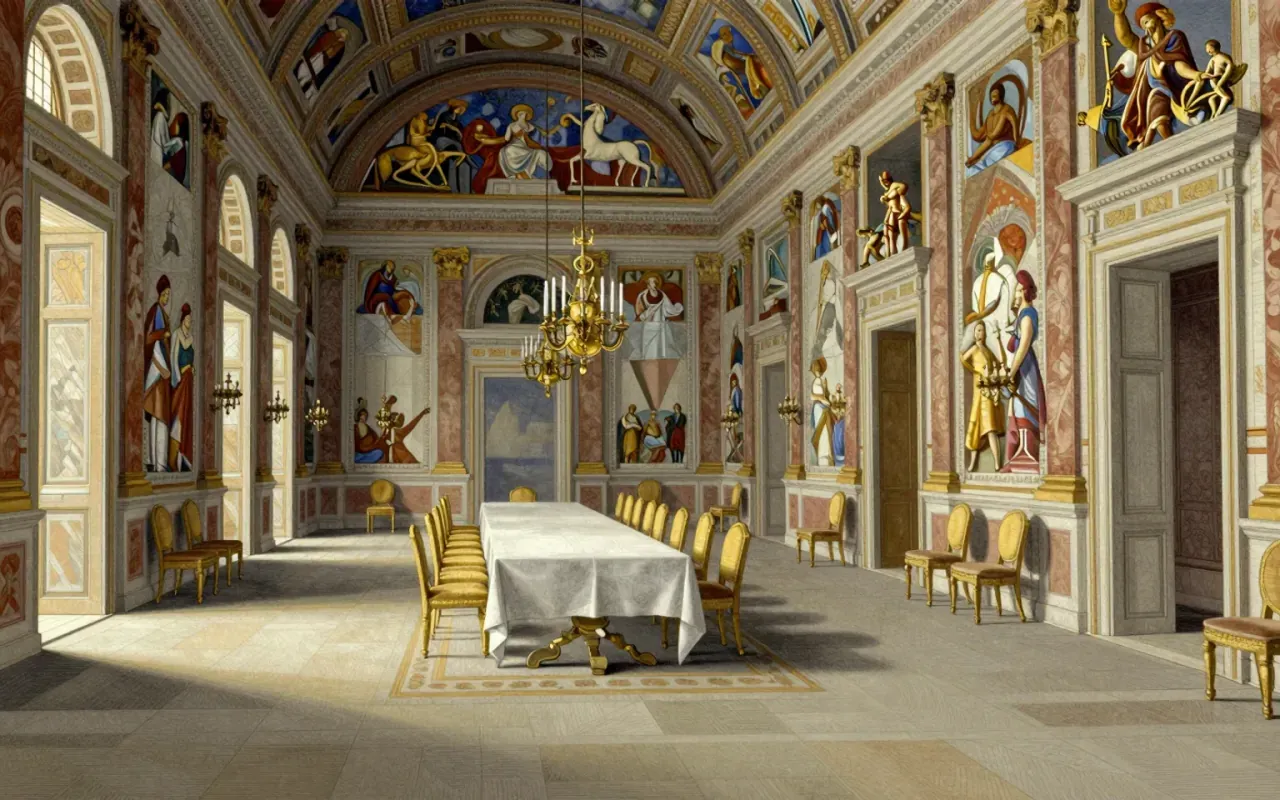
The Paris Peace Conference ran from January to June 1919 and formally involved seventy delegates from twenty-seven nations, though the substantive decisions were made in 145 closed sessions among the Big Four: Woodrow Wilson of the United States, Georges Clemenceau of France, David Lloyd George of Britain and Vittorio Emanuele Orlando of Italy, with Germany and Russia excluded from the negotiations entirely. The resulting Treaty of Versailles was signed on 28 June 1919 in the Hall of Mirrors at the Versailles Palace, the same room in which the German Empire had been proclaimed in 1871, a deliberate historical echo given France’s role in shaping the settlement’s terms.
Keynes’s Carthaginian peace and Foch’s opposite complaint
The economist John Maynard Keynes, who had participated in the British delegation, published a widely read critique characterising the treaty as a Carthaginian peace, meaning one designed to permanently crush rather than merely defeat the losing power, and specifically blamed its reparations terms for contributing to Weimar Germany’s later economic instability. French Marshal Ferdinand Foch took the opposite position, criticising the treaty as too lenient toward Germany and reportedly predicting it represented not peace but a twenty-year armistice, a remark historians note anticipated the outbreak of the Second World War with striking, if likely partly retrospective, accuracy.
Territory, disarmament, war guilt, and reparations left unspecified
The treaty required Germany to cede roughly 65,000 square kilometres of territory and seven million people, including Alsace-Lorraine to France and portions of Upper Silesia to the newly reconstituted Poland, while placing the Saar Valley under League of Nations administration for fifteen years pending a plebiscite and demilitarising the Rhineland under Allied occupation. Article 231, the so-called war guilt clause, required Germany to accept responsibility for the war’s losses and damages, and the treaty stipulated that Germany would pay reparations, though it left the specific amount to be determined separately, a gap that produced years of subsequent negotiation and revision through the Dawes Plan of 1924 and the Young Plan of 1929.
A compromise historians say satisfied no one
The historical record describes the treaty explicitly as a compromise that left no one satisfied, one that neither pacified nor conciliated Germany nor permanently weakened it in practical terms, a formulation that captures why historians continue to debate its severity from opposing directions rather than converging on a settled verdict. The question of whether the treaty was too harsh, as Keynes argued, or too lenient, as Foch maintained, remains, in the record’s own words, the subject of ongoing debate among historians and economists rather than a matter resolved by subsequent scholarship.
From Locarno to the Nazi Party: two very different aftermaths
Some of the treaty’s provisions proved difficult or impossible to enforce, including the demand for Kaiser Wilhelm II’s extradition for trial, since he had taken refuge in the neutral Netherlands, and several territorial plebiscites and occupation arrangements were time-limited or later modified. The 1925 Locarno Treaties subsequently improved relations between Germany and its western neighbours, offering a genuine, if temporary, diplomatic thaw, even as the earlier Allied blockade’s continuation into early 1919 had already caused an estimated 100,000 to 424,000 German civilian deaths from deprivation after the November 1918 armistice, a toll that fed German resentment of the settlement from its very outset.
A treaty worth reading for the argument it never actually settled
The Treaty of Versailles rewards attention for the genuinely unresolved debate over its severity as much as for its specific terms, since the same settlement has been credibly described by contemporaries and later historians alike as both too harsh and too lenient, a contradiction the treaty’s own compromise structure helps explain. Readers interested in diplomatic history will find real substance in the Big Four’s competing priorities, Clemenceau’s security concerns, Wilson’s idealism, Lloyd George’s balancing act; readers interested in the treaty’s connection to later events will find the record draws a direct line from German resentment of its terms to the rise of the Nazi Party, without claiming that outcome was the treaty’s only possible legacy.