A strategy of attrition, stated plainly
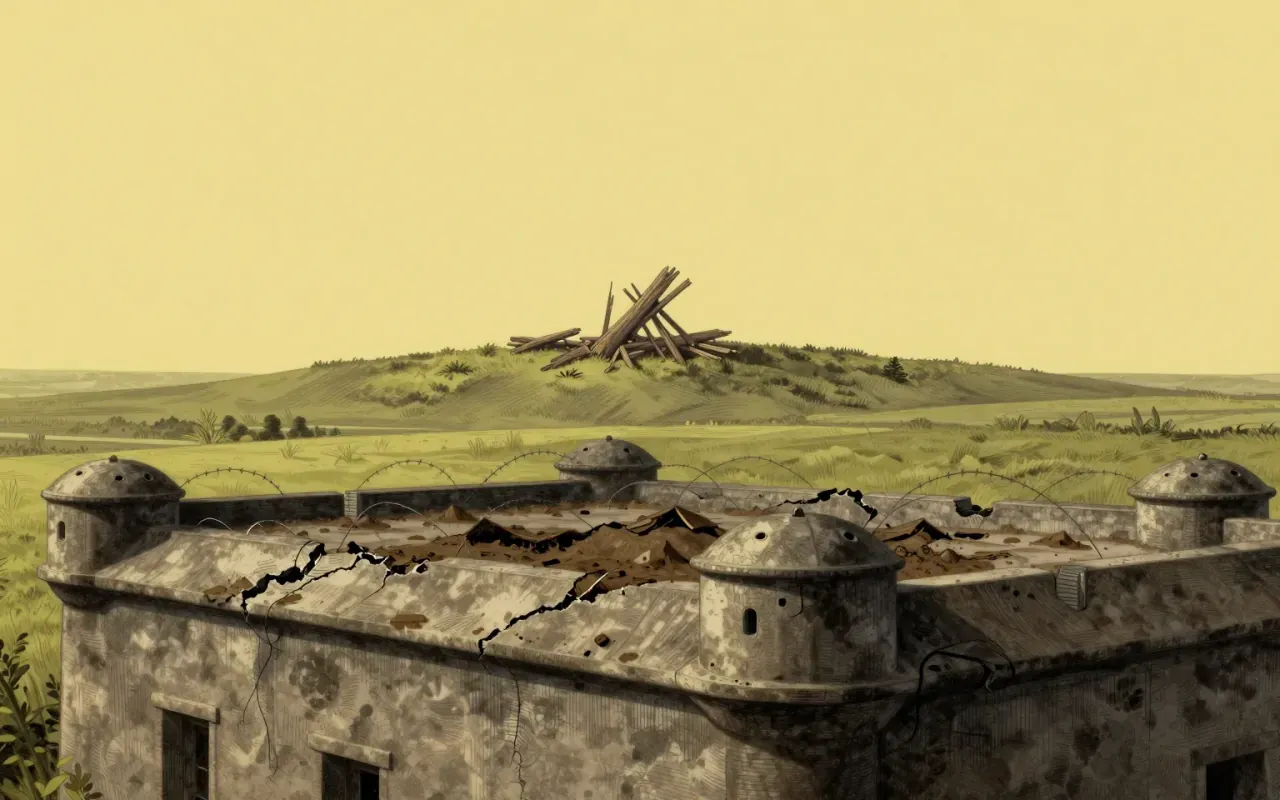
German chief of staff Erich von Falkenhayn designed the offensive that opened on 21 February 1916 with an explicit strategic aim recorded in his own planning: not to break through French lines but to force France to commit its reserves defending a position of symbolic importance, inflicting catastrophic losses on French infantry at comparatively lower cost to German forces. The assault began with a bombardment of some eight hundred guns firing close to a million shells, and Fort Douaumont, one of the war’s most fortified positions, fell within days, on 25 February, in part because its garrison had been reduced to a skeleton crew of around seventy technicians rather than a full defensive force.
A fort held by seventy technicians
Falkenhayn’s stated intent survives clearly enough in his own recorded strategic reasoning that historians can describe the battle’s purpose without having to infer it from outcomes alone, an unusual clarity for a First World War offensive whose deeper aims are often reconstructed only after the fact. That documented intent, to attrite rather than to conquer, shapes how the entire ten-month battle is now read: individual engagements, the German advance to within roughly three miles of Verdun’s citadel by late June, the French recapture and subsequent loss of Fort Douaumont in May, mattered less as steps toward a final breakthrough than as episodes in a deliberately prolonged contest of endurance.
A road that kept an army fed
France’s ability to sustain the defence for ten months rested substantially on organisational innovations credited to General Philippe Pétain, who took command on 25 February 1916. Rather than leaving divisions in continuous combat until they collapsed, as German practice tended to do, Pétain rotated units out after roughly two weeks at the front, a system that spread the psychological and physical toll across a much larger share of the French army over time. He also organised continuous truck convoys along a supply route that became known as the Voie Sacrée, the sacred way, keeping ammunition and fresh troops flowing into the battle despite the destruction of rail lines closer to the front.
Ten months for three miles
The battle’s ten-month duration, the longest of the war, produced combined casualties historians place above seven hundred thousand, with French losses running from roughly three hundred and seventy-seven thousand to four hundred thousand and German losses between three hundred and thirty-seven thousand and three hundred and fifty-five thousand, figures whose ranges reflect genuine uncertainty in how casualties were recorded and categorised at the time rather than a single agreed count. Averaged across the battle’s length, this amounted to something like seventy thousand casualties a month, for a front line that moved only a few miles in either direction before German forces were finally halted and pushed back by the year’s end.
A hero’s arc that later reversed
Pétain emerged from Verdun as France’s most celebrated soldier, promoted to command a full army group within months and eventually made a Marshal of France in 1918, a reputation built directly on the rotation and supply innovations that had sustained the defence. That same reputation, as the Lion of Verdun, is what makes his later career so difficult to reconcile: in 1940, at eighty-four, he negotiated France’s armistice with Nazi Germany and then led the collaborationist Vichy regime as head of state until 1944, a transformation Charles de Gaulle later summarised as a life successively banal, then glorious, then deplorable, but never mediocre, a judgment historians still use to frame the same unresolved question.
A battle that became a national symbol
French national memory fixed on Verdun less as a strategic outcome than as a symbol of endurance, since the battle’s ultimate result, a German offensive halted after enormous losses on both sides, left the front line close to where it had started but gave France a story of collective sacrifice and resilience that outlasted the war itself. Read alongside Pétain’s later trial and conviction for treason in 1945, a sentence commuted to life imprisonment in recognition of his earlier service, Verdun becomes less a simple story of heroic defence than a case study in how a nation’s most celebrated wartime figure can later become its most notorious collaborator, without either fact cancelling out the other.