More pyramids than Egypt
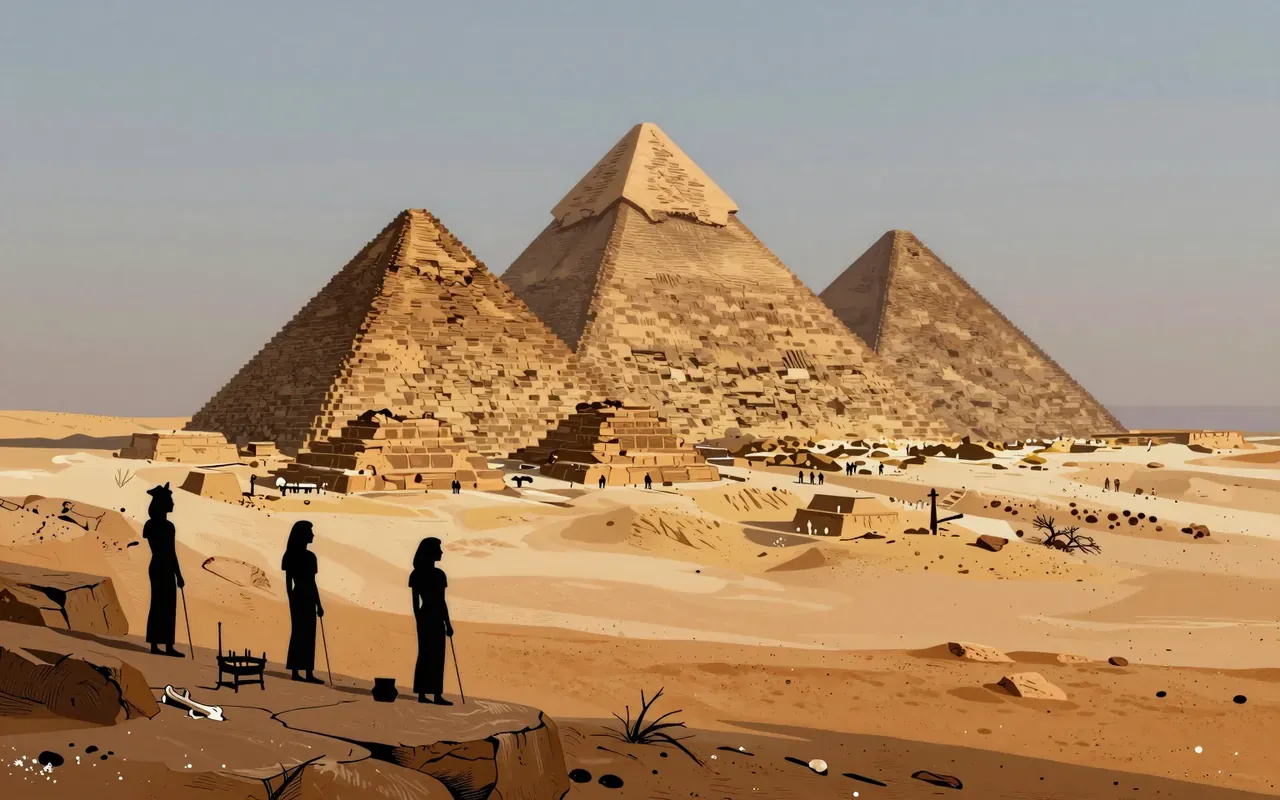
Along the Nile in what is now northern Sudan, successive Kushite kingdoms built roughly two hundred and fifty-five pyramids over a span of more than a thousand years, more than double the number ever built in Egypt itself, though individually much smaller and steeper, typically rising no more than thirty metres from narrow bases at an incline of around seventy degrees. Construction began at El-Kurru around the eighth century BC under the Napatan kingdom, continued at nearby Nuri, where twenty-one kings and dozens of queens and princes were eventually buried, and later shifted south to Meroe once the Kushite capital relocated there, where pyramid building continued for roughly seven centuries until around 350 AD. Burial chambers were cut beneath the pyramids rather than inside them, a structural difference from Egyptian practice that briefly puzzled excavators before the arrangement’s purpose, concealment of the entrance after the ruler’s funeral, was properly understood.
A destructive rediscovery
Much of the modern understanding of these sites depends on excavation history nearly as dramatic as the monuments themselves. In the 1830s the Italian treasure hunter Giuseppe Ferlini demolished pyramids from the top down in search of gold, destroying more than forty of them and, in one case, recovering genuine jewellery from the burial of a Kushite queen that European collectors initially assumed too sophisticated to have been made anywhere in sub-Saharan Africa. Fortunately, the French traveller Frédéric Cailliaud had documented several sites in good condition only a few years earlier, providing a baseline against which the destruction could later be measured. The first genuinely systematic archaeological study came only in 1916 to 1919, under the Harvard archaeologist George Reisner, whose findings were not even published until 1955 and whose own excavation ended prematurely after a staircase collapse killed five of his workers, showing how recent, incomplete and occasionally deadly the serious scholarly investigation of this civilisation has actually been.
Emulation, not copying
Kushite rulers built pyramids in evident emulation of a much older Egyptian funerary tradition, one associated with elite private burials rather than royal ones by the time Kush adopted the practice, reflecting Kush’s long and sometimes politically dominant relationship with Egypt to its north, including a period when Kushite kings themselves ruled as Egyptian pharaohs. Adapting the form to a much smaller footprint while retaining its steep, distinctive silhouette allowed Kushite kings to claim continuity with prestigious Egyptian royal tradition without needing anything like Egypt’s resources or labour force to build at comparable scale. The distinctive placement of burial chambers beneath rather than inside the pyramid may reflect independent structural innovation adapted to different building techniques and materials available locally, including combinations of granite and sandstone assembled with counterbalance lever hoists, rather than a simple, unmodified copy of Egyptian construction methods transplanted wholesale into a different environment.
A puzzle in burial placement
The clearest historical disagreement concerns how much independent Kushite innovation, as opposed to straightforward Egyptian influence, the pyramids actually represent, a question complicated by how much physical evidence Ferlini’s nineteenth-century destruction removed before careful documentation could assess it properly. The below-ground placement of burial chambers genuinely confused early excavators working from Egyptian assumptions about pyramid design, and it took Reisner’s more careful fieldwork to establish that entrances had been deliberately concealed after burial rather than never having existed in the expected Egyptian location at all. Precise dating of the earliest pyramids also carries some uncertainty, since the standard attribution of the first monuments at El-Kurru to a specific eighth-century king rests on reasonable inference rather than explicit contemporary confirmation of exactly when construction there began, leaving the opening chapter of the tradition’s history somewhat less firmly fixed than the many centuries of building that followed it.
A civilisation known through trade goods
The pyramids stand today as physical proof of a sophisticated, powerful civilisation that, before Reisner’s excavations, was known to most outsiders mainly through scattered biblical references rather than as a subject of serious study in its own right. Artefacts recovered from the burial sites, ranging from bows and horse harnesses to imported glass and metal vessels, document extensive trade links reaching Egypt and the wider Hellenistic world, evidence of a civilisation fully engaged with its regional economy rather than isolated on the Nile’s southern reaches. The destructive legacy of Ferlini’s treasure hunting also left a lasting cautionary example within archaeology itself, helping establish the case for careful, non-destructive excavation methods, a lesson visible today in recent underwater and robotic surveys of flooded burial chambers at the sites he once looted. The pyramids now hold recognised World Heritage status, protecting what remains after nearly two centuries of uneven attention.
A late and uneven scholarship
The Nubian pyramids are worth attention as much for the story of their rediscovery as for the monuments themselves, since the history of scholarship here runs directly through both a genuinely destructive nineteenth-century treasure hunt and a dangerous, incomplete early twentieth-century excavation that killed several workers before yielding results published decades later. Readers drawn to ancient Egypt should not assume they already know this material simply because the pyramid form looks broadly familiar, since the numbers, proportions, underlying construction logic and burial arrangement all differ in ways that reward closer attention rather than casual comparison. Anyone interested in African history poorly served by popular attention, in the mechanics and ethics of early archaeology, or simply in an underappreciated ancient civilisation with a genuinely striking number of surviving monuments will find this subject substantial. Those wanting definitive answers on every point of dating and origin should expect real, still-unresolved gaps instead.