A failed canal, a dump, and a school built above both
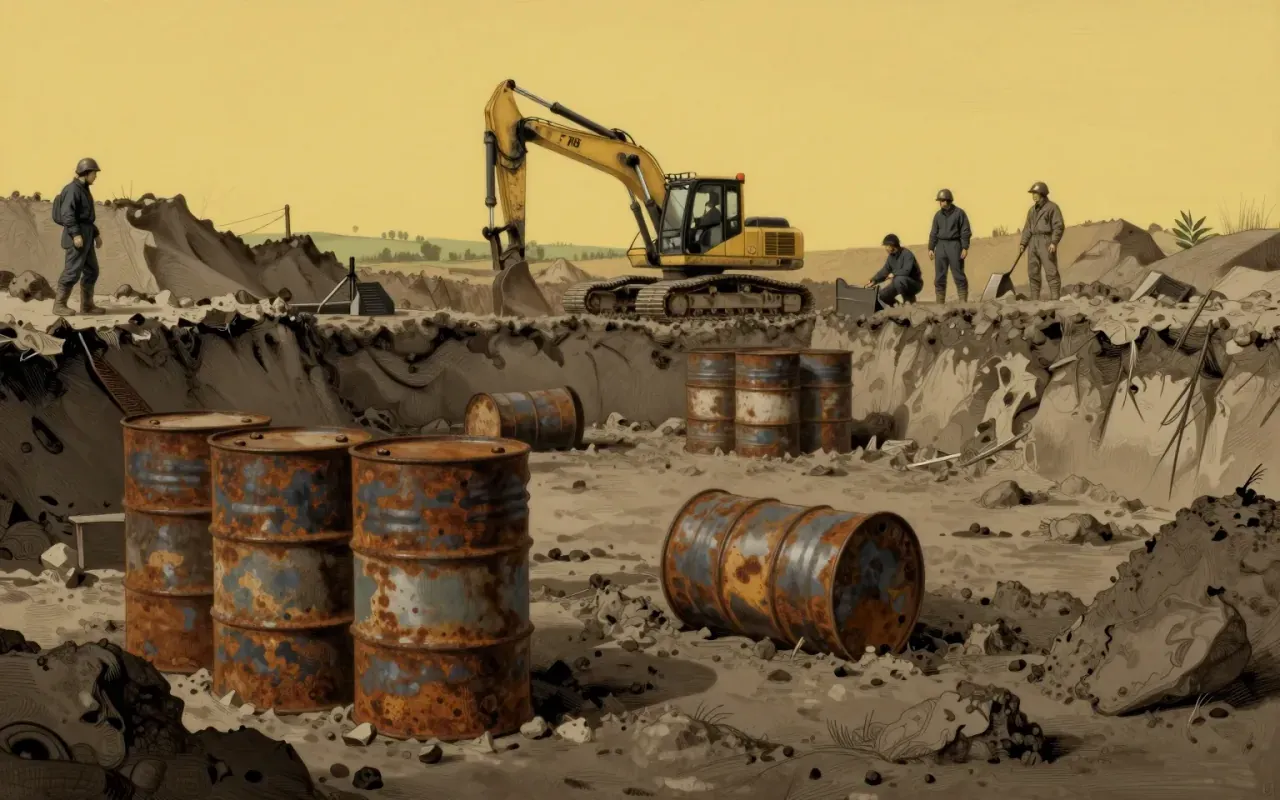
The canal itself began as an 1890s hydroelectric project by William T. Love that failed after the Panic of 1893, leaving a roughly one-mile, forty-foot-deep trench that Niagara Falls used as a municipal dump by the 1920s. Hooker Chemical Company purchased the site in the 1940s and, between 1942 and 1952, buried approximately 21,800 tons of industrial waste, including caustics and chlorinated hydrocarbons, twenty to twenty-five feet underground in steel drums. In 1953 the company sold the land to the Niagara Falls School District for one dollar, including a liability waiver, and the district built an elementary school on the site in 1955 before further land was sold for residential development later that decade.
Journalists and a mother’s activism turned symptoms into a case
Public awareness of the contamination built gradually rather than emerging all at once. Niagara Falls Gazette reporters David Pollak and David Russell identified fifteen organic chemicals in residents’ sump samples in late 1976, and journalist Michael Brown expanded the investigation in 1978 through door-to-door surveys documenting birth defects and other health anomalies among residents. Lois Gibbs, whose son had developed epilepsy and asthma, founded the Love Canal Homeowners Association in August 1978 and organised a sustained two-year campaign, including one episode in which activists held two Environmental Protection Agency employees at the association’s offices for roughly five hours to pressure federal intervention.
Waste dumped when disposal standards were far looser than today’s
Hooker’s dumping practices reflected the largely unregulated hazardous-waste disposal standards of their era, decades before federal hazardous-waste law existed, and state investigators found more than eighty compounds in toxic vapours from eleven homes’ basements after New York declared a public health emergency on 2 August 1978, with soil analysis eventually identifying over two hundred distinct organic chemicals including benzene, chloroform, toluene, dioxin and PCBs. The scale and variety of chemicals found reflected the range of industrial processes, dye, perfume and solvent manufacturing among them, that had fed waste into the site over the preceding decade, long before anyone living above it understood what lay beneath their homes and school.
What the tests actually proved, and what scientists still disputed
Specific health findings included elevated white blood cell counts, a recognised precursor to leukaemia, in 1979 blood tests, and chromosomal damage found in roughly a third of tested residents against a baseline population rate of about one percent, along with documented higher rates of low birth weight and birth defects that later research found subsided once exposure ended. At the same time, the article notes that initial scientific studies did not conclusively prove the chemicals caused all of the various illnesses residents reported, and researchers remained divided for years, with some subsequent studies unable to find harm, while a 1998 commentary attributing residents’ symptoms to stress from media coverage rather than chemical exposure was itself later contradicted by further research confirming reproductive health risks.
A single dollar sale that still ended in a $129 million settlement
The federal government responded with unprecedented speed for the time: President Carter’s emergency declaration on 7 August 1978 was the first ever issued for a disaster that was not naturally occurring, and Congress followed in 1980 with the Comprehensive Environmental Response, Compensation and Liability Act, commonly known as Superfund, with Love Canal placed as its very first entry on the National Priorities List. Despite the liability waiver Hooker had attached to its original one-dollar sale of the land, a federal judge ruled in 1994 that the company had acted negligently, and Occidental Petroleum, which had since acquired Hooker, agreed in 1995 to pay 129 million dollars in restitution, following a cleanup that ultimately cost around 400 million dollars over twenty-one years before the site was removed from the Superfund list in 2004.
Worth reading for the law it produced, not just the disaster itself
Love Canal is worth engaging closely less for the disaster’s specific toxicology, which researchers continued to debate for years, than for how directly it reshaped American environmental law: a company’s liability waiver from decades earlier proved no permanent shield against a later negligence finding, and a single, geographically contained contamination case became the direct impetus for a federal framework, Superfund, that now governs hazardous-site cleanup nationwide. Readers approaching the case mainly for its human toll, roughly 950 families eventually evacuated, gain the most from tracing how that toll converted into durable legal and regulatory change, a legacy that has outlasted the specific scientific disputes over which individual illnesses the buried chemicals actually caused.