Four decrees, one week
Charles X had spent his reign testing the limits of the constitutional charter he ruled under, and on 25 July 1830 he issued four ordinances dissolving the newly elected Chamber of Deputies, suspending press freedom, narrowing the electorate to exclude much of the commercial middle class, and calling new elections under the changed rules. Parisians rose against the decrees within two days, and three days of street fighting, 27 to 29 July, drove royal forces out of the city; Charles X abdicated on 2 August and left for Britain. Rather than crown his young grandson as he had intended, or establish a republic, the provisional government installed his cousin Louis Philippe of the House of Orleans as a constitutional monarch styled king of the French rather than king of France.
Barricades counted by the thousand
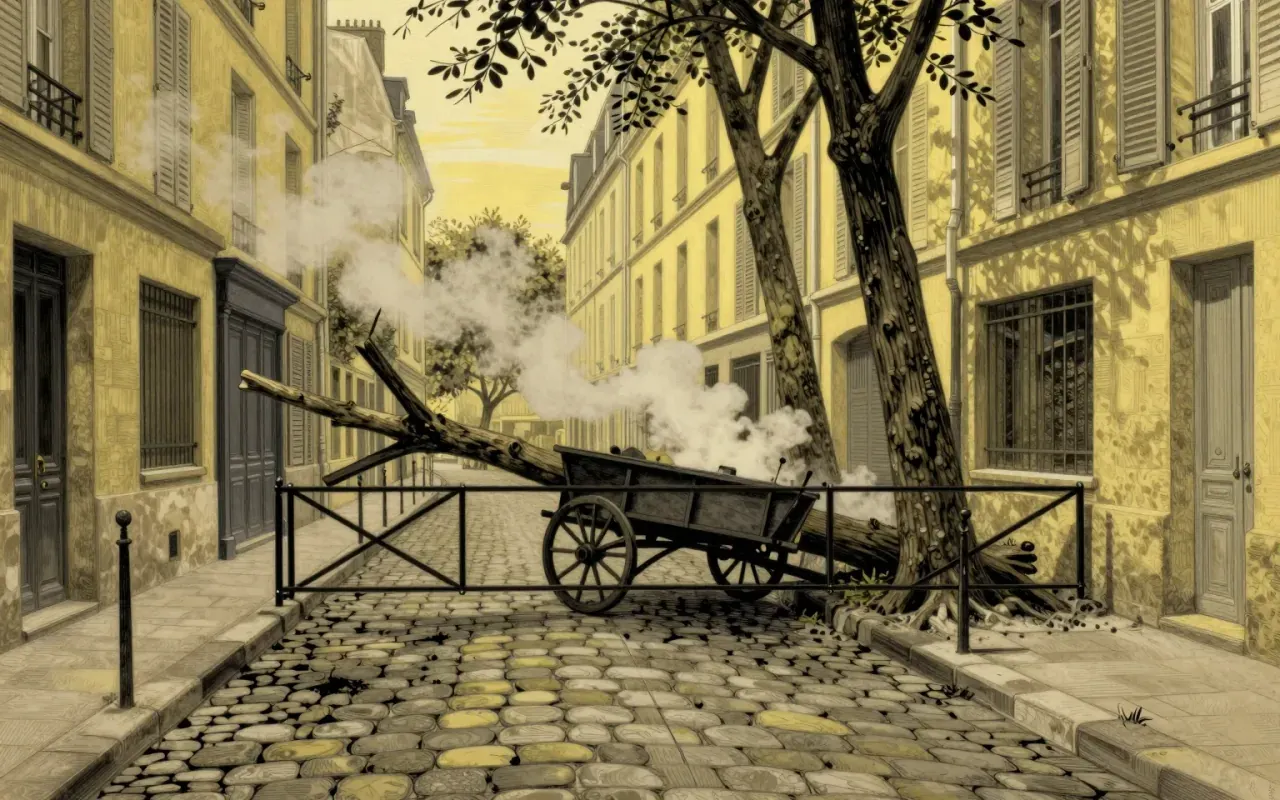
The three days of fighting are documented largely through contemporary accounts from participants and observers on both sides, including a note sent to the royalist commander Marshal Marmont warning him plainly that what he faced was no longer a riot but a revolution, and later republican memoirs written by men disappointed with how the fighting’s outcome was used. The scale of the barricading, reportedly more than four thousand structures across the city by the second day, and the specific, almost incidental detail that crowds who took the Louvre largely refrained from looting its collections, come from these overlapping eyewitness accounts rather than from any single official record of the uprising.
Who actually fought
The immediate trigger was a political dispute over constitutional limits that mattered most directly to the propertied and professional classes threatened by the narrowed franchise, but the actual street fighting was carried out substantially by working-class Parisians, including men left unemployed as factories shut down in the unrest, whose willingness to build barricades and fight royal troops turned a legal grievance into an armed uprising within two days. That combination, a middle-class political complaint and a working-class fighting force, produced a revolution whose cause and whose combatants were not the same group, a mismatch that shaped both how quickly the fighting succeeded and how bitterly its result was received by some of those who had done the fighting.
A revolution’s disputed authorship
Historians continue to disagree over how to characterise the revolution’s social character. One reading treats it substantially as a bourgeois revolution, driven by the commercial and professional classes whose economic and political interests the July Ordinances directly threatened, with working-class participation as necessary but subordinate fuel. Another emphasises the popular energy of the fighting itself, the absence of significant looting suggesting a degree of political consciousness among the crowds rather than simple opportunism, and treats the eventual installation of a monarch friendly to banking and industrial interests as a case of the propertied classes capturing a revolution broader groups had actually made possible through their own risk and effort.
A king chosen over a republic
The provisional government’s choice of Louis Philippe over a republic, and over Charles X’s intended successor, reflected a preference for stability and constitutional continuity over more radical change; his supporters became known as Orleanists, standing apart from Legitimists loyal to the senior Bourbon line and from republicans who felt the revolution’s outcome had betrayed its own momentum. That disappointment surfaced again within two years in a further, smaller rebellion in 1832, and the tensions the July Revolution left unresolved, between a narrow electorate and a broader population that had shown it could put fighters in the street, persisted through Louis Philippe’s own reign until it too was overthrown in 1848.
A spark that reached beyond France
The July Revolution’s most far-reaching effect may have been outside France altogether: news of Charles X’s fall helped trigger an uprising in Brussels that led to Belgian independence, an uprising in Poland against Russian rule that same November, and unsuccessful revolutionary attempts in parts of Italy, making 1830 a genuinely continental moment rather than a purely French one. Read for the three days themselves, the material offers a fast, dramatic sequence of events; read for what came after, it is a useful case study in how the group that fights a revolution and the group that benefits from it are not always the same people.