Bread, a crowd at the Hotel de Ville, and a march begins
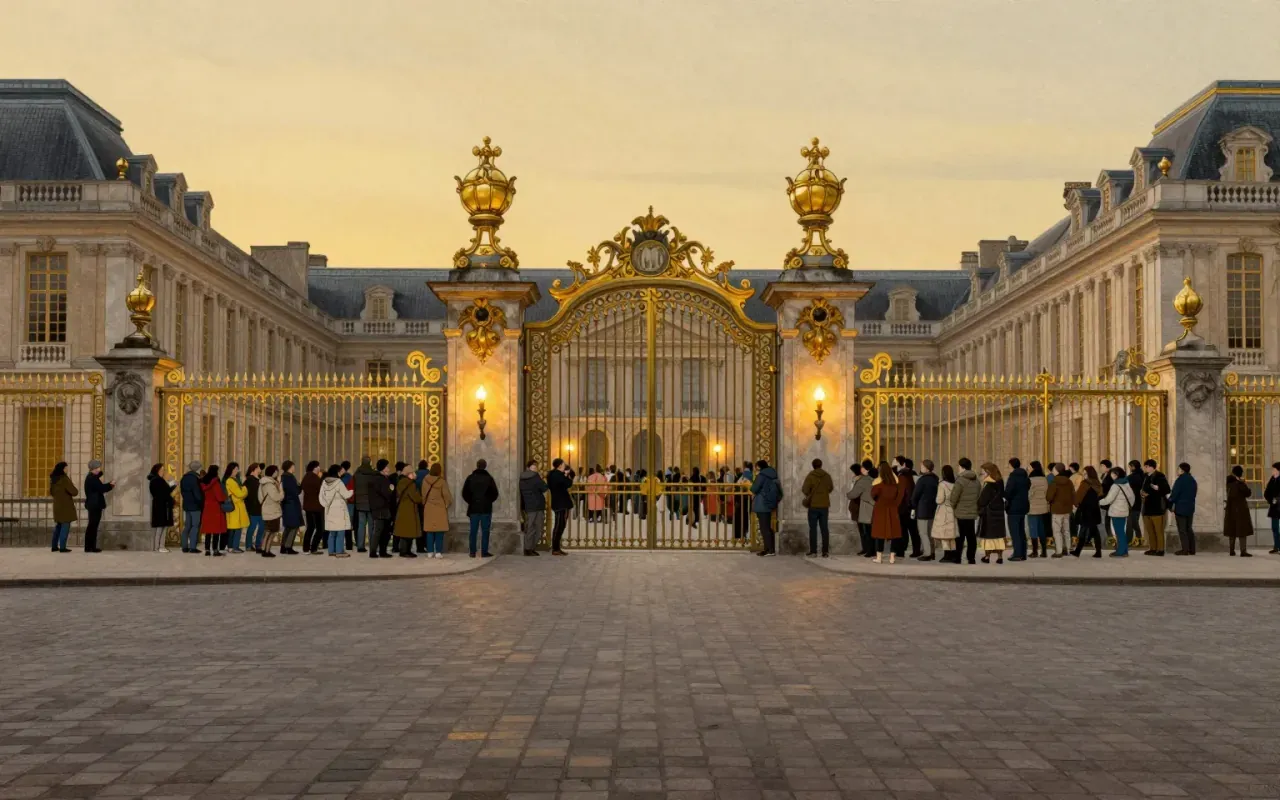
On the morning of 5 October 1789, women in Paris’s markets, angered by bread shortages and high prices, gathered and marched toward the Hotel de Ville, where the crowd swelled to somewhere between six and ten thousand. Stanislas-Marie Maillard, who had taken part in the storming of the Bastille three months earlier, emerged as an organiser and led the group, joined by roughly fifteen thousand National Guardsmen under the reluctant command of the Marquis de Lafayette, on the six-hour walk to Versailles in the rain. That evening the crowd entered the National Assembly itself, and a delegation of women was received by Louis XVI, who promised food from the royal stores.
A night at Versailles, told mostly by men who were not in the crowd
Much of the detailed sequence of that night and the following morning comes down through accounts written afterward by people who were not themselves market women: contemporary newspapers, the recollections of deputies and guards, and later narrative historians including Thomas Carlyle in the nineteenth century and Georges Lefebvre, Albert Soboul and Simon Schama in the twentieth, each emphasising different aspects, economic hardship, class conflict, or court and military detail. The women who actually walked from Paris left comparatively little testimony of their own, which means the episode is known largely at second hand, filtered through observers with their own political sympathies and, in some cases, decades of hindsight.
Why a bread riot ended at a royal palace
Bread had become an obsession in Paris that autumn: ordinary workers were spending close to half their income on it, after a weak harvest and years of rising prices. The immediate spark was shortage and cost, but the destination was not chosen at random. A march on Versailles had reportedly been proposed a month earlier by the Marquis de Saint-Huruge, meaning the idea already existed among some Parisians before the bread crisis reignited that October. Fear that the king’s soldiers might move against the Assembly, stoked by reports of an officers’ banquet where royalist symbols were reportedly trampled, added a political grievance to the economic one that drove the crowd forward.
Who planned it, and whether anyone did
Historians remain divided over how organised the march really was. Some, including Christopher Hibbert and writers close to his account, give real weight to the theory that Louis Philippe, Duke of Orleans, a cousin of the king with his own ambitions, encouraged or funded the crowd’s departure for Versailles. Others, notably Lefebvre and Soboul, treat any Orleanist involvement as ordinary political manoeuvring that could not have moved a crowd without the underlying economic desperation already present, while Schama’s account largely leaves the Duke out altogether. A royal investigation at the time cleared both the Duke and the deputy Mirabeau of orchestrating the events, though suspicion followed the Duke for years afterward.
A king who stopped resisting
By the afternoon of 6 October, after guards had been killed at the palace gates and the queen had narrowly escaped her own chambers, Lafayette persuaded the king to appear on the balcony and agree to return to Paris. A procession of the royal family, roughly a hundred deputies, and a crowd said to have grown past sixty thousand made the nine-hour journey back to the Tuileries Palace, which had stood empty since the reign of Louis XIV. From that point Louis XVI made no further open resistance to the Assembly, and the National Constituent Assembly itself relocated to Paris within two weeks, ending Versailles’s role as the seat of French government.
Worth reading past the popular myth of spontaneity
What makes the march worth returning to is less the drama of the crowd itself than the gap between how it has been remembered and what the sources actually support. The idea that it was a purely spontaneous outburst of hungry women does not survive contact with the evidence of an earlier proposal to march, nor does the alternative picture of a fully stage-managed conspiracy survive the failure of any investigation to prove one. Readers willing to sit with that unresolved middle ground, rather than pick the tidier story, will come away with a clearer sense of how the French Revolution’s early months actually moved people and power out of Versailles for good.