A morning of muskets, an afternoon of cannon fire
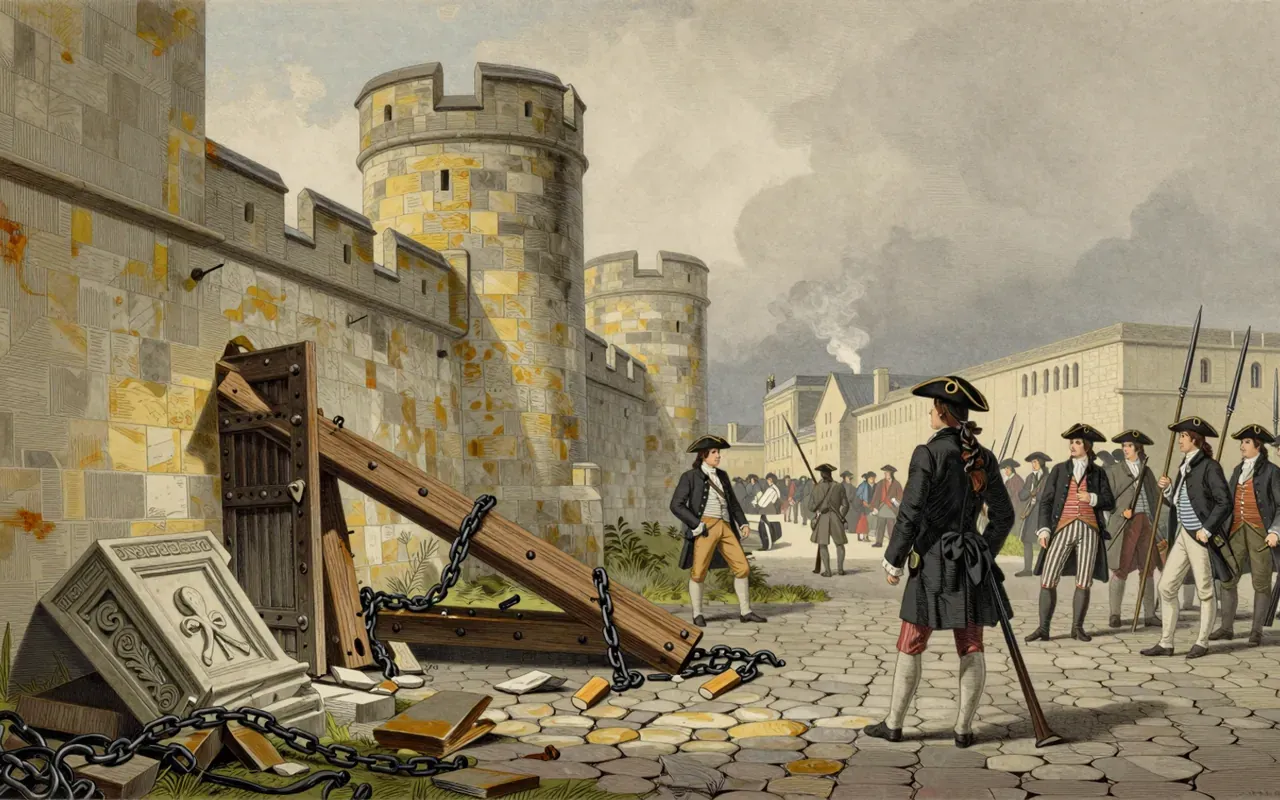
On the morning of 14 July 1789, a Paris crowd broke into the Hotel des Invalides and took between twenty-nine and thirty-two thousand muskets, though without powder or shot. They then moved to the Bastille, a royal fortress used as a prison, to demand its cannon be withdrawn and gunpowder released. Talks stalled through the morning, and around half past one in the afternoon the crowd surged into the fortress’s outer courtyard after the drawbridge chains were cut, triggering gunfire. Mutinous French Guards later reinforced the roughly seven hundred to one thousand attackers with cannon. By five in the afternoon the governor ordered his garrison to stop firing, and the gates opened half an hour later.
A contemporary ambassador’s dispatch and a list of 954 names
Close accounts of the day survive from people writing very soon after it happened rather than from official histories composed later. The British ambassador, John Frederick Sackville, reported to London two days afterward that a great revolution had occurred with comparatively few lives lost, while a Swiss officer in the garrison, Ludwig von Flue, later criticised the governor’s indecisive leadership. Paris authorities subsequently compiled an official list of 954 names as vainqueurs de la Bastille, self-declared conquerors, even though fewer than a thousand people had actually taken part, a discrepancy that shows how quickly participation in the event became a claim worth making rather than a fact simply recorded.
Why a nearly empty fortress became the target
The crowd’s target made sense given the moment: rumours were spreading that the king intended to use troops encamped nearby to move against the newly assertive National Assembly, and Parisians needed arms and powder to defend themselves. The Bastille, though it held only seven prisoners, four forgers, two men judged insane, and one nobleman confined by his own family, still functioned as a working fortress with thirty cannon and a garrison of eighty-two veteran soldiers and thirty-two Swiss grenadiers. Its governor, Bernard-Rene de Launay, had been born within its walls. Roughly five thousand royal troops camped at the Champ de Mars nearby never moved to relieve the garrison, a passivity historians treat as decisive as any failure inside the fortress itself.
A founding moment, or a useful piece of theatre
Historian Ian Davidson has argued that the true founding moment of the revolution came earlier, when Louis XVI backed down before the Third Estate at Versailles in late June, and that the Bastille’s fall mattered less for its military substance than for putting armed popular action, rather than parliamentary manoeuvring, at the centre of events for the first time. Others treat the day’s disproportionate casualties, ninety-eight dead among the attackers against a single defender killed in the fighting, as evidence that the garrison’s fall owed more to the inertia of nearby royal forces than to any real battle. The debate is less about what happened than about which moment deserves the title of beginning.
A demolished fortress and a date that outlived it
The governor did not survive his surrender. Dragged toward the Hotel de Ville, de Launay was beaten and then stabbed to death by the crowd, and his head was displayed on a pike, along with that of the city’s chief magistrate, an eyewitness English doctor present that day recording the sight as horrifying. The fortress itself was demolished within about five months, its stones sold off as souvenirs or distributed to French districts, and its symbolic key was later given by Lafayette to George Washington. Despite the building’s disappearance, the date became the anchor for France’s national holiday, commemorating not the building but what its fall was taken to represent.
Worth separating the day from its later meaning
What makes the day worth studying closely is precisely the mismatch between the modest military event, a lightly defended fortress holding almost no prisoners, taken after a few hours of fighting, and the enormous symbolic career it went on to have. Readers who already know the outline, an oppressive prison stormed by the people, gain the most from seeing how selectively that outline was built afterward, from an official list inflating participation to a governor’s death recast as popular justice. The value is not in debunking the day but in seeing how a real, bloody, fairly ordinary urban riot became the founding image of a revolution.