A secret society’s timetable
A secret organisation called the Filiki Eteria had planned coordinated uprisings across Ottoman-ruled Greek territory for March 1821, but Ottoman discovery of the plot forced the rebellion to begin earlier and less evenly than intended, starting in the Peloponnese in early 1821. What followed was eight years of fighting, complicated by two separate civil wars among rival Greek factions in 1823 and 1825, by an Egyptian intervention on the Ottoman side that brought most of the Peloponnese back under control by late 1825, and finally by the intervention of Britain, France, and Russia, whose combined fleets destroyed the Ottoman-Egyptian navy at Navarino in 1827, clearing the way to the independence recognised by the London Protocol of 1830.
A record kept by both sides
The war’s record is shaped by sources with clear stakes in how it would be remembered: Greek revolutionary leaders like Yannis Makriyannis left memoirs celebrating irregular fighters as the movement’s backbone, while foreign observers and philhellenes, including volunteers who died in the fighting, generated a separate stream of sympathetic Western reporting that helped build European support for the Greek cause. Later Greek national historiography drew heavily on both, building klephts and armed local irregulars into founding heroes of the new state. More recent scholarship, working from the same underlying evidence, has pushed back on that heroic framing without discarding it entirely, a shift that shows how a founding national narrative can be revised without collapsing.
Six years fought alone
For most of its length the war was a Greek fight sustained with only sporadic outside help, since the major European powers remained formally neutral despite considerable private philhellenic sympathy for six years after the fighting began. Ottoman authority proved unable to suppress the revolt on its own, which is why Sultan Mahmud II turned to his nominal vassal Muhammad Ali of Egypt for reinforcement; Egyptian forces under Ibrahim Pasha brought most of the Peloponnese back under control by the end of 1825, a reversal severe enough that revolutionary morale is recorded as having fallen sharply, and it was this Egyptian success, more than any single Ottoman action, that eventually drew the great powers into direct intervention.
Heroes with mixed motives
One clear revision in recent scholarship concerns the klephts and armatoloi, the irregular fighters long celebrated in Greek nationalist historiography as embodiments of the freedom-or-death spirit that became the country’s motto. More recent historians describe these same fighters as driven substantially by economic interest rather than national consciousness, noting they sometimes allied with Ottoman authorities and preyed on Christian and Muslim communities alike rather than fighting a purely national war, while still generally sparing ordinary people and retaining genuine popular support. That reassessment does not overturn the war’s outcome but complicates the simple story of a unified national uprising that the war’s own commemoration later constructed.
An accidental battle
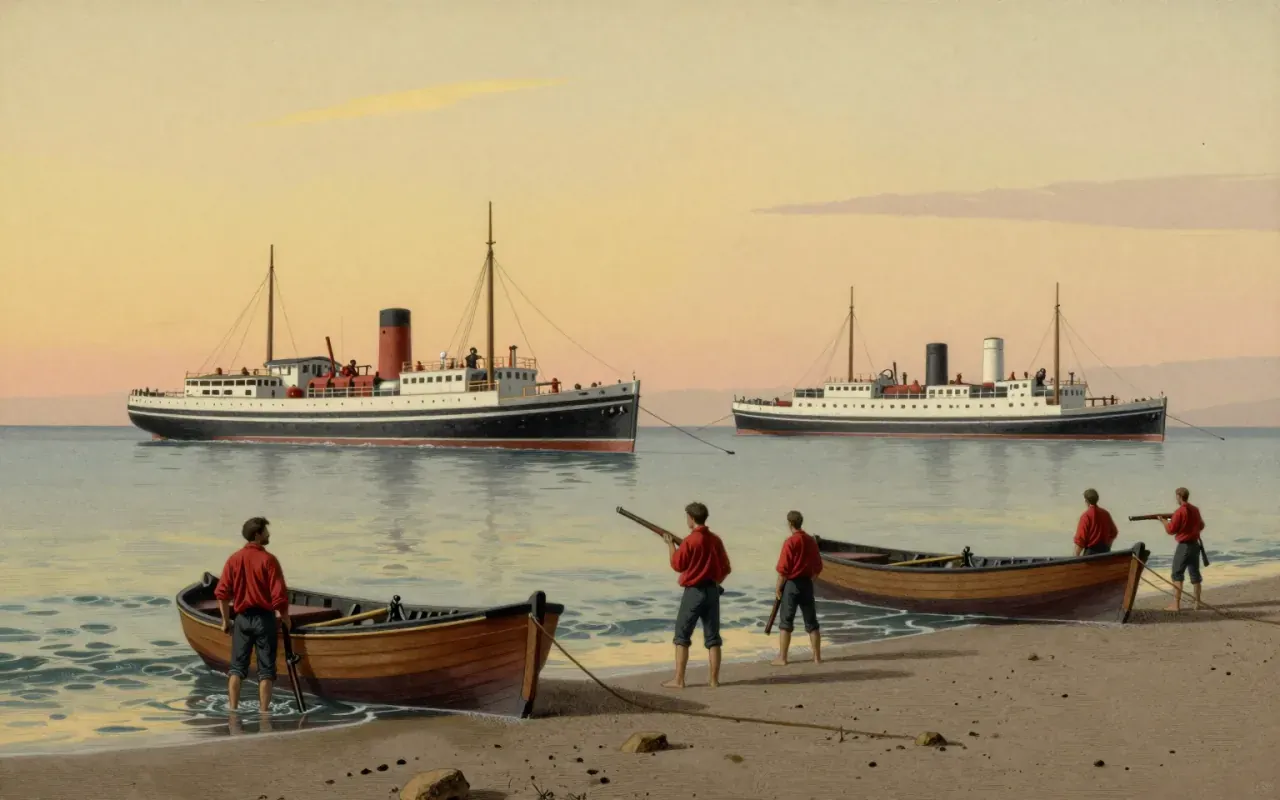
The Battle of Navarino, fought on 20 October 1827, began almost by accident: a British admiral entered the bay to enforce an armistice, a dispute over an Ottoman fireship escalated into gunfire, and within a short time the full allied fleet of twenty-two British, French, and Russian ships was engaged with a far larger Ottoman-Egyptian force of some seventy-eight vessels. The outcome was decisive and lopsided, roughly four thousand Ottoman and Egyptian sailors killed or wounded against fewer than two hundred allied dead, and most of the Ottoman fleet destroyed or captured. Historians treat the battle as the war’s real turning point, since the Greek revolutionary cause had been faltering before it and moved toward secured independence afterward.
A war that made a nation
The war produced, by later estimate, upward of two hundred and forty thousand deaths across military action, massacre, and destroyed communities on both sides, a toll that makes the eventual establishment of an independent Greek state in 1830 a costly rather than a swift achievement. What makes the material worth attention is less the familiar Western focus on figures like Lord Byron, whose death drew sympathetic attention but whose military contribution was limited, than the longer Greek struggle that preceded and outlasted foreign involvement, and the honest scholarly reassessment of which parts of that struggle’s later mythology hold up against the underlying evidence.