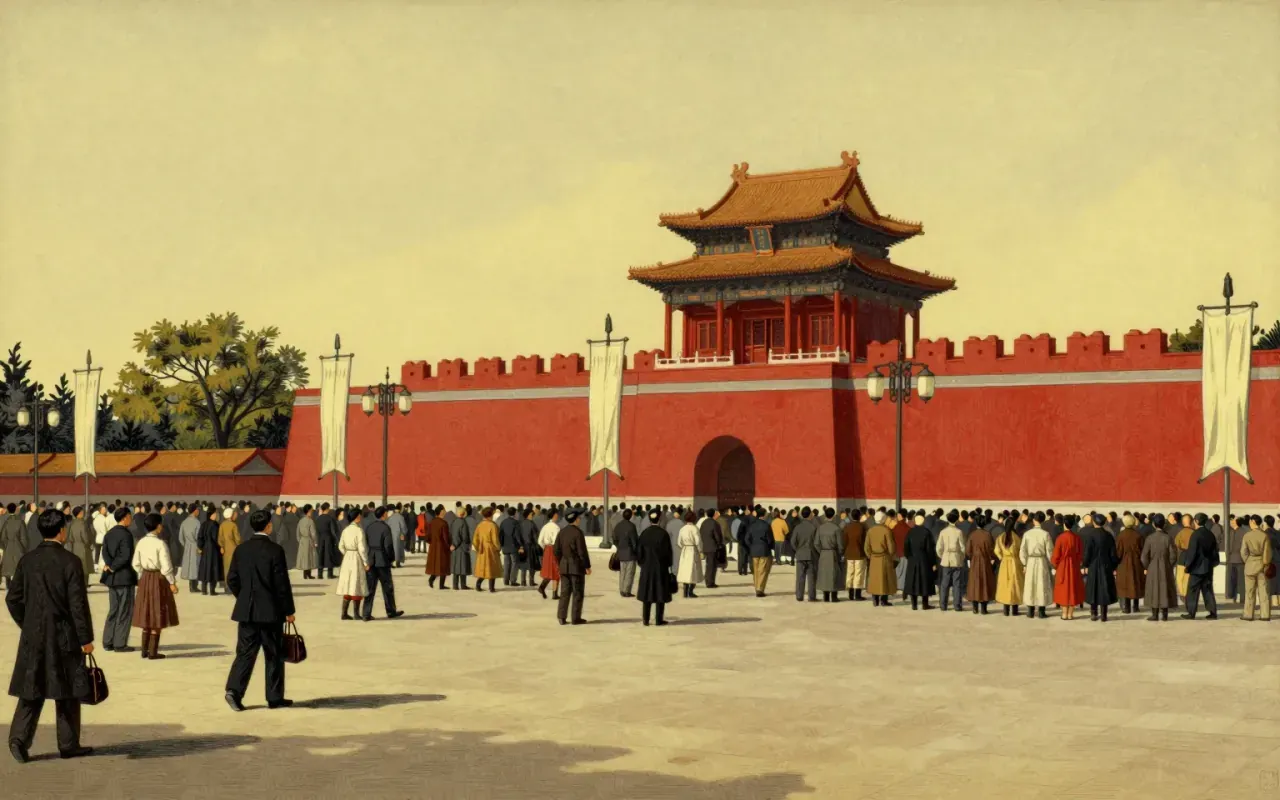
An October afternoon
At three in the afternoon on 1 October 1949, Mao Zedong stood above Tiananmen Gate in Beijing and announced the founding of the People’s Republic of China, having already declared the new state to a political consultative conference ten days earlier. A newly designed red flag with five stars was raised to a twenty-one gun salute, followed by the first public parade of the People’s Liberation Army, some sixteen thousand troops strong. The proclamation came after more than two decades of intermittent civil war between the Communist Party and the Nationalist government, a conflict resumed in full after Japan’s defeat in 1945. Mao became chairman of a new Central People’s Government, with Zhou Enlai as premier, while the defeated Nationalist government withdrew to Taiwan by December, retaining only that island and a scattering of smaller territories under its control.
Documenting the day
The ceremony itself is comparatively well documented for a mid-century Asian event: contemporary foreign press, including American newspapers, reported the proclamation within days, and photographs of Mao at the gate survive alongside official Chinese Communist Party records of the preceding consultative conference. The larger civil war that led to that afternoon is harder to reconstruct precisely, since troop strengths and casualty figures come mostly from the two rival governments’ own military records, each with reason to shade numbers in its favour, and estimates of civilian deaths across the conflict still vary by millions depending on the source. American diplomats present in China at the time, including General George Marshall, left assessments of Soviet involvement that historians have since had to weigh against later evidence of Soviet arms transfers in Manchuria, since contemporary denials and later documentation do not fully agree.
Why the Nationalists lost
The Communist victory by 1949 followed from a combination of Nationalist weakness and Communist organisation rather than any single battlefield turning point. Years of war against Japan had drained the Nationalist government’s finances and credibility, while wartime inflation and corruption eroded support among the very urban and business classes it depended on. The Communists, by contrast, had used the interlude of nominal wartime alliance to expand their rural base areas and refine the peasant mobilisation and land reform tactics developed earlier, giving them a larger and more committed following by the time full civil war resumed in 1946. Soviet transfer of captured Japanese weapons in Manchuria and Soviet control of the region in 1945 gave Communist forces an early material advantage there, even as American aid continued flowing to the Nationalists. By 1948 the military balance had shifted decisively enough that Nationalist collapse followed quickly.
Soviet role disputed
Historians continue to argue over how decisive Soviet material support actually was compared with the Nationalist government’s own internal failures, since American officials at the time found no direct evidence of Soviet arms reaching Communist forces even as later documentation shows the Soviets did hand over stockpiles in Manchuria. Casualty totals for the war’s final phase are similarly contested, with figures for combined military dead ranging widely and civilian deaths estimated anywhere from roughly two and a half to six million, a gap wide enough to change how the conflict’s human cost is understood. There is also disagreement about how genuine the wartime Nationalist-Communist alliance against Japan ever was, with some historians treating it as substantive cooperation and others as two parties positioning for the resumption of civil war they both expected. No formal peace treaty or armistice was ever signed, leaving the conflict’s legal end permanently unresolved.
A divided legitimacy
The proclamation created a division of Chinese territory and legitimacy that has persisted ever since. The Soviet Union recognised the new government within a day, and other communist states quickly followed, while Western nations continued for years to treat the Nationalist government relocated to Taiwan as China’s legitimate representative. The People’s Republic moved rapidly to nationalise industry and consolidate one-party rule across the mainland, ending decades of warlordism, foreign concession and civil conflict that had shaped the country since the fall of the Qing dynasty. Nationalist forces continued sporadic guerrilla resistance in border regions and even in Burma for more than a decade afterward, but never seriously threatened the new government’s control of the mainland. The unresolved status of Taiwan, still claimed by Beijing and still separately governed, remains the proclamation’s most direct and unfinished consequence, shaping East Asian diplomacy to the present day.
An unfinished conclusion
The ceremony at Tiananmen Gate is a useful anchor for a much longer and messier story, and readers should approach it less as a single dramatic moment than as the visible tip of a decades-long collapse of the old order and consolidation of the new one. Its value lies in how cleanly it marks the transition, even though the war that produced it resists tidy explanation and the peace that followed it was never formally signed. Anyone interested in how twentieth-century civil wars end, in the mechanics of great-power involvement short of direct war, or in the roots of the still-unresolved Taiwan question will find the underlying material rewarding, if not conclusive. Those hoping for a straightforward battle narrative will instead find a slow accumulation of economic exhaustion, shifting foreign backing and organisational advantage that only culminated, rather than resolved, in the events of an October afternoon.