Fourteen years learning guerrilla war
Garibaldi fled Italy after a failed uprising in 1834 and spent the following fourteen years in South America, fighting first for a breakaway republic in Brazil and then in Uruguay’s civil war, where he commanded a naval squadron and raised the Italian Legion whose red shirts later became his movement’s defining symbol. That decade and a half of guerrilla and naval combat, including victories and defeats recorded in detail from both conflicts, gave him practical military experience unavailable to most European revolutionaries of his generation, experience he brought directly back to Italy when he returned in 1848 to join the wave of nationalist uprisings then sweeping the continent.
Admirers on every continent
Garibaldi’s international reputation is unusually well documented through contemporaries who wrote about him directly and by name: Abraham Lincoln, Victor Hugo, Alexandre Dumas, Charles Dickens, and Friedrich Engels are all recorded as admirers, and the historian A. J. P. Taylor later called him the only wholly admirable figure in modern history, a claim striking enough that it is frequently quoted as shorthand for how completely his contemporaries idealised him. This breadth of documented admiration is itself a historical fact worth attention, since it shows how thoroughly the Garibaldi myth was constructed in real time, by people who knew him or watched him from abroad, well before later historians had occasion to test that reputation against the fuller record.
A thousand men against a kingdom
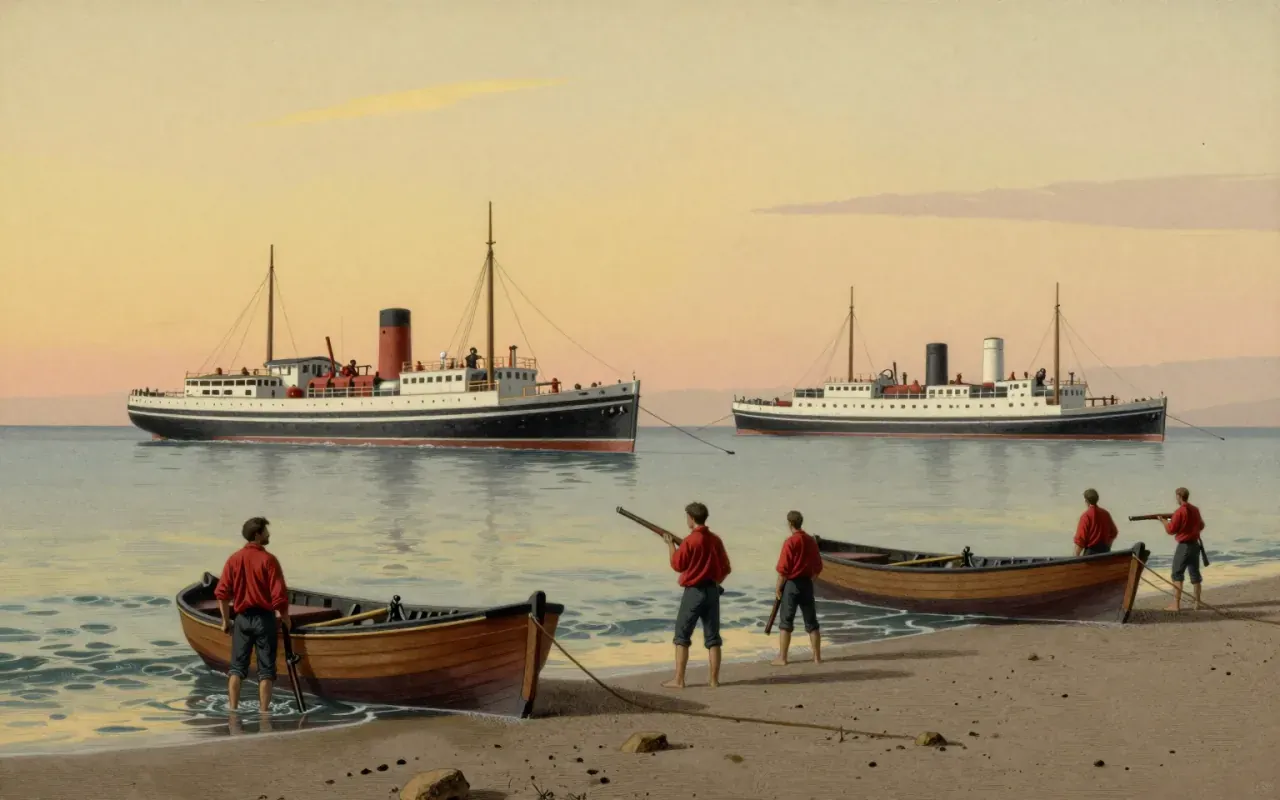
In May 1860, Garibaldi sailed from Genoa with roughly a thousand volunteers, the Redshirts, aboard two ships, landing at Marsala in Sicily and winning a decisive early victory at Calatafimi despite being outnumbered, a success that let him declare himself dictator of Sicily in the king’s name within days. He went on to take Palermo and then crossed to the mainland, entering Naples that September without having to fight a battle for the city itself, before a larger engagement at the Volturno River in which his force, by then swollen to some twenty-four thousand volunteers, held off a comparably sized Neapolitan army until regular Piedmontese troops arrived to settle the outcome.
Hero to peasants, enemy of their cause
More recent scholarship has complicated the popular image of Garibaldi’s Sicilian campaign as a purely national uprising. Historians note that much of the peasant support that helped his small force succeed grew out of local hatred for exploitative landlords rather than any commitment to Italian nationhood as such, and that when peasant unrest against those landlords threatened to spiral into broader rioting, Garibaldi himself sided with the landlords against the rioters, revealing a limited interest in social revolution beneath the nationalist cause he publicly championed. This does not overturn his military achievement, but it complicates the idea that his support was uniformly patriotic rather than substantially opportunistic and locally motivated.
A crown handed over at Teano
Garibaldi’s personal republicanism, inherited from his early mentor Giuseppe Mazzini, sat uneasily beside his practical decision to hand his conquered territories to the monarchist Piedmontese state rather than pursue an independent republic. He distrusted and, over the loss of his native Nice to France, openly attacked Piedmont’s chief minister Cavour, yet he respected King Victor Emmanuel II enough to meet him at Teano in October 1860 and formally subordinate his gains to the king’s authority, a pragmatic choice that let the unified Kingdom of Italy be proclaimed the following March without the civil conflict a more doctrinaire commitment to republicanism might have produced.
A myth built faster than it could be checked
Garibaldi went on fighting for causes connected to Italian unification for another decade, attempting to seize Rome in 1862 and again in 1867, and even commanding French volunteer forces during the Franco-Prussian War in 1870 and 1871, before retiring to the island of Caprera, where he died in 1882. The gap between the admiring, near-mythical figure his contemporaries described and the more complicated record later historians have assembled, a pragmatic monarchist beneath the republican rhetoric, a man who backed landlords against the peasants whose support made his campaign possible, makes him a genuinely rewarding subject for a reader willing to hold both versions in mind at once.