Twenty seconds at dawn, over five thousand dead
The Great Hanshin earthquake struck at 5:46:53 a.m. local time on 17 January 1995, a magnitude 7.3 event with a hypocentre seventeen kilometres beneath a point near Awaji Island, about twenty kilometres from central Kobe, lasting roughly twenty seconds. It killed between 5,502 and 6,434 people, most of them in Hyogo Prefecture, injured somewhere between 36,896 and 43,792 more, and displaced between 251,301 and 310,000 residents, making it Japan’s second-deadliest earthquake of the twentieth century after the 1923 Great Kanto earthquake, which had killed more than 105,000 people in and around Tokyo decades earlier.
A death toll built from old roofs and spreading fire
A large share of the deaths came from the collapse of older traditional houses, which combined heavy tiled roofs weighing up to two tons with light wooden frames designed mainly to withstand typhoons rather than strong shaking; when the supporting frames failed, the roofs crushed the unreinforced walls beneath them in what specialists describe as pancake-style collapses. Roughly 300 fires broke out and spread through heavily damaged neighbourhoods afterward, compounding the toll, while widespread disruption to water, electricity and gas service left nearly 400,000 buildings with irreparable damage and destroyed 120 of Kobe’s 150 port quays.
A building code from the 1960s that had already been judged inadequate
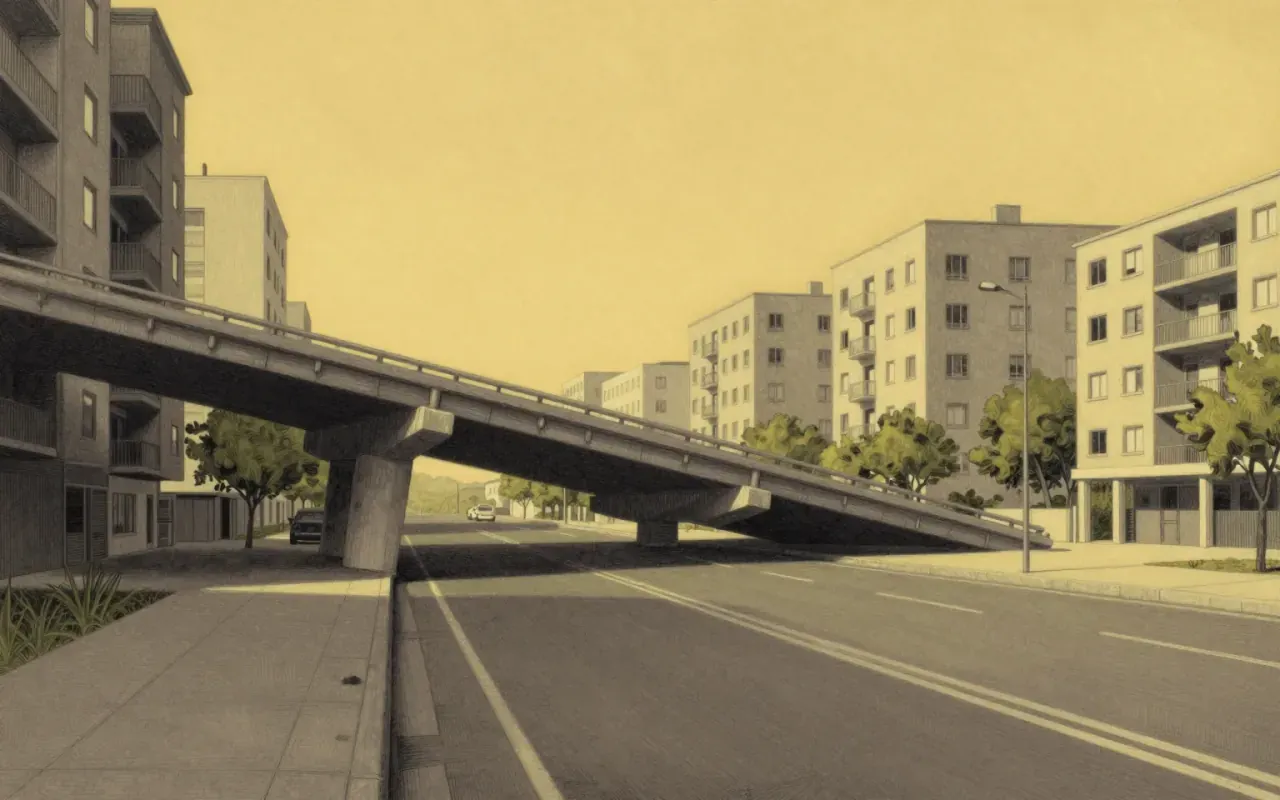
A clear pattern emerged in which building code era predicted survival more reliably than the earthquake’s raw force: elevated structures including sections of the Hanshin Expressway’s Kobe route had been built properly according to the reinforcement standards in force during the 1960s, standards already recognised at the time as inadequate and subsequently revised more than once, most significantly in 1981. Buildings actually meeting that 1981 code, with reinforced walls and lighter roofing, generally survived intact, meaning the disaster effectively tested two generations of Japanese construction standards against the same earthquake and showed a clear, documented difference in outcome between them.
A crime syndicate filled a gap the government left open
Criticism of the government’s initial relief response was pointed enough that a notable and unusual detail entered the disaster’s record: the Yamaguchi-gumi crime syndicate was actively involved in relief efforts from the earliest hours, distributing substantial quantities of food and supplies to affected residents while official channels were still organising their own response. Roughly 1.2 million volunteers ultimately took part in relief work over the disaster’s first three months, a scale of civilian mobilisation that itself became a significant, lasting feature of how the earthquake reshaped Japanese attitudes toward volunteerism as organised civic participation.
A command structure rebuilt so the delay could not repeat
In direct response to documented delays in mobilising help, Japan’s national government granted the Ground Self-Defense Forces automatic authority to respond to earthquakes above a certain magnitude without waiting for separate authorisation, removing a bureaucratic step that had slowed the initial 1995 response. Fire response control was similarly centralised, shifting coordination from individual local departments to central command bases in Tokyo and Kyoto, while the transport ministry began designating reinforced disaster-prevention routes intended to remain passable during future earthquakes, reforms aimed specifically at correcting the command and coordination failures the Kobe disaster had exposed.
Worth reading for how fast recovery followed such visible failure
Despite the severity of the initial damage, including the near-total loss of port capacity, Kobe’s economy recovered with striking speed: import volumes returned to pre-earthquake levels within a year, and manufacturing output across greater Kobe reached 98 percent of its projected pre-quake level by March 1996, just under fifteen months after the disaster. Readers drawn to the earthquake’s death toll and the visible early failures in government response gain the most from holding that alongside this rapid recovery, since the two threads together, documented institutional shortcomings and an unusually fast economic rebound, capture the disaster’s fuller and more complicated legacy better than either fact alone.