Decades of religious war behind it
The Edict of Nantes was issued against the backdrop of the French Wars of Religion, a series of conflicts between Catholic and Protestant factions that had convulsed France for thirty-six years by the time Henry IV signed the settlement. The wars are conventionally dated from the Massacre of Vassy on 1 March 1562, an attack on a Huguenot congregation that triggered the first open fighting between the two sides, through repeated cycles of war, temporary truce, and renewed violence that left the French monarchy’s authority badly weakened. By 1598, restoring internal peace had become a precondition for rebuilding royal power, and the edict Henry issued that April was designed explicitly as a political settlement to end the fighting rather than a statement of religious principle for its own sake.
A king who had changed sides before
Henry IV’s own religious history shaped his approach to the settlement directly. He had been compelled to convert to Catholicism following the Saint Bartholomew’s Day Massacre in 1572, not long after his marriage to Margaret of Valois, then abjured Catholicism in 1576 to rejoin Protestant forces after escaping royal custody. Facing the practical necessity of securing his claim to the French throne, he converted to Catholicism again on 25 July 1593, a move historians generally treat as politically pragmatic given his earlier, sustained personal commitment to Calvinism. The Edict of Nantes followed five years later, addressing the reconciliation this final conversion demanded between Henry as a Catholic king and the Protestant allies and subjects whose earlier support had helped bring him to power.
Freedom, with real limits attached
The edict itself was not a single simple document but a set of four texts: a main body of ninety-two public articles, fifty-six additional secret articles, and two royal letters patent covering military and religious provisions separately. Together these granted Huguenots freedom of conscience and worship within specified towns, the right to hold public office and serve as judges, and permission to maintain schools and universities with government funding. These were substantial concessions for a religious minority in this period, though the edict stopped well short of full equality: Protestants remained legally obligated to pay tithes to the Catholic Church and to observe its holidays, a reminder that toleration under the settlement meant coexistence within a still explicitly Catholic state rather than genuine religious parity.
Fortified towns, funded by the Huguenots themselves
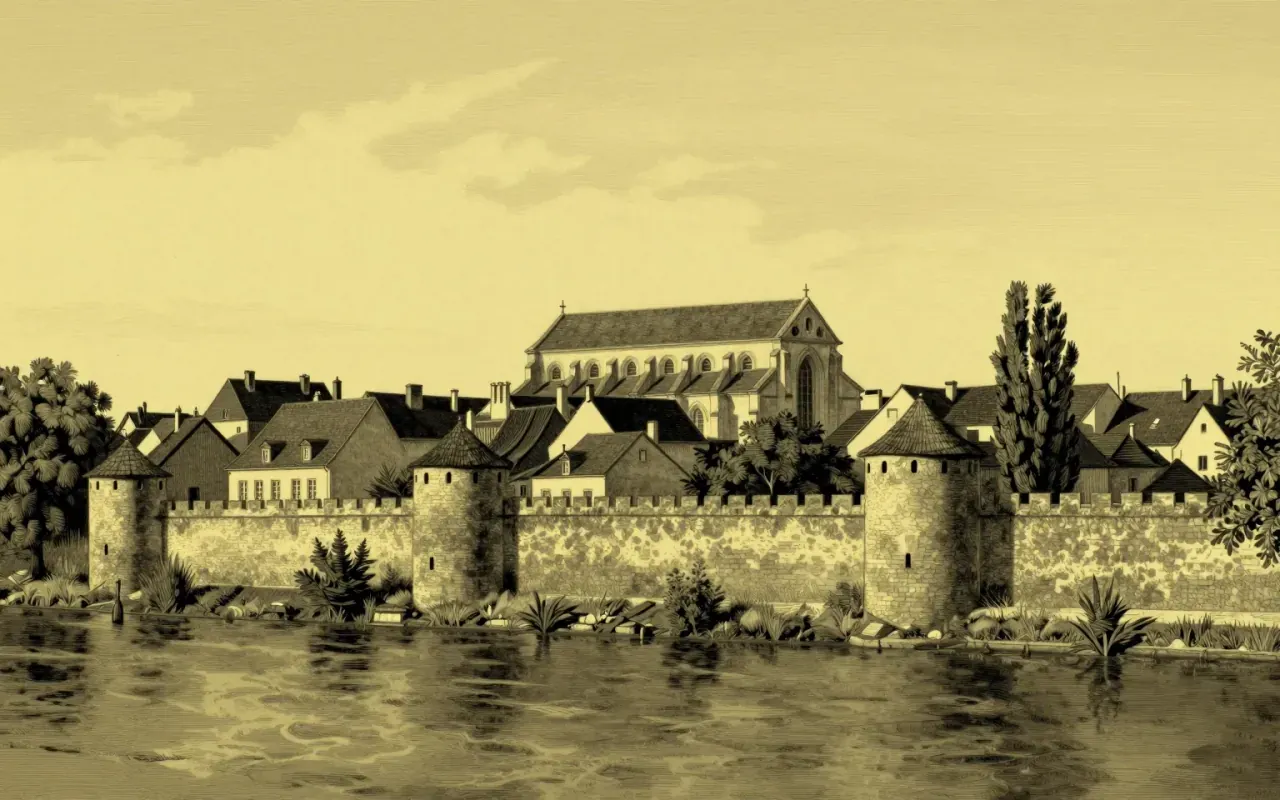
Security guarantees under the edict took a distinctly military form. Huguenots retained control of fortified strongholds, most notably La Rochelle, whose garrison cost an estimated 180,000 écus annually to maintain, alongside a further 150 emergency forts kept at Protestant expense rather than the crown’s. These provisions, sometimes described as creating a state within the state, reflected the reality that a purely legal guarantee of toleration carried little weight without the physical means to resist renewed persecution if royal policy shifted again. The military brevets underpinning these arrangements were renewed in 1606 and 1611, but were reduced by degrees over subsequent years as the monarchy’s own authority and confidence recovered, quietly eroding one of the edict’s most concrete protections well before its formal revocation.
Parlements dragged their feet for years
Formal signature by the king did not guarantee smooth implementation. Provincial parlements, the regional courts responsible for registering royal edicts before they carried full legal force, resisted the settlement in practice even where they could not openly defy the king. The Parlement of Paris delayed registration for ten months before finally recording the edict in 1599, and the Parlement of Rouen did not fully accept its terms until 1609, more than a decade after Henry had signed it. This slow, uneven implementation across different regions of France illustrates how much local institutional resistance a royal edict could face even when issued by a reigning monarch determined to see it enforced, and it foreshadowed the fragility of the settlement over the longer term.
Revoked by the grandson, reversed a century later
Henry IV was assassinated on 14 May 1610, and the religious settlement he had built outlived him by a further seventy-five years before his grandson, Louis XIV, revoked it outright through the Edict of Fontainebleau in October 1685, declaring Protestantism illegal across France. Protestant ministers were given a fortnight to convert or leave the country, while ordinary Protestants faced a formal ban on emigration alongside intensified persecution, including documented use of torture, despite that ban. An estimated 400,000 Huguenots nonetheless fled France for Britain, the Dutch Republic, Prussia, Switzerland, and parts of North America and southern Africa, a loss of skilled labour to rival Protestant states that France would not attempt to reverse in law until Louis XVI’s Edict of Versailles restored religious freedom on 7 November 1787.