Four days of queuing, one new electorate
Between 26 and 29 April 1994, South Africa held its first election open to citizens of every race, choosing a 400-seat National Assembly by proportional representation. The African National Congress won 12,237,655 votes, 62.65 percent, and 252 seats; the National Party took just over 20 percent and 82 seats; the Inkatha Freedom Party won just over 10 percent and 43 seats. Nearly 19.7 million votes were counted, with a further 193,081 rejected as invalid. The Assembly’s first act was to elect Nelson Mandela president, and he was inaugurated on 10 May 1994, at 75 the country’s first black head of state after 27 years in prison.
A count nobody could fully verify
Much of what is known about how the count actually worked comes from Steven Friedman, who headed the Independent Electoral Commission’s information analysis unit during the vote and wrote about it afterward, including in a twentieth-anniversary retrospective. He described the exercise as a technical disaster salvaged as a political triumph, and said the absence of a reliable voters’ roll made it impossible to verify results with confidence. That account, from an official embedded in the counting process rather than an outside observer, is the main source for the claim that the announced results reflected negotiation among parties as much as a precise tally of ballots, a detail rarely mentioned in accounts that focus only on the outcome.
Four years of talks, massacres and walkouts
The election followed four years of negotiation that began after F.W. de Klerk unbanned the ANC in February 1990 and released Mandela from Victor Verster Prison later that month. Talks proceeded unevenly: a 1992 referendum among white voters endorsed continuing the process, but the multiparty CODESA talks collapsed the same year over constitutional deadlock, and negotiations were twice suspended after mass killings, at Boipatong in June 1992 and Bisho in September 1992. A further Multiparty Negotiating Process resumed in 1993 and set the election date. Inkatha, boycotting until the last moment, agreed to take part only on 19 April 1994, forcing stickers to be added to ballots already printed for the vote eight days later.
How clean was the count, and did it matter
What remains disputed is how literally to take Friedman’s account of the count. He suggested the final results, which gave Inkatha control of KwaZulu-Natal, kept the National Party just above a fifth of the vote with a guaranteed deputy presidency, and denied the ANC the two-thirds majority it would have needed to write a constitution unilaterally, were closer to a negotiated settlement than an exact record of votes cast. He also argued that outcome helped avert wider violence. Because the underlying ballots were never independently reverified, historians are left weighing an insider’s testimony about irregularity against an official result that has stood, unchallenged in court, for three decades.
A shared government nobody had governed under before
The immediate effect was to end apartheid’s herrenvolk democracy, in which only white South Africans had held full political rights, and to replace it with universal adult suffrage. Because the interim constitution required any government to include parties that won enough votes, the ANC’s short-of-two-thirds result produced a Government of National Unity, in which Mandela served as president alongside de Klerk and Thabo Mbeki as deputy presidents, and the National Party and Inkatha held cabinet seats. This forced power-sharing shaped the drafting of South Africa’s permanent constitution over the following two years. The election date, 27 April, was later declared a public holiday, Freedom Day, commemorating the transition each year.
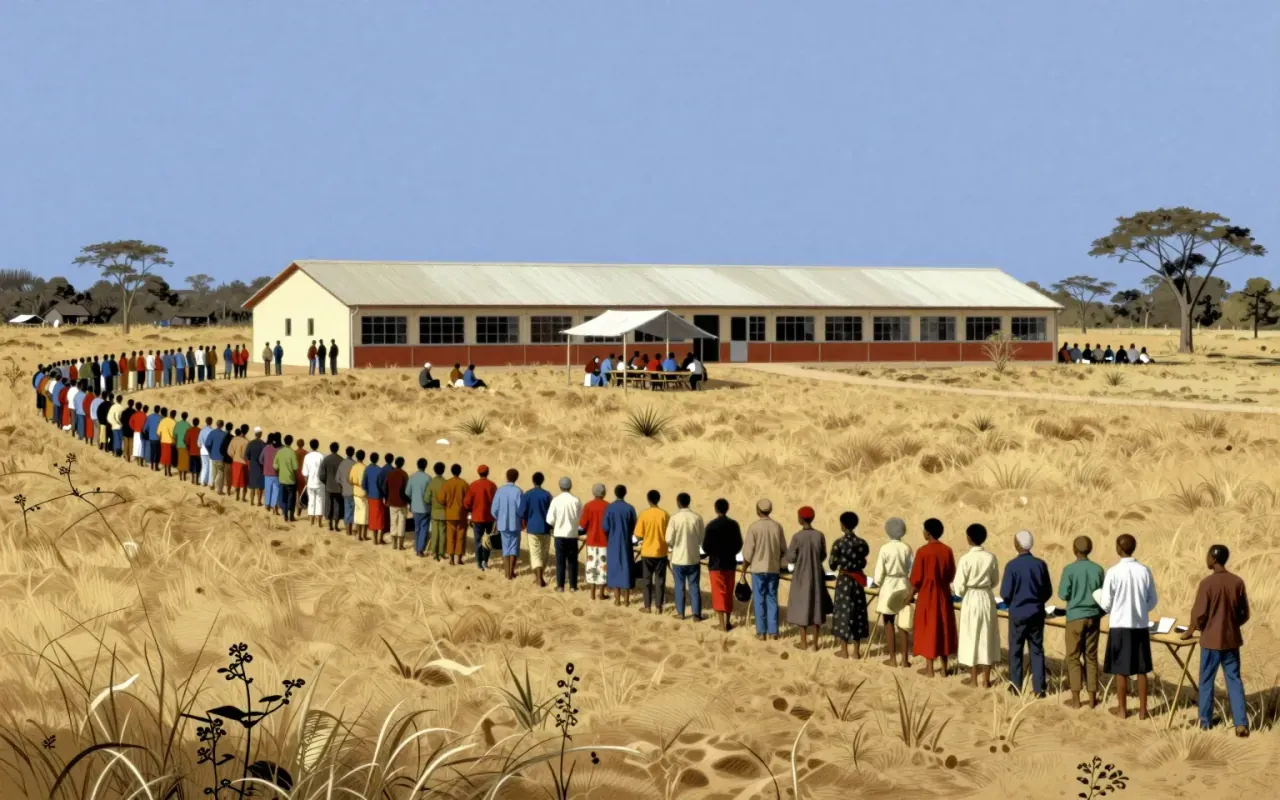
A vote worth understanding beyond the photograph of the queues
The election is worth studying past its familiar photographs of long, patient queues, because the more interesting story sits in what those queues fed into: an administrative process that, by the testimony of the person who oversaw its data, could not fully guarantee its own accuracy, and a result shaped as much by prior negotiation as by ballots. That does not diminish what the vote achieved, ending centuries of minority rule and installing Mandela as president, but it complicates the idea of a perfectly clean democratic birth. Readers drawn to how fragile transitions actually get built, rather than how they are remembered, will find this one repays a closer look.