Drought meets stripped-out soil
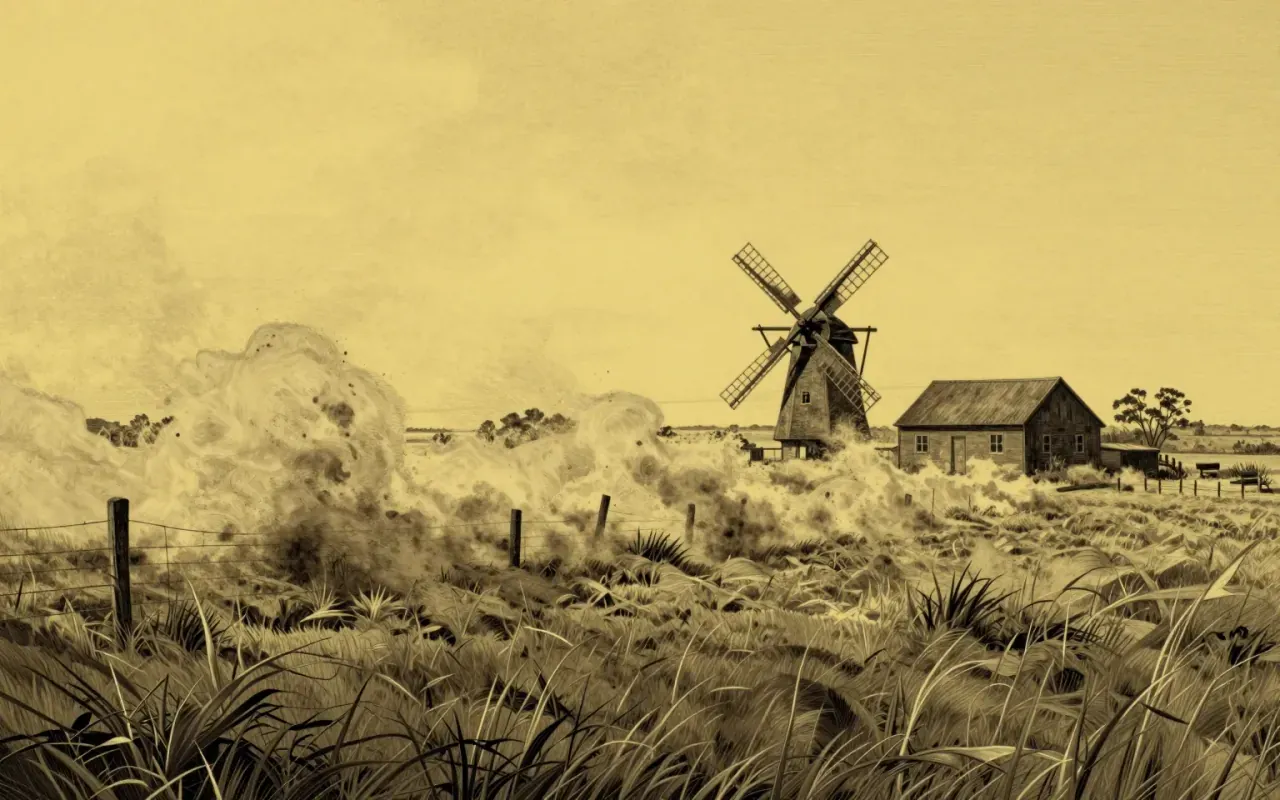
The Great Plains entered an unusually dry period in the summer of 1930, and the first major dust storm was recorded that September, but conditions worsened considerably over the following years, with a severe two-day storm in May 1934 carrying dust as far as Chicago. The most extreme single event, remembered as Black Sunday, struck on 14 April 1935, when a cold front moving down from Canada whipped up enormous walls of dust at speeds around sixty miles an hour. Drought persisted in three separate waves through the decade before ending with a return of regular rainfall in the autumn of 1939, with substantial recovery rains following in 1941.
Black Sunday, April 1935
The period left an unusually rich documentary and cultural record, partly because the federal government deliberately commissioned it: the Farm Security Administration hired photographers, including Dorothea Lange, whose images of displaced farm families became some of the era’s defining visual documents. Literary accounts followed closely behind, most famously John Steinbeck’s The Grapes of Wrath, alongside Sanora Babb’s less widely known contemporary novel and Woody Guthrie’s recorded ballads, together creating a cultural record that has shaped public memory of the decade at least as strongly as the government’s own statistical and agricultural data.
A federal response built on soil science
The disaster resulted from a combination of natural and human factors reinforcing each other: severe multi-year drought coincided with decades of deep plowing that had destroyed the native grasses which once held Great Plains topsoil in place, while the conversion of grassland to cropland without dryland farming methods, along with practices like leaving fields bare through the peak wind season and burning crop stubble, stripped the soil of the organic material and vegetation that might otherwise have limited erosion. Mechanised farming had also encouraged expansion into marginal, more arid land less suited to the intensive cultivation being applied to it.
Measurable results by decade’s end
Historians have long debated what lesson the Dust Bowl actually teaches: Donald Worster argued that later twentieth-century agribusiness repeated the same unsustainable, technology-dependent farming errors that produced the original disaster, while Mathew Bonnifield instead read the period as a demonstration of human endurance and capacity to overcome hardship. A more recent and more empirical dispute concerns the scale of migration out of the region: research published by Long and Siu in 2018 found that outward migration from Plains states rose only slightly compared with the 1920s, and that population decline in the region resulted primarily from fewer people moving in rather than from the mass exodus long assumed by popular accounts.
An exodus that recent research complicates
The federal response under President Roosevelt established lasting institutions, including a dedicated soil erosion agency created in August 1933 under Harold Ickes and further conservation programmes led by Hugh Hammond Bennett, which promoted techniques such as crop rotation, strip farming, contour plowing and a shelterbelt project that planted more than two hundred million trees from Canada to Texas. These measures reduced blowing soil by roughly sixty-five per cent by 1938, even before drought conditions themselves eased the following year, and established a continuing federal role in land management and soil conservation that persisted well beyond the crisis itself.
A cultural record as vivid as the statistics
This is a rewarding subject specifically because it invites you to hold two things at once: the vivid cultural memory built by photography, fiction and song, and more recent quantitative research that complicates the mass-exodus version of events those cultural works helped fix in the popular imagination. It rewards attention to both the human-caused agricultural failures and the specific, effective policy response that followed. It leaves open, rather than resolves, the larger interpretive question of whether the decade should be read primarily as a warning about unsustainable practice or as a story of successful adaptation.