Revelation, migration, and unification within one lifetime
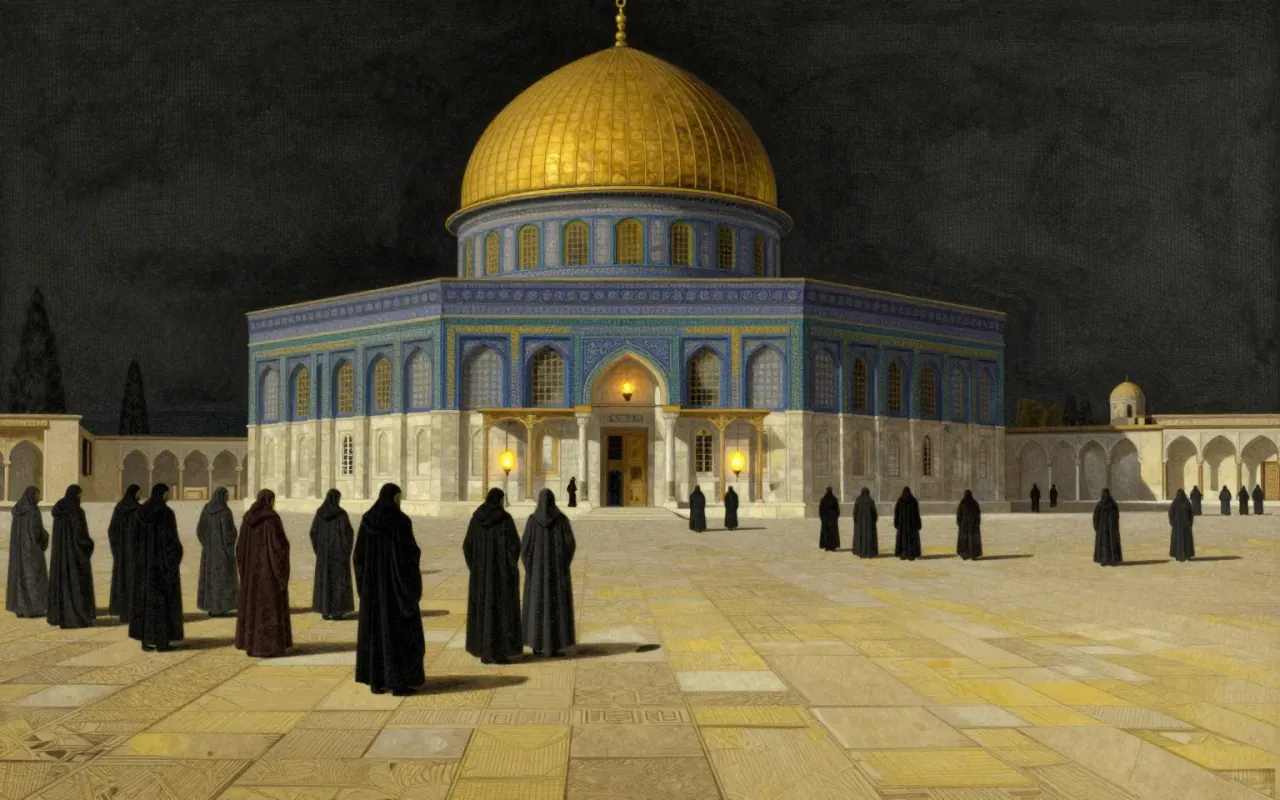
Muhammad was born around 570 in Mecca and, according to Islamic tradition, received his first revelation around 610 at about the age of forty, later reciting further revelations that his followers preserved as the Quran. Facing sustained opposition from Mecca’s ruling clans, he and his followers migrated to the nearby city of Medina in 622, an event that marks the start of the Islamic calendar and that saw him establish a governing community under an agreement known as the Constitution of Medina. Years of intermittent conflict with Mecca ended in 629 when Muhammad took the city with little resistance, and by his death in 632 most of the Arabian Peninsula had come under Muslim rule.
A biography written thirteen decades on
The Quran itself contains comparatively little direct biographical information about Muhammad, and the earliest connected biography, by Ibn Ishaq, was written around 767, roughly a century and a third after Muhammad’s death; the original text does not survive and is known only through later excerpts preserved by other writers. Hadith collections, recording Muhammad’s sayings and actions, were likewise compiled generations after his lifetime, and their compilers developed elaborate systems for ranking the reliability of the chains of transmission behind each report. Historian John Burton has summed up the resulting evidentiary gap by noting that little of documented use to a historian survives from Muhammad’s early life beyond confirming that he existed, leaving a long interval between the events and their written record.
Persuasion, pressure, and outright conquest
Muhammad’s growing following in Mecca drew initial support from women, freed slaves and lower-status members of society, and provoked organised opposition from the city’s established clans, who imposed a boycott on Muhammad’s own clan and, according to tradition, physically threatened him when he sought support elsewhere. After the migration to Medina, expansion proceeded through a mixture of alliance-building, negotiated agreements and military conflict with Mecca and other Arabian groups over roughly eight years, culminating in the largely unopposed capture of Mecca in 629. Beyond Muhammad’s own lifetime, further Muslim conquests under his immediate successors spread Islamic rule rapidly across a much wider area, though historians note that within these newly conquered regions, conversion of local populations generally proceeded gradually over subsequent generations rather than immediately.
What the hadith debate is actually about
Historians distinguish sharply between the historicity of Muhammad’s life and the reliability of specific hadith reports about him, since many hadith were compiled long after his death and, in the assessment of a number of Western scholars, some were composed specifically to support later theological or legal disputes rather than to preserve genuine memory. Muslim scholarly tradition developed its own rigorous methods for assessing transmission chains and generally places greater confidence in properly authenticated hadith than in the biographical, or sira, literature. A related and long-debated episode is the so-called Satanic Verses incident, reported by early biographers but rejected by Muslim scholars by the twentieth century, on which contemporary Western academic opinion remains divided rather than settled.
From one peninsula to a fast-growing caliphate
Historians dispute how far early Muslim expansion depended on force as opposed to voluntary conversion, with the historian Richard Bulliet specifically rejecting the popular characterisation of the process as conversion by the sword; documented exceptions, such as the forced conversion of the Samaritans, are treated as departures from a more typical pattern rather than the norm. Following Muhammad’s death, the Rashidun and then Umayyad caliphates extended Muslim political control rapidly across the Middle East, North Africa and into Spain, even though the sources indicate that the Muslim share of the population in many of these regions, including Iran, Iraq, Syria, Egypt and Spain, remained under ten per cent well into the Umayyad period.
A founding story worth reading for its sourcing problem
The birth of Islam is a case where the religious and political story is comparatively well outlined but the documentary basis for the human details is unusually thin and unusually late, which makes the historiography as important as the narrative itself. Readers interested in religious history will find a genuinely significant seventh-century transformation of Arabian society and politics; readers interested in how religious traditions construct biography over time will find, in the century-plus gap before Ibn Ishaq’s account and in the ongoing hadith debates, one of the clearer examples available of how source distance shapes what can be claimed with confidence.