A goldsmith’s secret project
Johannes Gutenberg was born in Mainz sometime between the 1390s and 1406, with historians conventionally settling on 1400 for convenience given the lack of a precise record, to a family split between a patrician merchant father and a mother of lower social standing. By the mid-1430s he was working as a goldsmith in Strasbourg, and by around 1440 he had begun developing, in some secrecy, the system of movable-type printing that would define his later reputation. He returned to Mainz by 1448, borrowed heavily from the financier Johann Fust to fund the venture, and completed his most famous work, a 42-line Bible, around 1455, selling copies for a price equivalent to roughly three years of a clerk’s wages. A lawsuit brought by Fust the following year stripped Gutenberg of control over his own workshop, and he died in 1468, his grave now lost.
A life documented mostly by a lawsuit
No document survives from Gutenberg’s childhood or youth, and biographers have long noted that entire decades of his life pass without a single surviving record to fill them. What is known in real detail comes chiefly from legal papers connected to his 1456 dispute with Fust, which describe an earlier partnership over what the documents call the project of the books and record Fust’s accusation that Gutenberg had diverted invested funds to other purposes. Because none of his printed work carries his name or a date, attributing specific books to him depends on typographical analysis and external references rather than direct evidence, and the familiar image of Gutenberg himself, first appearing in print a century after his death, is understood to be an imagined likeness rather than an actual portrait.
Reusable letters, a lucrative first customer
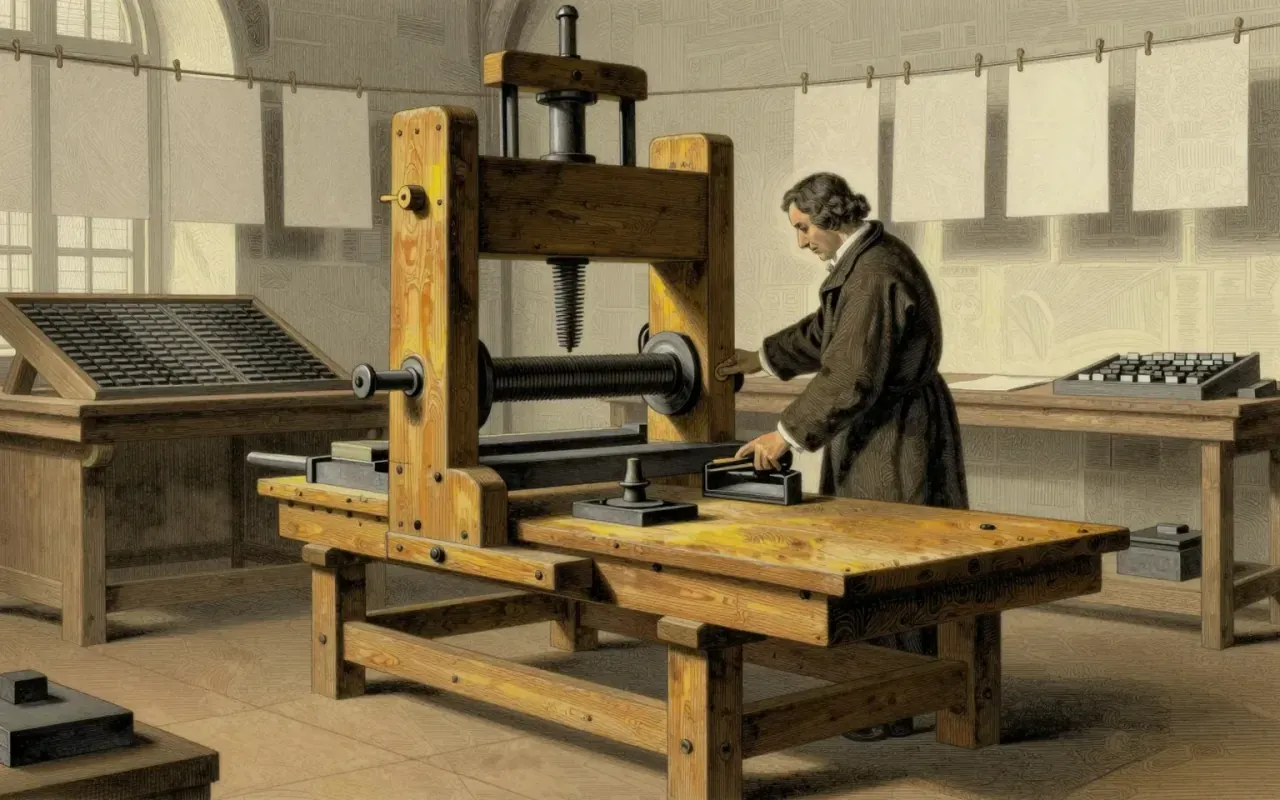
Gutenberg’s technical achievement combined several existing elements, a wine-press design adapted for printing, a durable alloy of lead, tin and antimony that cast quickly into type, and an oil-based ink suited to metal rather than wood, into a single working system capable of reproducing text far faster than hand-copying could. His reasoning, so far as it can be reconstructed from the physical evidence rather than any surviving explanation of his own, seems to have been aimed squarely at economic advantage: reusable type let a single set of letters print an unlimited number of pages, and a large religious market, above all demand for Bibles, gave the invention an obvious and lucrative first application once it worked reliably enough to sell.
A method still being reverse-engineered
Even Gutenberg’s exact method remains debated: a 2001 digital analysis of surviving type from his Bible found irregularities that seem inconsistent with the standardised punch-and-matrix casting technique later associated with printing, leading its authors to propose he may have used a cruder, one-off mould for each letter rather than a single reusable template, a genuinely more primitive approach than long assumed. Whether Gutenberg lost control of his business through simple financial overreach or through some deliberate manoeuvre by Fust to seize a working invention once it proved viable is also argued over, since the surviving lawsuit records Fust’s version of events rather than an independent account. A once-popular story crediting a rival Dutch printer with the invention instead of Gutenberg is now generally regarded by historians as legend, unsupported by any securely dated evidence earlier than his own work.
Credit that arrived after his death
Printing spread from Gutenberg’s Mainz workshop to well over a hundred European cities within about forty years, and the technology is now generally credited as a necessary condition for the scale and speed of later developments including the Reformation and the wider spread of Renaissance learning, even though historians increasingly treat it as one contributing factor among several rather than a sole cause. Gutenberg himself received a modest court pension from the Archbishop of Mainz in 1465, a rare formal acknowledgement in his own lifetime, but he died three years later without significant wealth or the personal fame the invention would eventually bring him, since his own name appeared on none of the books that made the technology’s reputation.
An inventor known mainly through his debts
Gutenberg is worth attention for how completely the scale of his invention’s later consequences outstrips the surviving evidence of his own life: no personal writing, no dated books under his name, and a biography reconstructed largely from a lawsuit over unpaid debts. Readers interested in how quickly a single technical innovation can reorganise how information moves through a society will find the wider story of the press’s spread genuinely rewarding to follow. Readers hoping for a well-documented personal account of Gutenberg’s own reasoning, ambitions or working method will come away disappointed, since almost everything about him beyond the technology itself remains inference rather than record.