A customs union first, three wars after
Economic integration among German states began well before political unification, through the Prussian-led customs union, or Zollverein, established in 1818 and expanded over subsequent decades, alongside a rapidly growing railway network from the 1830s that connected previously isolated regions. Political unification followed through three wars directed chiefly by the Prussian minister-president Otto von Bismarck: the Second Schleswig War against Denmark in 1864, the Austro-Prussian War of 1866, which excluded Austria from the resulting German Confederation, and the Franco-Prussian War of 1870 and 1871, after which the German Empire was proclaimed on 18 January 1871, with the Prussian king Wilhelm I as its first emperor.
Treaties, constitutions, and Bismarck’s own words on blood and iron
The documentary record for unification includes the 1866 treaty establishing the North German Confederation, the 1871 constitution of the new German Empire, and the Treaty of Frankfurt formalising French recognition after defeat, alongside contemporary writings by figures including the philosopher Johann Gottlieb Fichte, whose earlier arguments for German linguistic and cultural unity fed into later nationalist thinking. Bismarck’s own September 1862 statement that the great questions of the age would be resolved not by speeches or majority votes but by iron and blood is frequently cited as capturing the pragmatic, force-oriented approach that shaped his subsequent policy.
Denmark, then Austria, then France: three wars in seven years
The Austro-Prussian War of 1866 settled what historians call the German dualism question in favour of a smaller Germany excluding multi-ethnic Austria, formalised through the Peace of Prague and the establishment of the North German Confederation under Prussian leadership. The Franco-Prussian War of 1870 to 1871 then brought the remaining southern German states into the unified structure, driven partly by shared nationalist sentiment mobilised against France and resulting in the annexation of Alsace-Lorraine, a territorial acquisition that left a lasting grievance in French politics for decades afterward. Together the two wars settled within seven years both of the major questions, exclusion of Austria and inclusion of the south, that had frustrated earlier nineteenth-century attempts at German political unity.
Master plan or opportunism: the debate over Bismarck’s intentions
Historians dispute how far Bismarck pursued German unification as a deliberate long-term objective from the start of his career as opposed to responding opportunistically to a sequence of separate political and military opportunities that happened, in combination, to produce a unified German state. The available record notes explicitly that factors other than Bismarck’s own strategic calculation, including existing economic integration through the Zollverein and railway development, contributed to reorganising German states’ political, economic, military and diplomatic relationships, complicating any account that credits unification to Bismarck’s design alone. Bismarck’s own later remarks and private correspondence, cited by different historians to support opposite readings, have done little to settle the question either way.
An empire proclaimed in a French palace, and the tensions it left behind
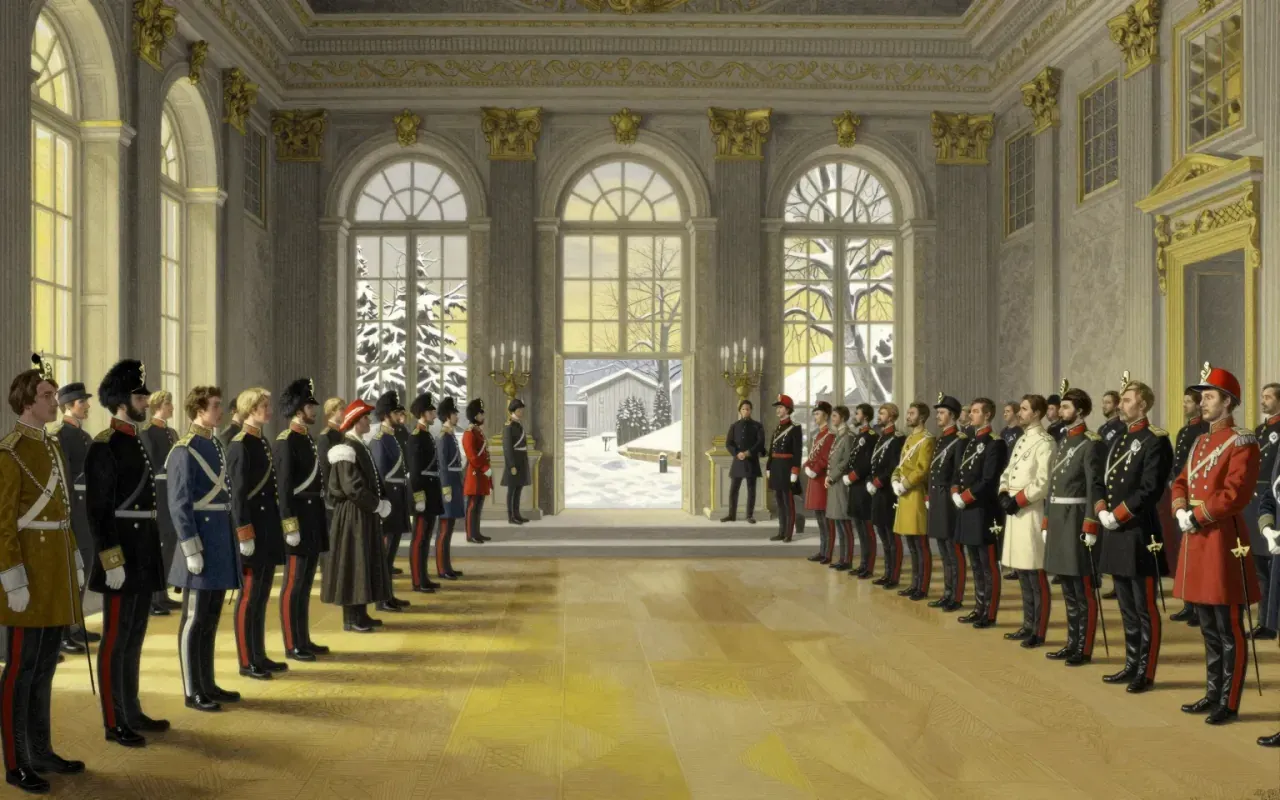
The German Empire was proclaimed in the Hall of Mirrors at the Palace of Versailles on 18 January 1871, a deliberately symbolic setting given the ongoing war with France, and the resulting state combined twenty-five member states under a federal structure in which the Prussian king held the imperial title and Bismarck served simultaneously as Prussian minister-president and imperial chancellor. The new empire’s rise disrupted the existing European balance of power, and historians identify the alliance systems that developed in response, the Franco-Russian Alliance of 1894 and the Anglo-German naval race that began in the late 1890s among them, as preconditions that contributed directly to the tensions culminating in the First World War.
A unification worth reading for its disputed motive as much as its outcome
German unification rewards attention chiefly for the unresolved debate over Bismarck’s own motives, since the same three wars can be read either as steps in a coherent long-term strategy or as a sequence of narrower opportunistic decisions that only look coordinated in retrospect. Readers interested in nineteenth-century diplomacy and military strategy will find in the Danish, Austrian and French wars a clearly sequenced case study; readers interested in how historical actors’ intentions get reconstructed after the fact will find Bismarck’s unification a genuinely open question rather than a settled biographical fact.