Europe’s map redrawn
Representatives of more than two hundred states and princely houses gathered in Vienna from September 1814, with the main business dominated by Austria’s Klemens von Metternich, Britain’s Viscount Castlereagh, Russia’s Tsar Alexander I, Prussia’s Karl August von Hardenberg, and France’s Talleyrand, representing a defeated power negotiating its own future. Over the following months they redrew the map left by Napoleon’s wars: Russia gained most of the former Duchy of Warsaw, Prussia took territory in Saxony and along the Rhine, Austria recovered Italian and Alpine territory, and the roughly three hundred states of the old Holy Roman Empire were consolidated into a thirty-nine-member German Confederation. The Final Act was signed on 9 June 1815, nine days before Napoleon’s defeat at Waterloo.
Minutes behind the ballrooms
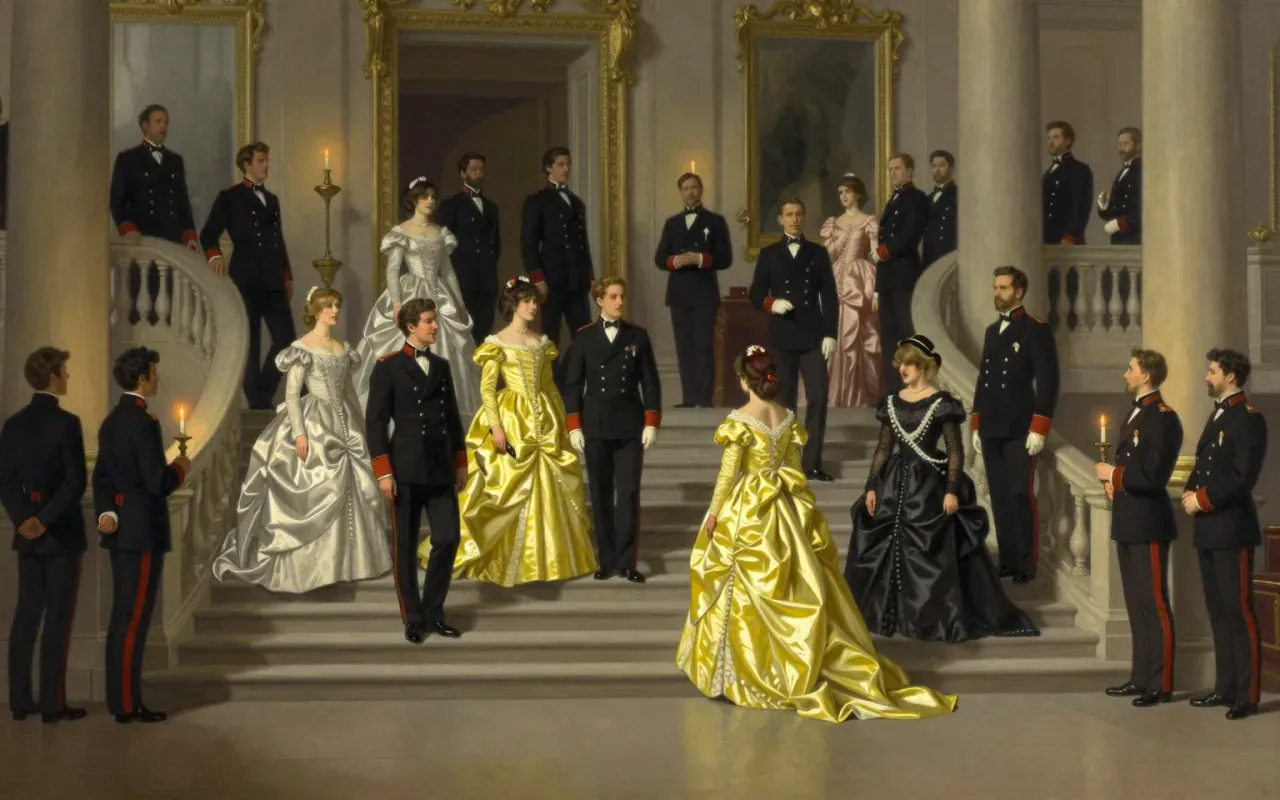
The congress’s formal decisions survive in a clear documentary record, the Final Act and the various bilateral treaties that fed into it, but a great deal of the actual negotiating happened away from any minute-taker, in the salons, banquets, and balls that gave the gathering its reputation as the dancing congress. Contemporaries and later historians alike treat this social dimension as more than decoration: informal conversation at these events is credited with smoothing disagreements that might have stalled in formal session, though because so much of that conversation went unrecorded, historians reconstructing the congress’s real turning points rely heavily on the participants’ own letters and memoirs, sources that reflect each writer’s later interests as much as the events themselves.
Balance over borders
The delegates’ guiding principle was preventing any single power, France above all, from dominating the continent again, which shaped territorial decisions more than any consistent concern for the wishes of the populations being reassigned. Belgium was joined to the Netherlands specifically to create a stronger buffer state against France, Prussia was given Rhineland territory partly to keep it engaged in watching France’s western border, and Italy was left divided among several separate rulers rather than unified, since a single strong Italian state fit no one’s balance-of-power calculations. Conservative leaders, Metternich foremost among them, also treated suppressing Bonapartist, liberal, and nationalist movements as inseparable from maintaining that balance.
Peace or suppression
Historians remain divided on how to judge the settlement. Critics, prominent through the nineteenth and twentieth centuries, argue the congress ignored the national and liberal aspirations already stirring across Europe and imposed a stifling conservative order that delayed, rather than resolved, the pressures building toward 1848 and beyond. More recent historians, including Henry Kissinger and Paul Schroeder, argue the settlement created a genuinely stable equilibrium, the first international order built on consensus among great powers rather than raw conflict, crediting it with preventing another general European war for roughly a century. Both positions rest on the same set of facts; they differ on whether stability purchased through suppression counts as a success or simply as a postponed reckoning.
A war resumed mid-conference
The negotiations were not conducted in a vacuum: Napoleon escaped his exile on Elba in March 1815 and returned to power in France for the period historians call the Hundred Days, resuming the war the congress had been convened to settle the aftermath of. Remarkably, the Vienna negotiations continued largely unaffected by this development, with the delegates completing and signing the Final Act on 9 June while Napoleon’s renewed campaign was still underway, only days before his final defeat at Waterloo. That the settlement’s central territorial and diplomatic bargains were finished before, rather than after, Napoleon’s last defeat says something about how independent the diplomatic process had become from the immediate military situation.
A century measured against 1914
Whether the Congress of Vienna deserves its reputation depends heavily on the time frame a reader applies to it: judged against the aim of avoiding a war on the scale of the Napoleonic conflicts, it succeeded for roughly a century, until 1914; judged against the liberal and nationalist movements it deliberately worked to contain, it produced decades of suppressed unrest that erupted repeatedly, in 1830 and again more broadly in 1848. The material is worth the time particularly for how openly it shows great powers trading territory and populations to serve a balance-of-power logic that had little regard for the people being traded, a pattern that recurs often enough in later diplomatic history to make this an instructive early case.