A disputed succession and a humiliating vassalage
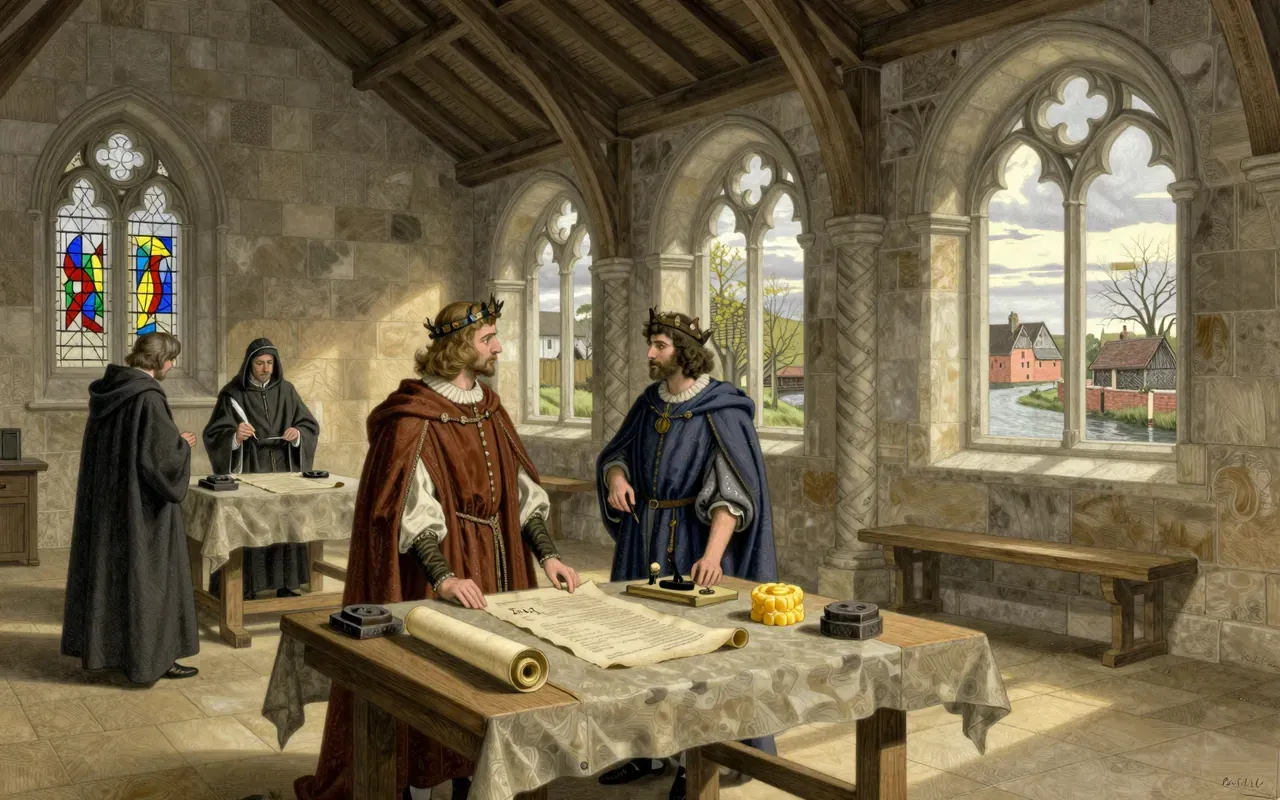
The war’s dynastic trigger came in 1328, when Charles IV of France died without a son and the French nobility, invoking the principle that a woman could not transmit a claim she did not hold herself, passed the crown to Philip of Valois rather than to Edward III of England, whose claim ran through his French mother. Underlying territorial friction, over the English-held duchy of Aquitaine, for which the English king was technically a vassal of the French crown, sharpened this dispute into open war from 1337. Fighting continued intermittently for over a century, through English victories at Crécy in 1346 and Agincourt in 1415, French recovery under Charles V and later Charles VII, and Joan of Arc’s intervention at Orléans in 1429, before a French victory at Castillon in 1453 ended the conflict with England retaining only the port of Calais on the continent.
Froissart’s chronicle and its taste for chivalric drama
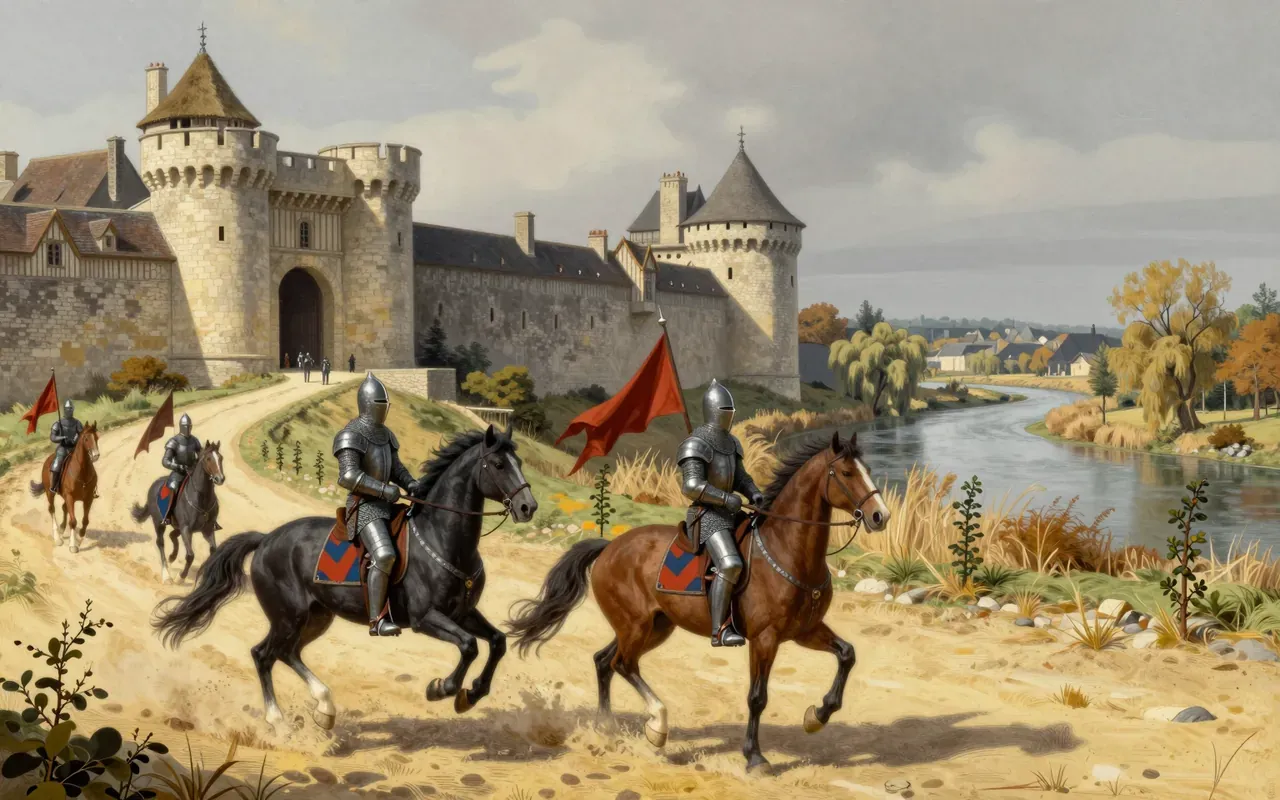
The chronicler Jean Froissart, writing during and shortly after much of the conflict, provides the fullest contemporary narrative of its middle decades, describing battles and the conduct of knights in vivid detail. Modern historians treat his work as valuable for atmosphere and general sequence but note that his evident interest in chivalric spectacle sometimes took priority over strict factual accuracy, particularly around numbers and the precise conduct of specific engagements. Other evidence, administrative and financial records on both sides, supplements and sometimes corrects the chronicle tradition, especially regarding the war’s economic burden, which fell heavily on both French and English populations through taxation and requisition over more than a century of intermittent campaigning.
Longbows, sieges, and three distinct phases
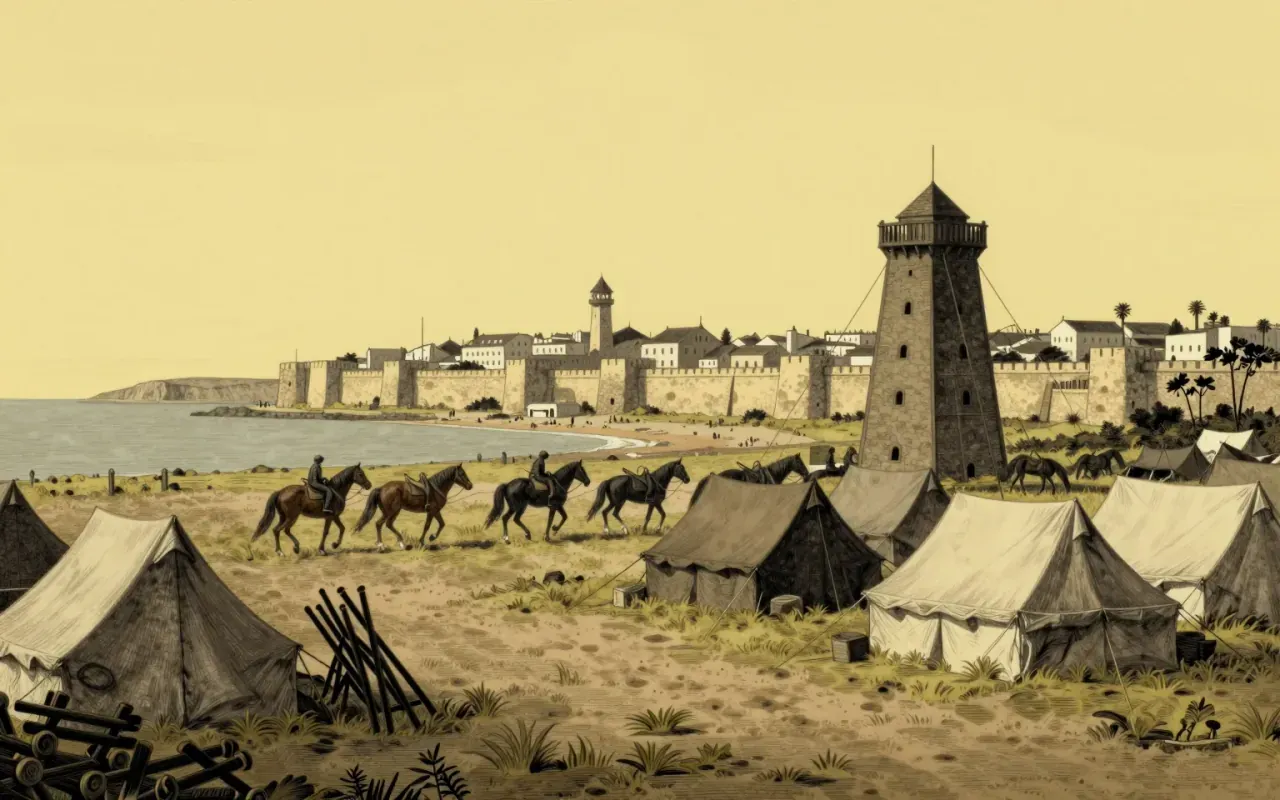
Historians generally divide the war into three main phases: an Edwardian phase from 1337 to 1360, featuring the longbow-driven English victories at Crécy and Poitiers and ending with a negotiated peace that left England substantial continental territory; a Caroline phase from 1369 to 1389, in which French forces under Bertrand du Guesclin steadily reduced English holdings to a handful of coastal towns; and a Lancastrian phase from 1415 to 1453, opening with Henry V’s victory at Agincourt and closing with the French recovery completed after the siege of Orléans and the eventual English defeat at Castillon. Across these phases the war saw a shift from armies built around feudal knightly service toward more professional forces using longbows and, in the later stages, early artillery.
Why the war is still argued over as much dynastic as national
Because the conflict began as a dispute over royal succession and feudal obligation rather than as a war between two settled nation-states in the modern sense, historians caution against reading back a fully formed sense of French or English nationalism onto its early decades. Modern scholarship instead tends to describe national identity as something the war itself helped generate over its long course, particularly in France, where the shared experience of invasion and eventual recovery, reinforced by figures such as Joan of Arc, contributed to a stronger sense of unified national identity than had existed at the war’s start. The extent to which economic strain, rather than dynastic ambition, drove the war’s persistence over so many decades is also a subject of ongoing historical argument.
Standing armies replace feudal levies
By the war’s end, both kingdoms had moved decisively away from armies raised through feudal obligation and toward standing forces of paid professional soldiers, a shift accelerated by the tactical value shown by disciplined longbow units and by the growing use of artillery in siege warfare. In France, the war’s demands contributed to a stronger and more centralised royal administration, capable of raising and financing large forces on a more permanent basis, while in England the financial exhaustion of the war’s final decades is linked by historians to the internal instability that erupted shortly afterward in the Wars of the Roses. England’s loss of nearly all its continental territory also redirected English ambitions toward maritime rather than continental expansion in the following century.
A long war worth reading for what it changed at home
The Hundred Years’ War rewards attention less for any single battle than for the institutional transformation it produced on both sides of the Channel, the move from feudal levies to professional armies, and from loosely unified medieval kingdoms toward more centralised states with a stronger sense of national identity. Readers drawn to military history will find genuinely consequential tactical innovation in the longbow campaigns; readers more interested in political history will find a slow-motion case study in how a century of intermittent war can reshape the governing structures of the states fighting it, well beyond whatever the original succession dispute was actually about.