A blight, then a catastrophe
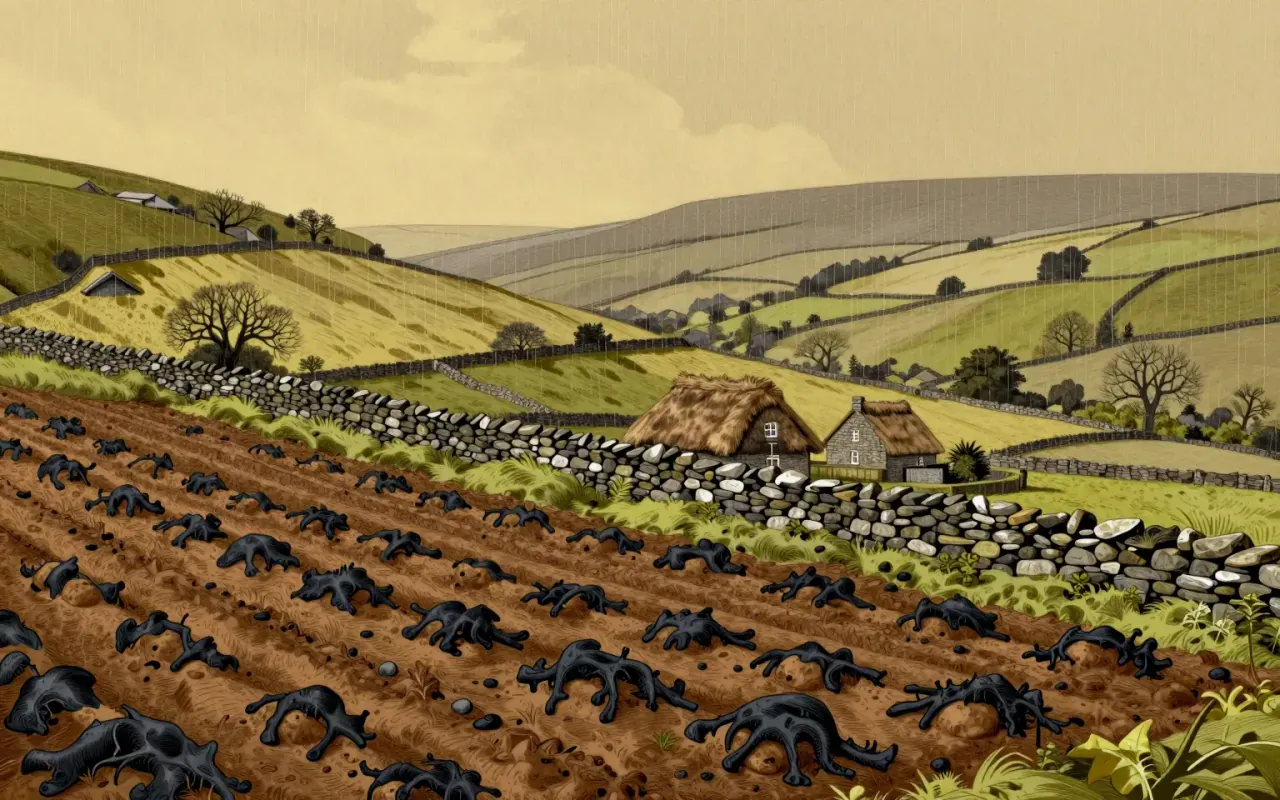
A potato blight, likely arriving from the Americas, reached Ireland in September 1845 and destroyed between a third and a half of that year’s crop; the following year was far worse, wiping out roughly three-quarters of the harvest. Ireland’s rural population had grown to around eight and a half million people by 1845, heavily dependent on the potato because decades of subdivided tenancies had left many families farming just a few acres, too little to grow anything but the crop that produced the most food per acre. The resulting famine, running roughly from 1845 to 1852, killed approximately a million people and drove more than two million others to emigrate, permanently altering Ireland’s population and its relationship with Britain.
Numbers nobody can fix precisely
Because no comprehensive famine-era census tracked deaths as they happened, the toll is reconstructed afterward from population figures before and after the crisis, parish and workhouse records, and emigration statistics, which is why historians give a range, commonly cited around a million deaths, rather than a precise count. Some localities show population drops of as much as two-thirds by later count, a scale that makes the aggregate national figure feel almost conservative in places. Contemporary reporting, including a widely quoted description by the historian Cecil Woodham-Smith of food leaving Ireland while people starved, and the Devon Commission’s own 1843 finding that many labourers’ entire diet was potatoes and water, form much of the documentary basis for reconstructing conditions on the ground.
A monoculture built by rent pressure
The famine’s severity reflected structural pressures that predated the blight by decades. Absentee landlordism drained an estimated six million pounds a year in rent out of Ireland even before the crisis, and a middleman system between landlords and tenants encouraged harsh treatment of smallholders already living close to subsistence. Population growth from roughly two million around 1700 to eight and a half million by 1845 had forced continual subdivision of farms, so that by the mid-1840s a large share of tenant holdings were under five acres, too small to grow the more resilient grain crops that might have provided a backup when the potato failed, a vulnerability built into the land system long before the blight arrived.
Policy failure or worse
The central historiographical argument concerns how to characterise the British government’s response once the crisis was underway. One line of interpretation treats the government’s shift toward laissez-faire relief, minimal intervention on the theory that markets would correct the shortage, as a genuine, if catastrophic, policy failure rooted in the economic orthodoxy of the time, embodied in officials like Charles Trevelyan who believed private enterprise would suffice. A harsher line, associated with nationalist historiography going back to the writer John Mitchel’s 1861 claim that the blight came from nature but the famine came from England, treats the response as closer to deliberate neglect or worse, a disagreement the article itself frames as an open, unresolved genocide question rather than a settled matter.
Grain leaving as people starved
Whichever framing a reader favours, the specific fact both sides work from is that food, including grain, continued to leave Ireland for export during the worst famine years, a policy consistent with free-trade principles the government was reluctant to override even as mortality rose. Later relief measures, including a controversial provision known as the Gregory clause that denied assistance to anyone holding more than a quarter acre of land, are described by the historian James Donnelly as functioning in practice as an instrument that helped cause death rather than prevent it, since it forced starving families to give up what little land they had to qualify for aid at all.
A diaspora that reshaped two continents
The famine’s demographic effect outlasted the crisis itself: Ireland’s population continued falling for a century afterward, and the emigration it triggered, at least a million people between 1845 and 1855 alone, sent hundreds of thousands to Britain and close to a million to North America, seeding Irish communities whose descendants, numbering in the tens of millions today, still identify with the famine as a founding event. That combination of a natural pathogen, a land system that had removed any margin for error, and a government response shaped by ideology as much as by the scale of the emergency, makes this a famine worth understanding in full rather than summarising as simple bad luck.