Communes and furnaces
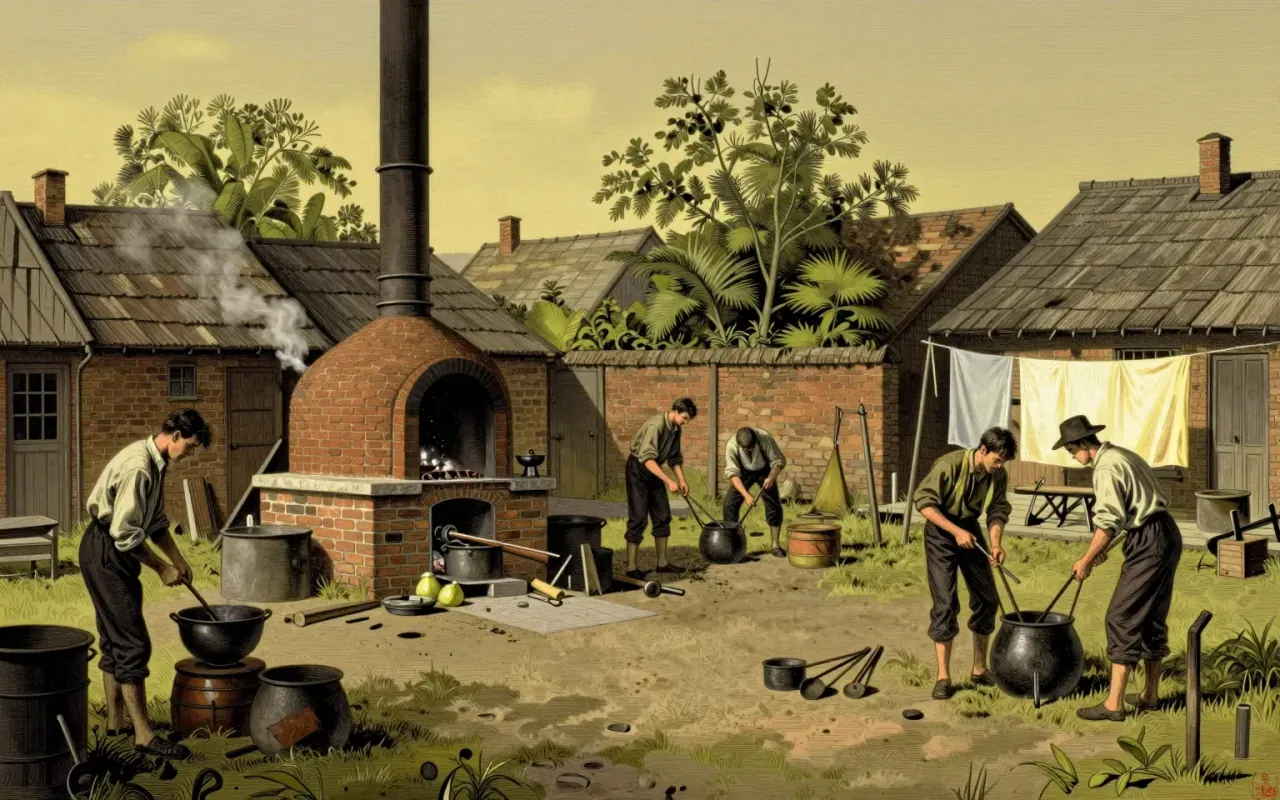
Launched by Mao Zedong in 1958, the Great Leap Forward aimed to push China past Britain’s industrial output within years by merging villages into vast collective communes, roughly twenty-five thousand of them by the end of that year, and by diverting rural labour into steel production and infrastructure projects. Private land ownership was abolished and money wages replaced with communal work points. Steel output figures were reported as doubling within the first year, though a large share of what was produced in improvised village furnaces proved unusable. As agricultural labour was diverted and local officials inflated harvest reports to satisfy targets set from above, food procurement stripped the countryside of grain even as reported production fell. By 1959 a famine had taken hold that lasted through 1961, prompting a policy reversal at the Lushan and later conferences and Mao’s gradual retreat from direct economic management.
Reconstructing a hidden famine
For years after the famine, the Chinese government’s own account, issued through the early 1960s, attributed hardship chiefly to natural disasters and Soviet withdrawal of aid rather than to policy, a framing that discouraged internal investigation and left few contemporaneous outside witnesses to the worst-affected rural areas. Demographers only began reconstructing the scale of excess deaths once national census and population data became available for outside analysis, decades after the events themselves, and economists such as Dwight Perkins and later researchers including Frank Dikötter worked from provincial archives, local records and survivor testimony gathered long after the fact rather than from real-time reporting. The resulting estimates, built from demographic modelling rather than direct body counts, necessarily carry wide margins of error, and the absence of contemporaneous independent journalism inside China means that much of what is known was reconstructed retrospectively rather than observed as it happened.
An incentive to lie
The disaster grew from a chain of political incentives as much as from any single bad decision. Local officials, judged on whether they met targets set by Beijing, had strong reason to overstate harvests, and once inflated figures reached provincial and national planners, state procurement was set against a harvest that existed on paper but not in the fields. Experimental farming techniques promoted nationally, including closer planting and deep ploughing, reduced yields in practice even though they were championed as scientific improvements. Criticism was actively discouraged: when the marshal Peng Dehuai raised concerns about the campaign at the 1959 Lushan conference, he was purged rather than heeded, a signal to other officials that honest reporting carried personal risk. Compounding weather problems, including drought and flooding in some regions, worsened an already deteriorating food supply, but the reporting failures and procurement policy had already set the crisis in motion before the weather turned.
A death toll without consensus
The death toll remains the campaign’s most contested figure, with published estimates ranging from about fifteen million to fifty-five million, most commonly settling around thirty million, a spread that reflects genuine uncertainty in demographic reconstruction rather than simple disagreement over facts. Historians also differ on how to weigh policy failure against environmental factors such as drought, since both clearly contributed but their relative share is difficult to isolate from surviving records. A further dispute concerns responsibility: some accounts stress Mao’s personal insistence on unrealistic targets and his suppression of dissenting officials, while others emphasise a wider system of provincial cadres competing to please superiors, arguing that blame concentrated solely on Mao understates how the incentive structure operated throughout the bureaucracy. Some scholars additionally document local officials using violence against those who failed to meet quotas, though how widespread such coercion was, compared with death from hunger alone, remains debated.
Retreat and resentment
The famine forced a retreat from Mao’s direct control of economic policy, as pragmatists including Liu Shaoqi and Deng Xiaoping took over day-to-day management from 1961 onward and reversed the most damaging industrial and agricultural targets, importing grain from Australia and Canada to ease the crisis. Mao’s prestige suffered but he retained ultimate political authority, and his eventual resentment of the pragmatists who had sidelined him fed directly into the Socialist Education Movement and, by 1966, the Cultural Revolution, through which he sought to reassert control. Infrastructure built hastily during the campaign, including numerous dams, later proved unsound, contributing to catastrophic failures such as the 1975 Banqiao Dam collapse. The episode remains widely cited among economists and historians as one of the largest famines in recorded history, and as a case study in how administrative pressure to report success can itself manufacture catastrophic failure.
A hard but necessary case
This is difficult material, and readers should approach it expecting no comfortable resolution: the death toll spans a range wide enough to leave real uncertainty about the scale of one of the twentieth century’s worst catastrophes, and responsibility is distributed across a system rather than resting neatly on one man’s decisions. Its value lies in showing, in unusually stark form, how administrative incentives to report success rather than truth can compound into disaster faster and further than any single bad policy would alone, a mechanism with relevance well beyond China or the 1950s. It is not an easy or a hopeful story, and readers seeking either heroism or a simple villain will not find one. But for anyone trying to understand how planned economies fail, or how political systems suppress the bad news that might have stopped them in time, the episode repays serious attention.