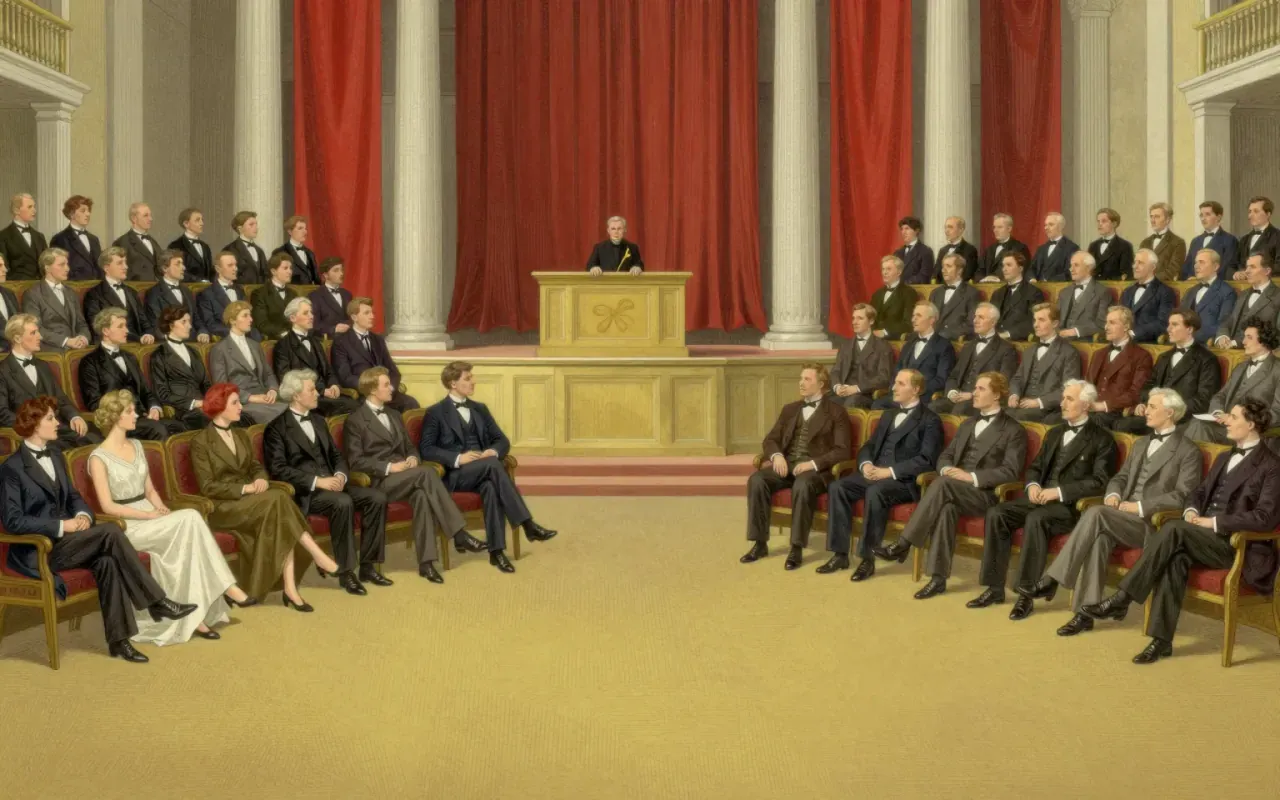
Lenin’s world party
The Communist International was founded at a congress convened in Moscow on 4 March 1919, organised by Vladimir Lenin and the Russian Communist Party in the immediate aftermath of the Bolshevik revolution and amid the continuing Russian Civil War. Its stated purpose was to build what its founders called a world party, a single coordinated international organisation dedicated to spreading communist revolution beyond Russia’s borders and replacing capitalist economic systems with collective ownership. This was a deliberate break from the looser, more federated model of earlier socialist internationals, reflecting Lenin’s conviction that revolutionary movements in different countries needed centralised direction rather than independent coordination if they were to succeed against organised state opposition.
Twenty-one conditions for admission
The organisation’s structure placed real power in a Moscow-based Executive Committee operating between annual world congresses, with Grigory Zinoviev serving as its first president from 1919 to 1926. At the Second World Congress, held in July and August 1920, the Comintern adopted twenty-one conditions for membership, requiring parties seeking to join to expel reformist figures from leadership, adopt strict internal discipline modelled on democratic centralism, build communist cells inside trade unions, and accept binding obedience to future Comintern congress decisions. Parties were also required to adopt the name Communist Party outright. These conditions functioned as a filter, ensuring that member parties abroad would operate more as disciplined branches of a single movement than as independent political organisations merely sympathetic to Bolshevik goals.
A congress where Moscow always had more votes
Soviet dominance within the Comintern was built into its formal structure rather than merely exercised informally. The Russian party held five voting representatives on the Executive Committee, compared with only one apiece for other major national parties, guaranteeing Moscow’s line a structural advantage in any vote regardless of how other delegations aligned. This imbalance became more pronounced, not less, as Stalin consolidated power within the Soviet Union during the mid-1920s, a period the organisation’s own history describes as Bolshevisation, marked by increasing centralisation and tighter Russian control over decisions nominally made by an international body. Stalin’s doctrine of socialism in one country, prioritising the defence of the Soviet state over the pursuit of revolution abroad, further subordinated the Comintern’s stated internationalist mission to specifically Soviet strategic interests.
Bolshevisation under Stalin
That subordination produced consequential policy choices. During what is called the Third Period, from 1928 to 1933, the Comintern directed member parties to treat social democratic parties as a primary enemy, applying the label social fascism to describe them, a sectarian approach that isolated communists from the broader organised labour movement at exactly the moment fascist movements were gaining ground in Germany. This policy has since been assessed as a significant contributing factor to the fractured German left’s failure to mount unified resistance to Hitler’s rise to power. The Comintern reversed course only after Nazi Germany’s ascension, adopting a Popular Front strategy from 1934 that sought broad alliances with socialist and liberal parties against fascism, formally ratified at the Seventh World Congress in July and August 1935.
Calling socialists fascists, then embracing them
The Popular Front era coincided with, rather than prevented, severe internal damage to the organisation itself. During Stalin’s Great Purge in the latter half of the 1930s, many Comintern officials and foreign communists who had relocated to Moscow, often as refugees from persecution in their own countries, were arrested and executed alongside Soviet citizens caught up in the same repression. This meant an organisation ostensibly dedicated to advancing communist movements abroad was simultaneously destroying a significant portion of the experienced foreign personnel it depended on to carry out that mission, a contradiction the historical record does not attempt to reconcile beyond noting that Stalin’s domestic political purges did not stop at the Comintern’s Moscow-based international staff.
Purged, then dissolved
Stalin formally dissolved the Comintern on 15 May 1943, presenting the move as a gesture of goodwill toward his wartime allies, Britain and the United States, at a point in the Second World War when maintaining that alliance mattered more to Soviet strategy than preserving an international revolutionary apparatus that had, by then, become largely an instrument of Soviet foreign policy rather than an independent driver of world revolution. Dissolution did not end Soviet coordination of foreign communist parties outright; successor mechanisms, including the Communist Information Bureau established in 1947, continued similar functions on a smaller scale after the war. The Comintern’s twenty-four-year existence illustrates how an organisation founded on genuinely internationalist premises can be steadily reshaped into an instrument serving the interests of the single state that hosts and funds it.