A flake bitten to test it
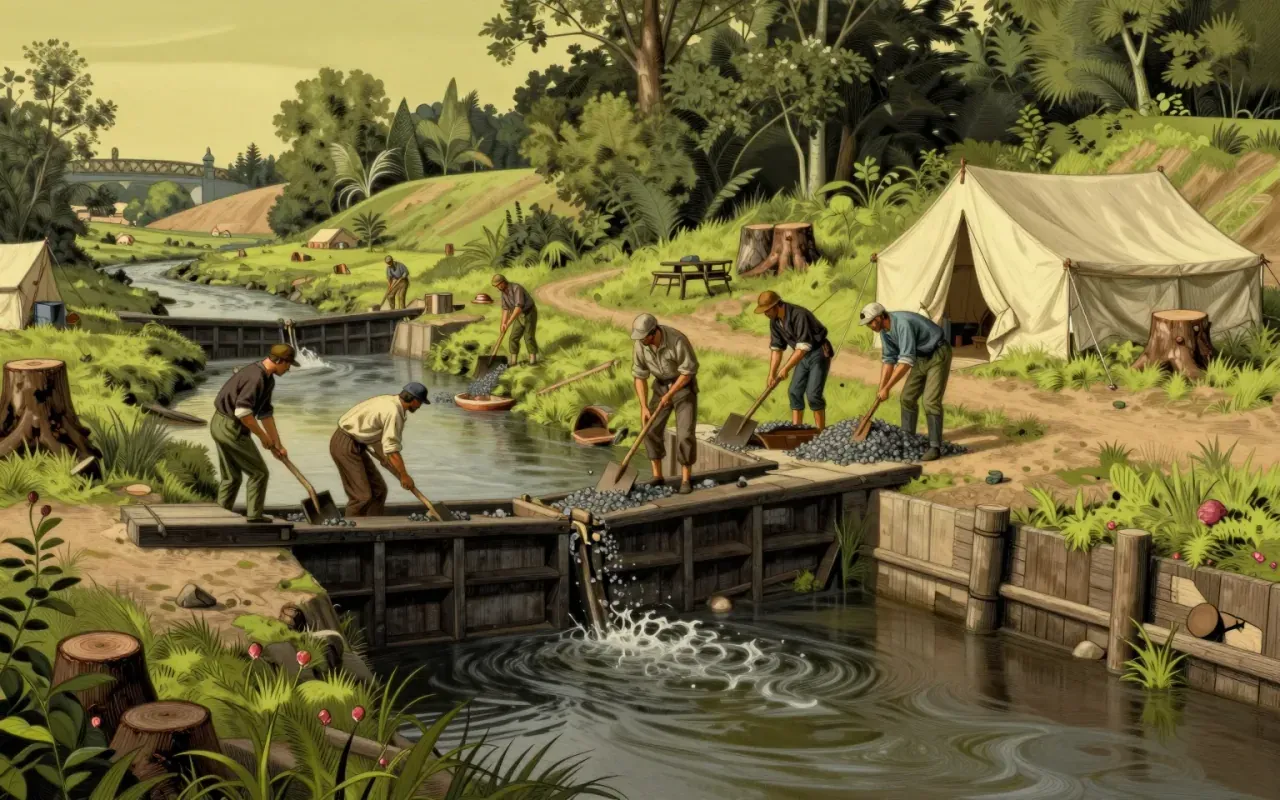
James Marshall, a carpenter overseeing construction of a sawmill for John Sutter, found flakes of gold in the South Fork of the American River on 24 January 1848 and tested the metal the crude way available to him, biting it to check its softness. News spread slowly at first, but a local newspaper publisher and merchant, Samuel Brannan, publicised the find that March, and within a year tens of thousands of prospectors, soon nicknamed forty-niners, were arriving by land and sea. By the time the rush tapered off around 1855, roughly three hundred thousand people had come to California, transforming a sparsely settled territory into a state and drawing an estimated twelve million ounces of gold out of its rivers and hills in the first five years alone.
Diaries, dispatches, and a presidential sample
The discovery’s timeline is unusually well anchored for a mid-nineteenth-century frontier event. Two workers at the mill, Henry Bigler and Azariah Smith, both kept personal diaries that recorded the January date independently, and a formal investigation into Sutter’s mineral claims that June produced an official confirmation. A sample of the first gold Marshall found was sent east and reached President James K. Polk in August 1848, physical evidence that the discovery was real rather than exaggerated rumour, and that flake survives today in a Smithsonian collection. This combination of private diaries, an official inquiry, and a preserved physical specimen gives historians a firmer factual footing than most frontier discovery stories can claim.
Word spreads, then the flood
The scale of the rush owed as much to publicity as to the gold itself. Brannan’s promotion of the find, including displaying gold he had acquired in San Francisco, is credited with turning a local discovery into a continental and eventually global migration, drawing not only Americans but significant numbers of prospectors from Mexico, China, Australia, Britain, and France. California’s non-native population grew from roughly fourteen thousand in 1848 to well over two hundred thousand by 1852, a rate of growth that outpaced any capacity to govern or supply the territory in an orderly way, which is part of why merchants supplying the sudden population, rather than the population itself, tended to profit most reliably from the boom.
Who actually got rich
The plainest evidence of who benefited comes from the economics of the rush itself: on average only about half of prospectors made even a modest profit once expenses were accounted for, and many who arrived later lost money outright, while merchants like Brannan and, somewhat later, the clothing manufacturer Levi Strauss built lasting fortunes supplying miners with goods rather than competing for gold directly. A foreign miners’ tax passed in 1851 specifically burdened Latino prospectors, formally excluding many from equal profit-making, and historians note that white miners generally outperformed Black, Indigenous, and Chinese miners working the same ground, evidence that the rush’s opportunities were distributed along racial lines rather than by chance alone.
A debated word for what happened next
The clearest and most disputed legacy of the rush concerns its effect on Native Californians, whose land and food sources were displaced by the sudden population influx and who faced organised violent reprisals when they resisted, described in the sources as counter-attacks in which native villages, heavily outgunned, were often slaughtered outright. Some historians now describe this violence, sanctioned or tolerated by state and local authorities during the period, as amounting to genocide, while the term itself remains a live point of scholarly argument rather than a settled classification, turning partly on how directly the resulting population collapse should be attributed to deliberate policy rather than to the chaotic byproduct of an uncontrolled migration.
A state built in two years
California moved from territory to state with unusual speed, drafting its own constitution in 1849 and gaining admission on 9 September 1850 as part of the broader Compromise of 1850, a pace of political development that reflected how quickly the gold rush had built a population and an economy large enough to demand it. The material is worth attention less for the familiar prospector’s tale than for what that tale leaves out: a boom whose real winners were mostly merchants rather than miners, and whose costs fell heavily and violently on people who had no part in the rush at all.