An order meant for other guns
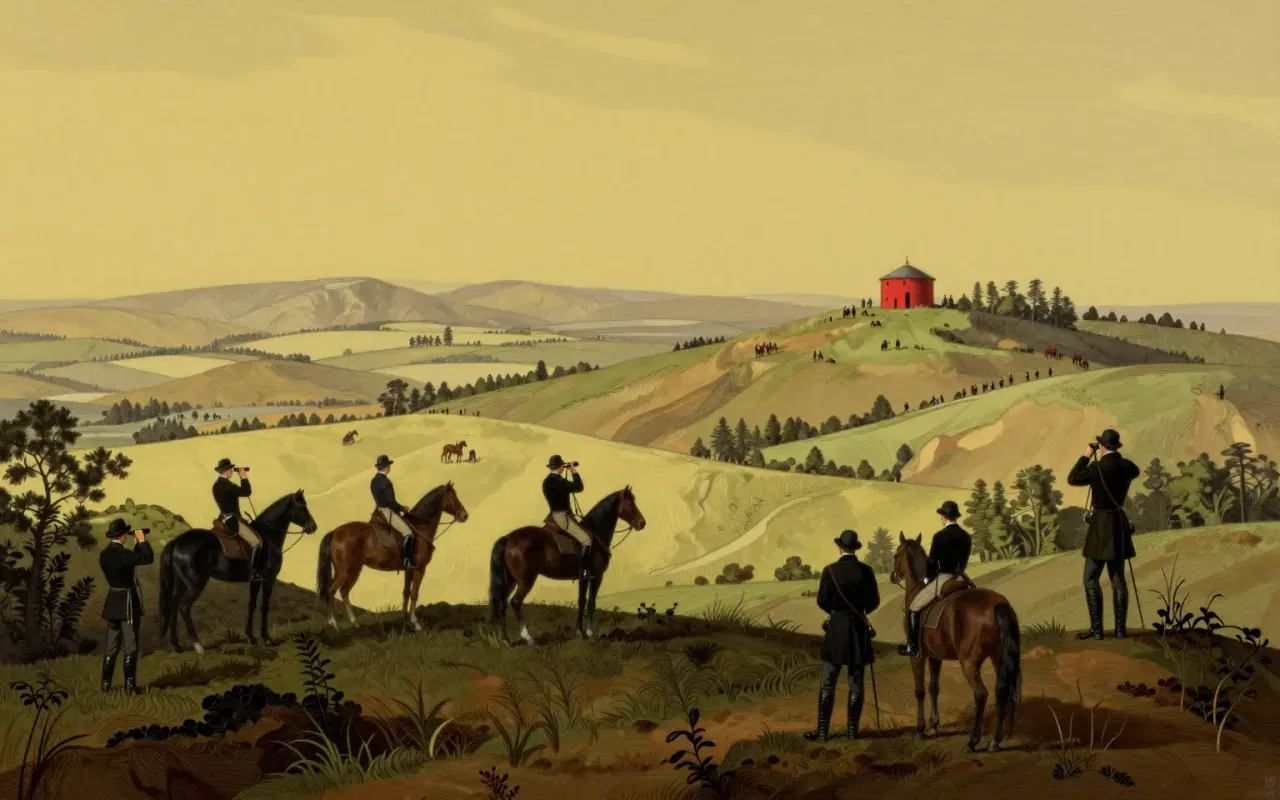
During the Battle of Balaclava on 25 October 1854, the British commander Lord Raglan wanted the Light Brigade to prevent Russian forces from carrying off captured Turkish artillery pieces from redoubts he could see clearly from his elevated position but that his cavalry commander, Lord Lucan, could not see from the valley floor. Raglan’s written order, carried by Captain Louis Nolan, told the cavalry to advance rapidly and prevent the enemy taking the guns away, language intended to describe the withdrawing Turkish pieces on the Causeway Heights rather than the heavily fortified mass of Russian artillery positioned at the valley’s far end, flanked by guns on both sides.
The one man who could explain it, dead
What happened between Nolan’s delivery of the order and the charge itself is not fully recoverable, because the one person best placed to clarify it did not survive to explain himself. Lucan, unable to see the guns Raglan meant, asked Nolan which artillery the order referred to; by Lucan’s own later account, Nolan gestured broadly toward the wrong end of the valley, toward the massed Russian guns rather than the Turkish ones being withdrawn. Nolan was killed within the charge’s first minute, and because no other witness recorded the exchange in enough detail to settle the question, historians are left with Lucan’s version, given after the disaster and by a man with every reason to shift responsibility elsewhere.
A chain of command built for confusion
The disaster reflects how badly suited the command structure was to resolving ambiguity under pressure. Raglan issued orders from high ground with a full view of the battlefield, Lucan received them in the valley with a much narrower field of vision, and Nolan, the only person who had heard Raglan’s intent directly, was expected to convey it accurately to a subordinate commander who could not see what the order referred to. Once Lucan passed the charge order to the Earl of Cardigan, who then led the brigade directly at the visible Russian guns rather than toward the withdrawing Turkish artillery Raglan actually meant, there was no further point at which the mistake could realistically have been caught before the cavalry was already committed.
Three men, three versions of blame
In the aftermath, the three senior officers involved each pointed blame elsewhere. Raglan’s official dispatch held Lucan responsible, describing him as bound by an excessive sense of duty to attack regardless of the risk. Lucan, furious at being made the scapegoat, published correspondence arguing Raglan had previously insisted on strict, literal obedience to orders and that Nolan’s gesture, not his own judgment, had misdirected the charge. Cardigan, who had simply carried out the order as passed to him, escaped blame entirely, returning home to public acclaim, a promotion to Inspector General of the Cavalry, and, by one widely repeated detail, a champagne dinner aboard his private yacht the same evening without checking on his own men.
Six hundred men, half gone in minutes
Of roughly six hundred and seventy men who rode into the valley, contemporary counts recorded around a hundred and thirteen killed, a hundred and thirty-four wounded, and roughly sixty taken prisoner, leaving fewer than two hundred still mounted by the time the survivors withdrew; individual regiments suffered losses in the range of half to more than three-quarters of their strength. The French general Pierre Bosquet, watching from a nearby position, is remembered for calling it magnificent but not war, a remark less often quoted alongside his blunter addition that it was simply madness.
A poem outlasting the argument
Alfred Tennyson’s poem, written within weeks of the charge and published in early December 1854, fixed the event in British public memory as a story of valour undone by someone’s blunder well before any formal inquiry could settle responsibility, and its account of six hundred riding into the valley of death has outlasted the courts-martial arguments that followed. The material rewards attention precisely because it refuses to resolve: the order’s exact wording survives, but the decisive conversation about what it meant does not, leaving a reader to weigh three self-interested accounts against each other rather than accept any one of them as the final word.