A surprise attack, an eighteen-thousand-mile voyage, a fleet destroyed
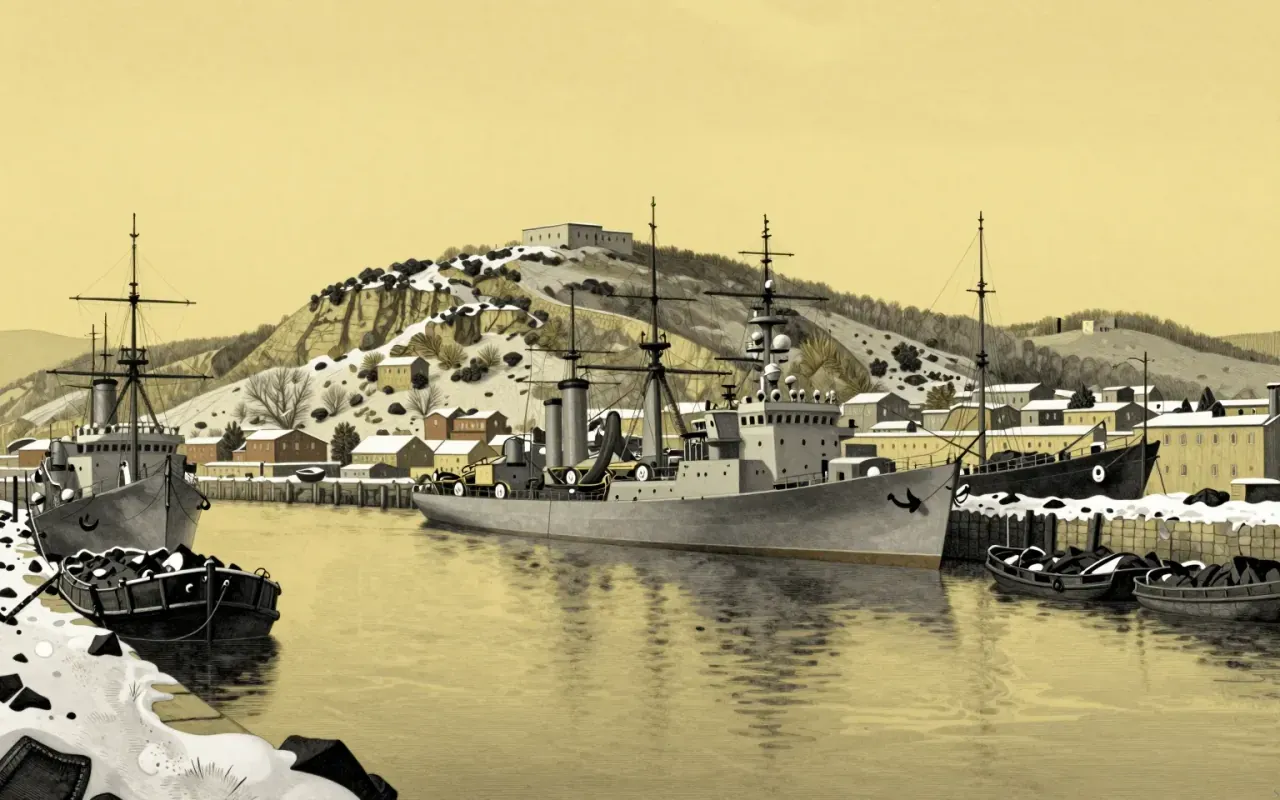
Japan opened the war with a surprise attack on the Russian Pacific Fleet at Port Arthur on 9 February 1904, beginning an eight-month siege that ended with the port’s fall in January 1905. Japanese forces captured Manchuria’s capital at the Battle of Mukden in March 1905, and the war’s decisive engagement came at Tsushima in May 1905, when Japan’s Combined Fleet intercepted and destroyed Russia’s Baltic Fleet after it had sailed roughly 18,000 nautical miles over more than seven months to reach the region, a defeat that effectively ended Russia’s ability to contest the war at sea and pushed both sides toward negotiation.
A peace negotiated in New Hampshire, resented in Tokyo
The Treaty of Portsmouth was negotiated over twelve sessions between 9 and 30 August 1905 in Portsmouth, New Hampshire, mediated by President Theodore Roosevelt, who had opened contact with both governments earlier that year and chose the location partly for its cooler summer climate; his role later earned him the Nobel Peace Prize, the first awarded to an American. The treaty, signed 5 September 1905, granted Japan recognition of its dominance in Korea, control of the Liaodong Peninsula and the South Manchuria Railway, and the southern half of Sakhalin island, while Russia retained the Chinese Eastern Railway in northern Manchuria and Japan abandoned its demand for a cash indemnity in exchange for the Sakhalin territory.
Two empires competing for the same contested territory
The war’s roots lay in competing imperial expansion following Japan’s victory in the First Sino-Japanese War of 1894 and 1895, after which the Triple Intervention had forced Japan to give up the Liaodong Peninsula, only for Russia to lease it and extend its own influence into Manchuria through the Trans-Siberian and Chinese Eastern Railways. Japan sought dominance over Korea while Russia consolidated its position in Manchuria, and negotiations between 1903 and 1904 aimed at dividing the two powers’ spheres of influence collapsed after repeated Russian delays, with contemporary Japanese diplomatic communications identifying those delays as a central cause of the escalating tension that led to war.
Whether Russia blundered into war or provoked it deliberately
Historians have specifically examined and largely rejected the theory that Tsar Nicholas II deliberately provoked the war to rally nationalist sentiment at home, finding the evidence points instead toward miscalculation and a serious underestimation of Japanese military capability by Russian officials and commanders. This matters because it shifts responsibility for the war’s outbreak away from a calculated Russian strategy and toward a more basic failure of assessment, a distinction that affects how historians read Russia’s subsequent conduct of the war and its unpreparedness for an opponent it had not taken seriously as a genuine military threat.
A war Japan won and its own public refused to believe was costly
Casualty figures show the war’s cost fell more heavily on the eventual winner than popular memory often suggests: Russia suffered between roughly 43,300 and 71,453 total deaths, while Japan’s losses ranged from about 80,378 to 99,000, alongside heavy losses of warships on the Russian side. Japan’s home population, aware chiefly of the war’s unbroken string of reported victories and unaware of the strain it had placed on Japanese finances and manpower, reacted to a peace treaty that secured no cash indemnity with the Hibiya riots, unrest severe enough to bring down the sitting Katsura cabinet in January 1906, even though the settlement had in fact secured Japan’s major strategic objectives.
Worth reading for what it broke, not just who won
The war’s lasting significance lies less in its specific territorial transfers than in what it demonstrated and triggered elsewhere. It stood as the first comprehensive military defeat of a major European power by a non-Western, Asian nation in the modern era, damaging assumptions of automatic Western military superiority across Asia, while Russia’s heavy losses and humiliating defeat directly contributed to the 1905 Russian Revolution, forcing constitutional concessions from the tsarist government. Readers drawn to the war’s naval drama at Tsushima gain the most from following these two threads outward, since the battle’s true weight lies in the assumptions it broke and the domestic upheavals it set in motion on both sides.