A battle for the air over southern England
Between 10 July and 31 October 1940, the dates by which British accounts usually bound the battle, though German historians treat it as one continuous campaign running into the night Blitz of 1940 and 1941, the Royal Air Force and Germany’s Luftwaffe fought for control of the skies over southern England and the Channel. Hitler had ordered the Luftwaffe on 1 August to win air superiority as a precondition for any cross-Channel invasion, and the campaign moved through a blockade phase against coastal shipping, an assault on radar stations and RAF airfields, and, from early September, a switch to bombing London and other cities. Britain kept its air defences intact through the autumn. Germany’s failure to break Fighter Command left the planned invasion, Operation Sea Lion, first postponed and then abandoned, usually recorded as Britain’s first major setback inflicted on Germany in the war.
Directives, logs and a wartime speech
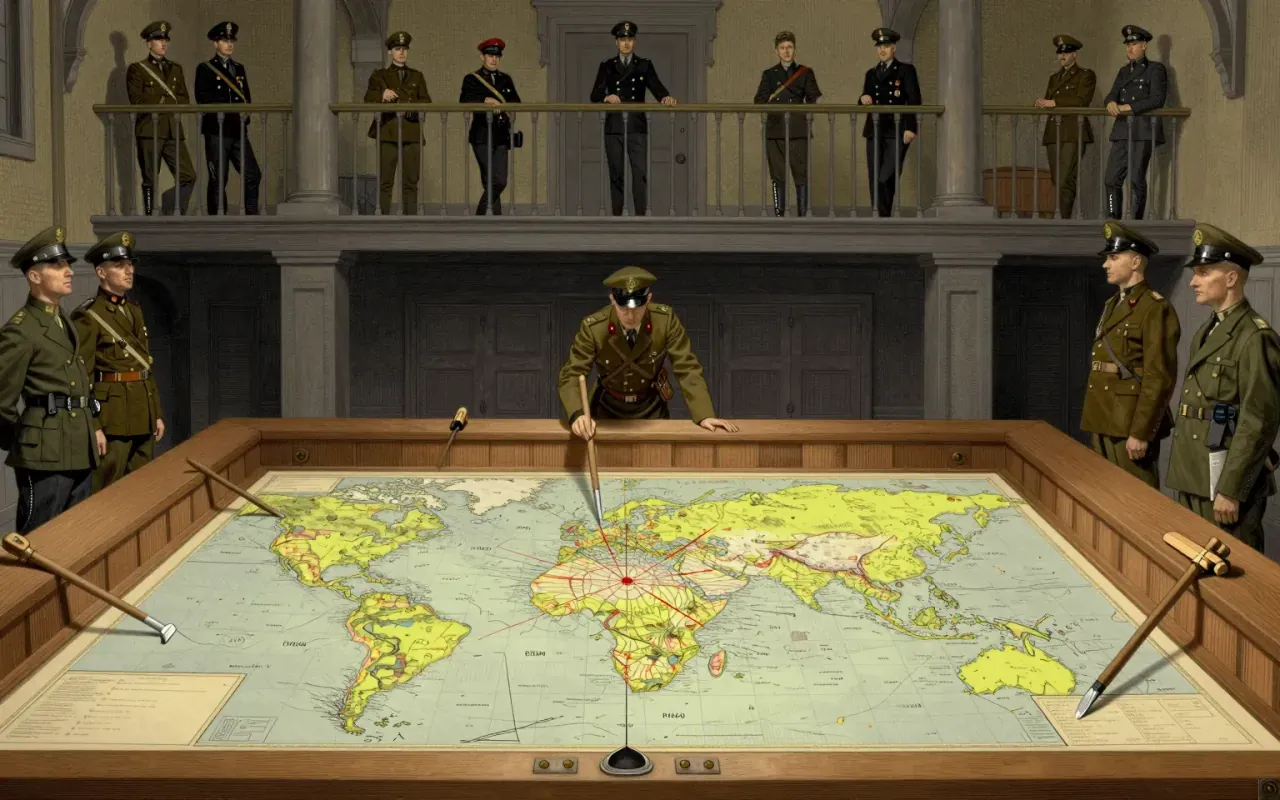
The record rests heavily on official paper generated at the time: Hitler’s own directives setting out strategy, the Luftwaffe’s operational logs, and Fighter Command’s tallies of sorties, losses and radar plots, later organised into the phases now used to describe the battle. Pilots on both sides left memoirs and combat reports that fill in what the directives do not say. Churchill’s wartime speeches, delivered as the fighting went on rather than composed afterward, did double duty as a contemporary account and a piece of persuasion aimed at sustaining British morale, and later readers have had to separate that persuasive purpose from the operational facts the speeches also convey. Much of the German side survives through captured High Command files, assembled and interpreted after the war rather than through an intact archive German historians chose and arranged themselves.
A system built to make scarce fighters count
Britain’s advantage lay substantially in the integrated system Air Chief Marshal Hugh Dowding had built at Fighter Command: radar stations feeding a chain of observers and plotting rooms that let controllers direct scarce fighters to where they were needed rather than keeping standing patrols aloft all day. Dowding also rotated exhausted squadrons out of the hardest fighting, something German commanders did less of, and had resisted Winston Churchill’s pressure earlier in 1940 to send more fighters into a losing campaign in France. The Luftwaffe, meanwhile, was working from a doctrine built around supporting an army in the field rather than an independent bombing strategy, its fighters were stretched thin escorting several hundred bombers a day, and its leadership disagreed on whether air superiority alone would suffice without the navy also controlling the Channel crossing. When attacks on airfields failed to finish the RAF, Hermann Goring shifted the campaign toward bombing cities in September.
Close numbers, disputed meaning
How the battle should even be dated is argued over, since German historians fold it into a single campaign running through the following spring rather than stopping it at the end of October. The raw casualty figures, around 1,744 British aircraft lost against roughly 1,977 German, look closer than the outcome suggests, and much of the disagreement concerns how to weigh that against Germany’s greater difficulty replacing experienced pilots. Fighter Command was not short of pilots overall, but by the middle of August it was short of ones with full training, a distinction easily lost in the shorthand later used to celebrate the pilots who flew as a small, heroic few. Whether the German invasion plan was ever more than pressure on Britain to negotiate is unresolved as well: a directive ordering preparations survives alongside contemporary judgements, from writers such as Len Deighton, that an actual crossing would have been close to suicidal.
An invasion cancelled, a commander removed
The immediate result was that Germany called off its only serious plan to invade Britain and turned its bombers to night raids on cities instead, while attention within the German high command drifted toward the invasion of the Soviet Union the following year. For Dowding personally the sequel was less triumphant: within weeks of the battle’s end he was removed from Fighter Command, a decision tangled up with a dispute over tactics with subordinates who favoured larger fighter formations and with unresolved problems defending against bombers at night. The battle’s later reputation, as the moment an invasion of Britain became impossible and as a formative piece of national memory, sits some distance from the messier record of doctrine disputes, pilot shortages and command politics that the archives show underneath it.
Reading past the national memory
This is a rewarding subject for a reader interested in how a command-and-control system, rather than any single dogfight, can decide a campaign, and in how quickly a wartime narrative, delivered in speeches meant to hold morale together, hardens afterward into the story a country tells about itself. It asks the reader to hold two things at once: a battle Britain did win, and a mythology about that battle that grew larger and simpler than the directives and loss returns underneath it. Anyone wanting a single dramatic turning point will find the record more contested and administrative than that, full of doctrine arguments and pilot-training statistics; anyone willing to read for that texture will come away with a clearer sense of what was decided in the autumn of 1940 and what was decided about it afterward.