Gold, law and a forced treaty
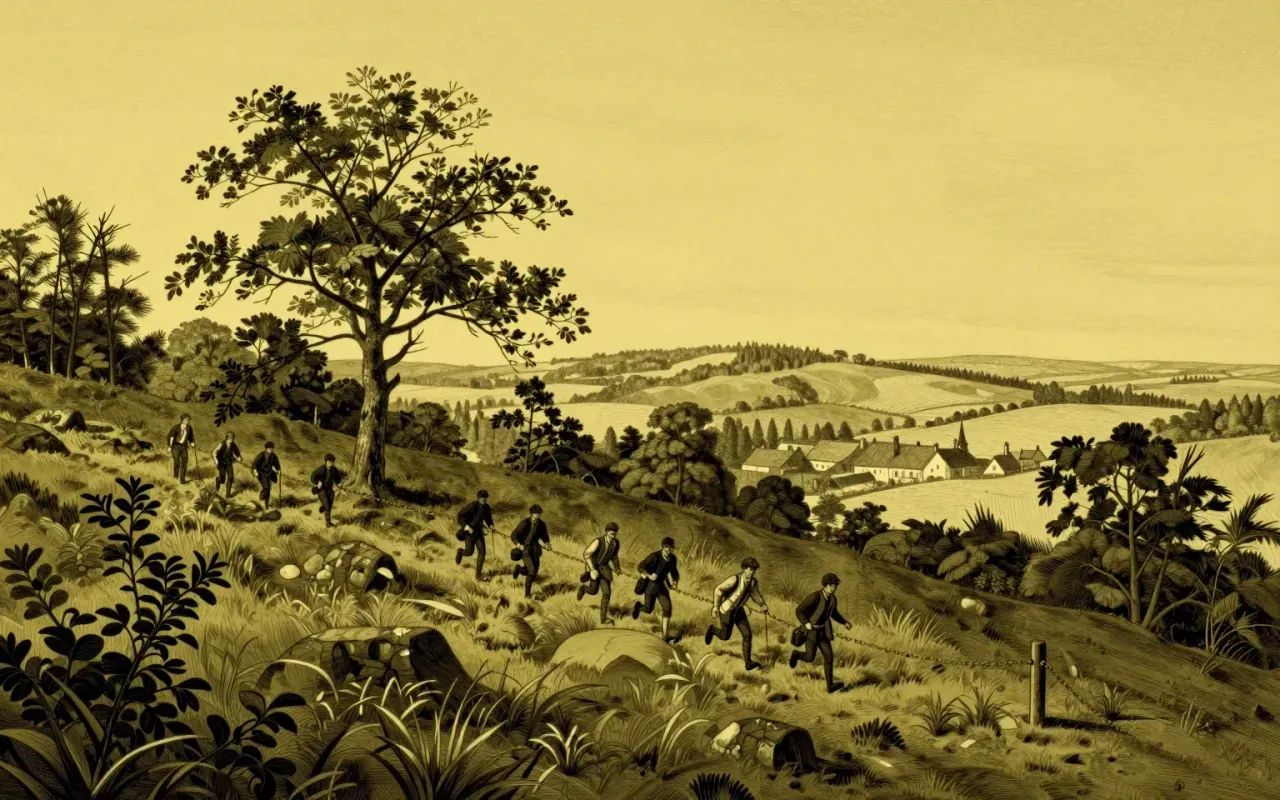
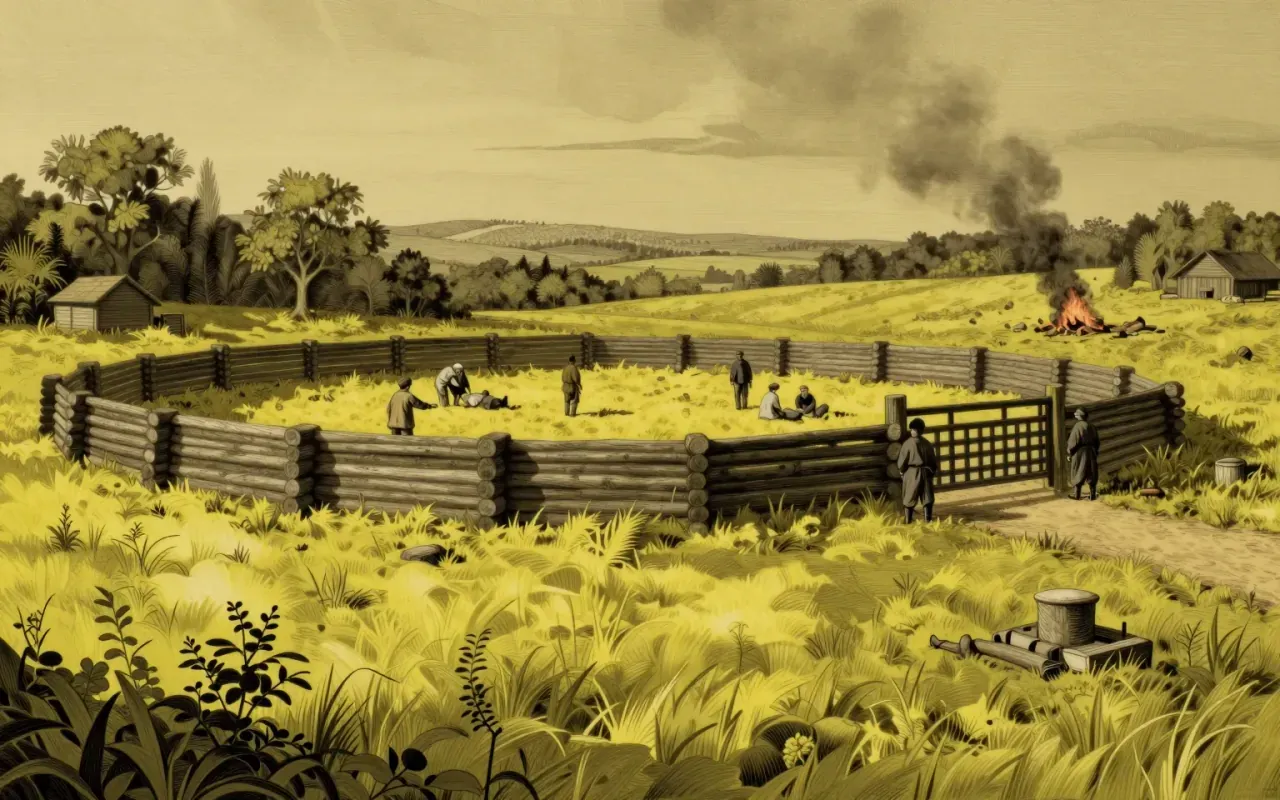
Pressure to remove the Cherokee from their ancestral lands in the southeastern United States intensified after gold was discovered near Dahlonega, Georgia, in 1828, and grew further once Congress passed the Indian Removal Act in 1830 and Georgia extended state authority over Cherokee territory. A small, unauthorised faction signed the Treaty of New Echota in December 1835, ceding Cherokee land for territory further west, a document the Senate ratified by a single vote despite fierce opposition from the elected Cherokee leadership under Chief John Ross. When voluntary emigration under the treaty fell short, federal troops under General Winfield Scott began forcibly rounding up Cherokee families in May 1838, holding thousands in internment camps before dispatching them west in twelve organised detachments between autumn 1838 and the following spring. Roughly fifteen thousand five hundred Cherokee people, along with some fifteen hundred enslaved African Americans they held, were forced onto the journey, settling near what became Tahlequah, Oklahoma.
Records that cannot be reconciled
The removal is documented through an unusually wide range of surviving material, including muster rolls and daily journals kept by the army and the Bureau of Indian Affairs, the personal papers of Chief John Ross, a formal letter of protest to Congress from Cherokee leader John Ridge, and a firsthand account from the missionary Elizur Butler, who travelled with one of the wagon trains and later produced the death estimate still most often cited today. Even with this volume of material, reconstructing exact mortality proved difficult, since Ross’s own expense claims for provisions and Army officer counts of people departing and arriving did not match cleanly, complicated further by individuals who migrated more than once, moved between different detachments, or obtained state citizenship specifically to avoid removal altogether, all of which make simple arithmetic between starting and ending population figures an unreliable method for establishing how many people actually died along the way.
Procedure weaponised
Removal proceeded despite fierce Cherokee legal resistance because federal and state authorities were willing to bypass the very Supreme Court ruling, Worcester v Georgia in 1832, that had affirmed Cherokee sovereignty against Georgia’s claims, since President Andrew Jackson declined to enforce a decision he had no independent obligation to carry out and Georgia continued asserting authority regardless. The Treaty of New Echota gave removal a veneer of legal consent even though the signatories represented only a small minority faction acting against the wishes of the elected tribal government and more than sixteen thousand Cherokee who formally petitioned Congress to reject it, illustrating how a treaty’s formal validity and its actual representativeness could diverge sharply when one party held enough power to accept whichever signatures it needed. Once voluntary emigration produced only a small fraction of expected departures, forced removal followed directly from the government’s prior commitment to a timeline it had already set regardless of Cherokee consent.
A death toll without consensus
Death toll estimates for the Cherokee removal alone range widely, from a 1973 demographic study proposing around two thousand deaths to a 1984 study concluding closer to six thousand, with Elizur Butler’s contemporary figure of roughly four thousand remaining the most frequently cited despite his own acknowledgement that it was an approximation rather than a verified government count. A separate and more fundamental disagreement concerns how to characterise the policy as a whole: historians including Jeffrey Ostler argue removal had genuinely genocidal dimensions, while Francis Paul Prucha and Robert Remini maintain Jackson acted from a paternalistic, if ultimately catastrophic, belief that removal would spare tribes from inevitable destruction rather than from any intent to cause mass death. A middle position, associated with historians including Donald Cole, finds no conscious design for genocide while still rejecting any defence based on supposed benevolent intentions, arguing the distinction matters less than the scale of documented, foreseeable suffering the policy actually produced.
Genocide or catastrophe
Removal permanently displaced most of the Cherokee Nation to what became Oklahoma, though roughly a thousand people avoided the journey and remained in North Carolina, forming the community now known as the Eastern Band of Cherokee Indians. Political division created by the treaty’s illegitimate signing did not end with arrival in the west, as members of the pro-treaty faction, including Major Ridge, John Ridge and Elias Boudinot, were assassinated in factional violence within years of resettlement. Congress formally designated the removal routes as the Trail of Tears National Historic Trail in 1987, and in 2004 the Senate passed a resolution apologising for what it termed ill-conceived federal policies toward Native nations. Despite the catastrophic disruption, the Cherokee Nation eventually rebuilt and grew substantially, and today constitutes the largest federally recognised Native American tribe by enrolled population in the United States, a demographic recovery that took place over roughly two centuries following near-total displacement from its original homeland.
Displacement and eventual recovery
The Cherokee removal rewards close attention precisely because the surrounding legal process, a minority-signed treaty, a single-vote Senate ratification, a Supreme Court ruling the executive branch simply declined to enforce, shows exactly how a democratic government’s own formal procedures can be manipulated to produce an outcome most of the affected population never consented to. Readers should not expect a precise death toll, since the surviving records genuinely cannot support one, but should take the persistent range of serious scholarly estimates, several thousand at minimum, as sufficient basis for judging the policy’s severity regardless of the exact figure. The unresolved historiographical argument over genocide, ethnic cleansing or well-intentioned catastrophe is not merely academic hairsplitting, since it shapes how directly responsibility is assigned to specific decision-makers rather than impersonal circumstance. Anyone interested in the mechanics of forced displacement, treaty fraud, or how legal process can be weaponised against the people it is meant to protect will find this an essential case.