A city cut off overnight, over a new currency
On 24 June 1948, the Soviet Union halted all rail, road and canal traffic into the Western-occupied sectors of Berlin, which sat entirely inside the Soviet zone of a Germany divided since 1945 under the Potsdam Agreement. The immediate trigger was the introduction of a new currency, the Deutsche Mark, in the Western zones on 21 June, to which the Soviets responded by announcing their own currency for the east. The United States, Britain, France and allied countries including Canada, Australia and New Zealand responded with the Berlin Airlift, flying supplies into the city until the Soviet Union lifted the blockade on 12 May 1949, with flights continuing until the end of September to build reserves.
An operation tracked flight by flight, ton by ton
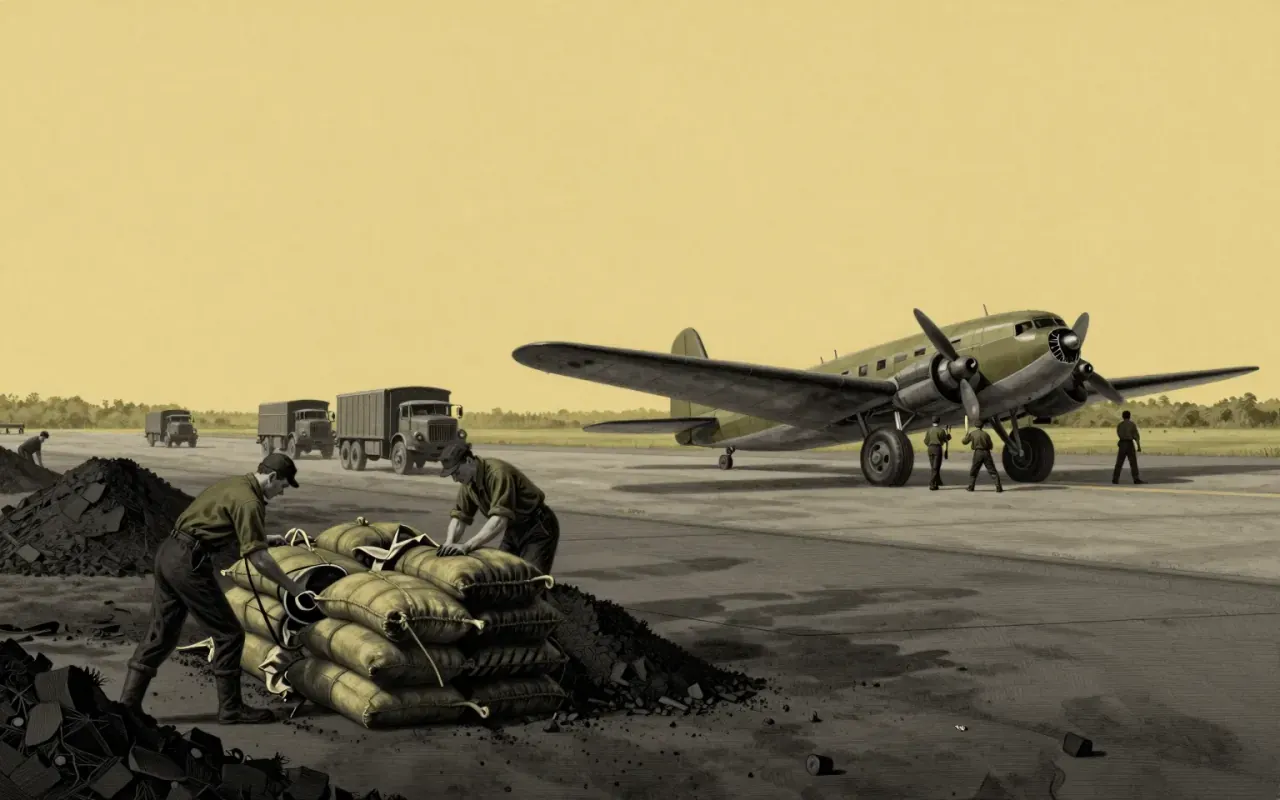
The airlift left an unusually detailed operational record. American and British forces delivered 2,334,374 tons of supplies over 278,228 flights, with the United States flying about 76 percent of the total and Britain most of the rest. Daily requirements rose from an initial estimate of under a thousand tons to 5,620 tons by October 1948 and a peak capacity near 8,893 tons by May 1949, with a single Easter weekend push in April 1949 delivering nearly 13,000 tons of coal in nine hundred and some flights without an accident. The operation cost 101 lives, forty British, thirty-one American, one Australian and fifteen German civilians, mostly in crashes tied to the harsh winter weather of 1948 and 1949.
A currency dispute inside a larger struggle for Germany’s future
The currency dispute sat inside a larger contest over Germany’s future. Western powers had spent early 1948 planning, at the London Six-Power Conference, to consolidate their occupation zones into an economically and politically stronger West German state, a project the new currency was meant to support. Soviet planners viewed this consolidation as a direct threat, and a March 1948 memorandum sent to Foreign Minister Molotov reportedly outlined a plan to regulate Western access to Berlin as pressure against the Western allies’ policy. Soviet officials publicly described the resulting restrictions as arising from unspecified technical difficulties on the railways and roads rather than acknowledging a deliberate blockade.
What Stalin actually wanted is still argued over
Historians remain divided on Stalin’s underlying aim. General Lucius Clay, the American military governor, interpreted the blockade as a coercive move meant to extract political concessions without provoking open war, betting on Western caution. Other accounts suggest Stalin sought more specifically to prevent the formation of a Western-aligned German state altogether, using Berlin’s vulnerability as leverage. Soviet internal assessments from April 1948 suggest planners believed their restrictions had already damaged American and British prestige and that a full airlift would prove too costly for the West to sustain, a calculation the subsequent eleven-month operation proved incorrect, though it remains unclear whether Stalin had a single fixed objective or was testing Western resolve incrementally.
A blockade that backfired into closer Western ties
The blockade’s failure produced the opposite of its apparent intent. A municipal election in West Berlin that December drew an eighty-six percent turnout with overwhelming support for non-communist parties, and hundreds of thousands of Berliners are recorded as having demonstrated support for continuing the airlift rather than accepting Soviet terms. Rather than isolating the city, the episode tied West Berlin more closely to the United States and Britain and hardened the division between the Western and Soviet zones that would harden further into separate West and East German states within the following year, making the blockade one of the opening confrontations of the Cold War rather than a resolution of Germany’s status.
Worth reading for the miscalculation behind it
The blockade rewards close attention chiefly because it captures a specific, documented Soviet miscalculation: internal assessments suggesting Western resolve and capacity had already been dented, followed immediately by an airlift that not only sustained a divided city through a harsh winter but expanded its capacity every few months until it comfortably exceeded what the blockade had aimed to prevent. Readers interested in how confident planning assumptions can collapse against unexpected persistence will find the episode’s real value less in its diplomatic outcome, a lifted blockade, than in the operational record of an improvised logistics effort outperforming what either side initially thought possible.