From a rejected art student to a decorated soldier
Hitler was born in 1889 in Braunau am Inn, Austria-Hungary, and after his father’s death in 1903 pursued art rather than the civil service career his father had wanted, applying twice to Vienna’s Academy of Fine Arts and being rejected both times, after which he lived in poverty in Vienna between 1907 and 1913. He served voluntarily in the Bavarian Army during the First World War, was wounded at the Somme and temporarily blinded by mustard gas in 1918, and received the Iron Cross First Class, an unusually high decoration for his rank, before returning to Munich after the war with no clear career prospects.
A 1919 letter, a 1925 memoir, and what each actually reveals
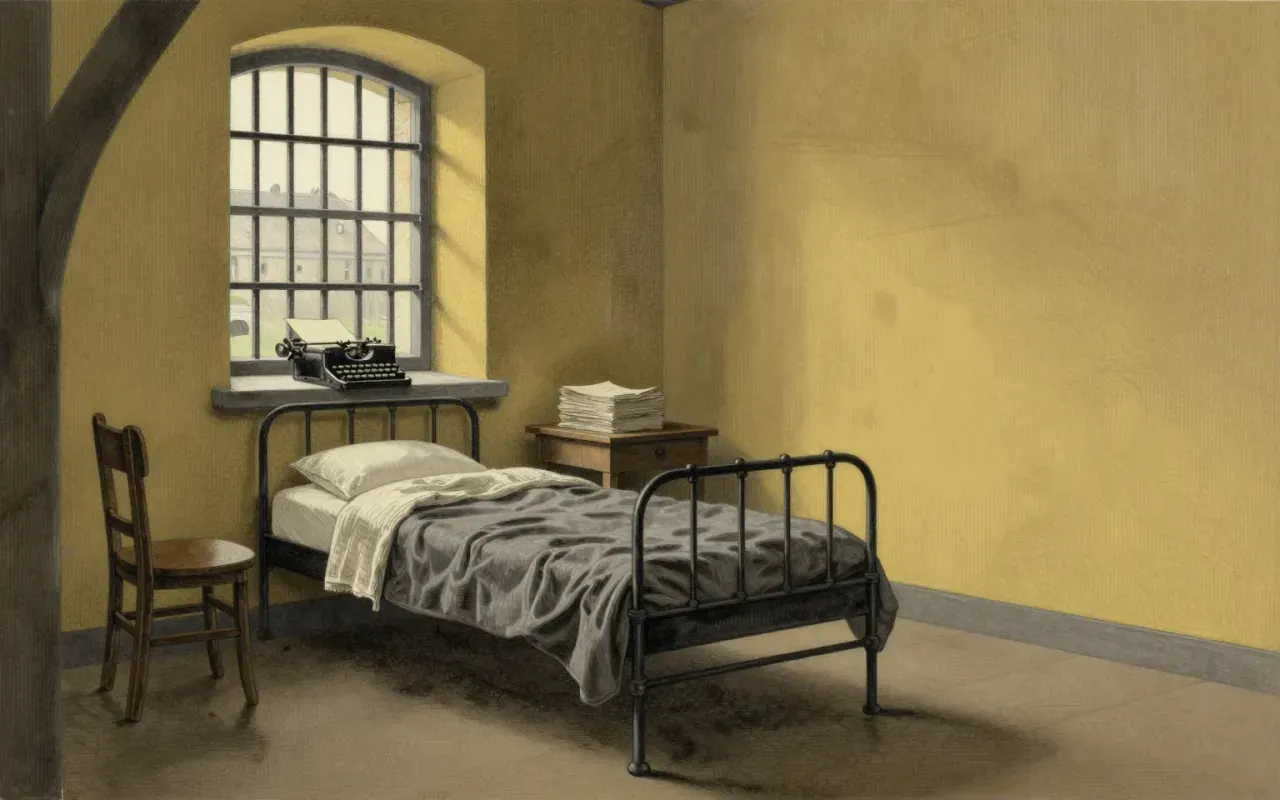
Hitler’s earliest known written statement on antisemitism dates to September 1919, when, working as an army intelligence agent assigned to monitor the small German Workers’ Party, he wrote that the government’s aim must unshakably be the removal of the Jews altogether, a document historians treat as an important marker even though it predates his rise to real political influence by more than a decade. His 1925 prison memoir, Mein Kampf, dictated during his sentence for the failed 1923 Beer Hall Putsch, laid out his territorial ambitions and, according to the historian Ian Kershaw, contains an undeniable genocidal thrust, though historians caution that the text mixes genuine ideological commitment with material shaped for propaganda effect.
A failed 1923 putsch, then legal power a decade later
Hitler’s attempt to seize power directly failed in November 1923, when his Beer Hall Putsch in Munich collapsed after police and the German army withdrew support, resulting in his arrest and a five-year sentence of which he served just over one year. He rebuilt the Nazi Party through the following decade, exploiting the economic devastation of the Great Depression to expand electoral support until the party won the largest number of seats in the November 1932 Reichstag election without a majority, at which point former chancellor Franz von Papen and other conservative politicians persuaded President Paul von Hindenburg to appoint Hitler chancellor on 30 January 1933, believing they could control him from within a coalition government, a miscalculation Hitler overturned within weeks through the March 1933 Enabling Act.
When historians say the antisemitism actually took hold
Historians including Richard J. Evans now largely agree that Hitler’s antisemitism did not represent a lifelong conviction stretching back to his Vienna years but instead emerged more specifically after Germany’s 1918 defeat, as part of his embrace of the stab-in-the-back myth, the belief that Germany’s military had been undermined by civilian and communist betrayal rather than defeated militarily on the battlefield. This dating matters for how historians understand the relationship between Hitler’s personal psychology and the broader postwar German political culture that produced similar grievances and scapegoating well beyond Hitler’s own party.
War, the Holocaust, and a death confirmed eighty years later by DNA
Hitler’s invasion of Poland in September 1939 triggered the Second World War in Europe, and his 1941 invasion of the Soviet Union and declaration of war on the United States expanded the conflict globally; under his direct ideological direction, Nazi Germany systematically murdered approximately six million Jews in the Holocaust alongside millions of other victims, contributing to a total European death toll historians estimate at roughly 28.7 million military and civilian deaths. As Soviet forces closed in on Berlin, Hitler married Eva Braun on 29 April 1945 and the couple took their own lives the following day in the Fuhrerbunker; in 2025, DNA analysis of preserved blood confirmed his identity and specifically refuted a longstanding claim, the Frankenberger thesis, that he had Jewish ancestry through his paternal line.
A life worth reading for how ordinary its early failures were
Hitler’s biography is worth reading carefully for how unremarkable and repeatedly unsuccessful his early life actually was, a rejected art student, an obscure army veteran, a failed coup leader imprisoned for treason, against the scale of destruction his later, legally achieved power made possible, since that gap is itself a caution against assuming historical monsters must show early, visible signs of their eventual capacity for harm. Readers interested in political history will find in his 1933 appointment a genuinely instructive case of miscalculation by establishment politicians who believed they could contain him; readers interested in the history of ideology will find the later, more precisely dated emergence of his antisemitism a useful correction to any assumption that such convictions are simply innate rather than shaped by specific historical circumstance.