Salutary neglect ends, and resistance begins
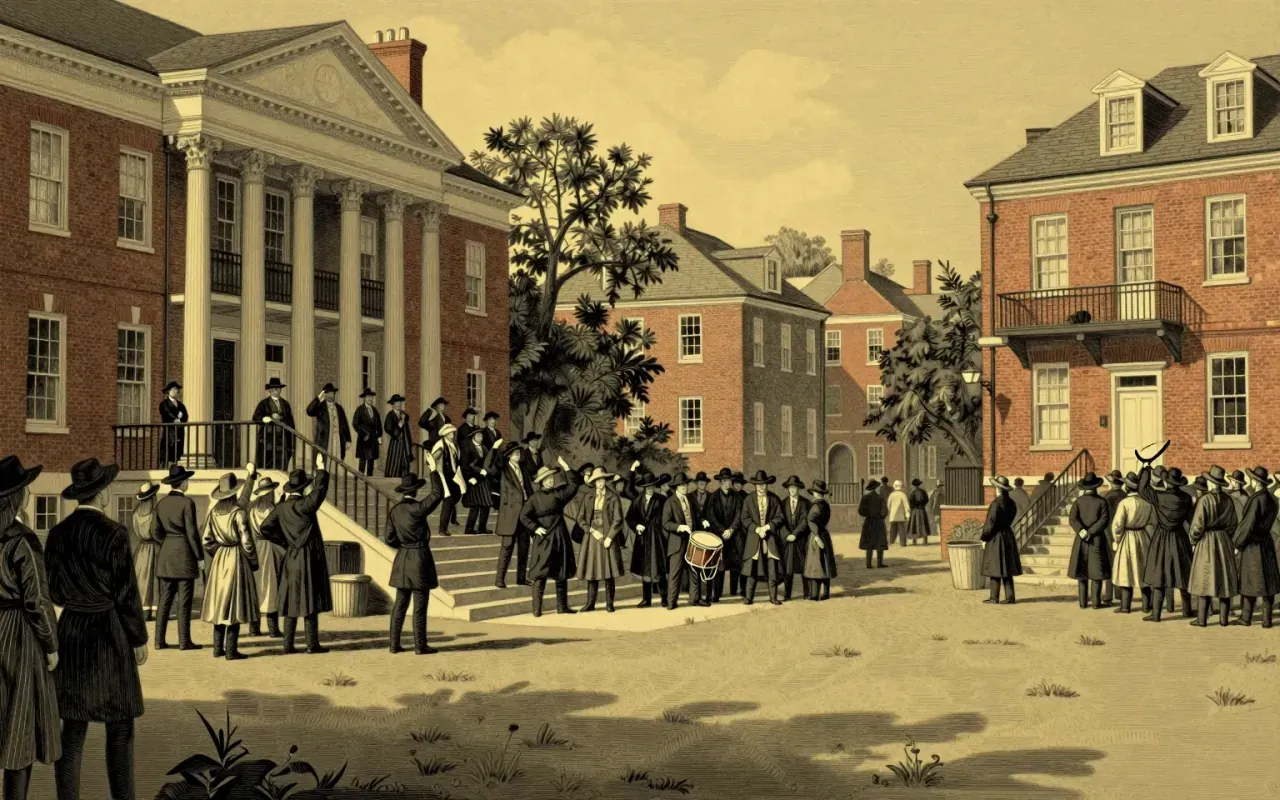
Following the end of the French and Indian War in 1763, Britain moved to recoup wartime costs and tighten administrative control over colonies that had previously operated under a loose policy later termed salutary neglect, imposing new taxes and enforcing existing trade restrictions, including the Navigation Acts dating back to 1651, more strictly than before. Colonial resistance organised progressively through the Stamp Act Congress of 1765, opposition to the Townshend Acts of 1767, the Boston Massacre of 1770 and the Boston Tea Party of 1773, provoking the Intolerable Acts and the convening of the First Continental Congress in 1774, before armed conflict began at Lexington and Concord in April 1775 and the Second Continental Congress adopted the Declaration of Independence on 4 July 1776.
Congressional records and a captain’s remembered words
Evidence for the revolution’s causes and course includes colonial charters, legislative and congressional records, and the surviving text of key documents including the Declaration of Independence itself and the Proclamation of Rebellion issued by King George III in 1775. A colonial captain’s remembered statement, that colonists had always governed themselves and always meant to, is cited as capturing the underlying colonial self-perception, though such retrospective quotations from participants carry the ordinary limitations of memory and later political framing that any historical account built partly on individual testimony has to weigh against more contemporaneous administrative and legislative records.
From taxation dispute to shots at Lexington and Concord
The dispute escalated from organised political protest into military conflict once British forces attempted to seize colonial military supplies at Lexington and Concord in April 1775, prompting the Second Continental Congress to appoint George Washington as commander of a newly formed Continental Army the following month. Formal separation followed just over a year later: the Lee Resolution affirming support for independence passed on 2 July 1776, and the Second Continental Congress adopted the Declaration of Independence, drafted primarily by Thomas Jefferson as part of a five-member committee, on 4 July 1776, asserting the principle that all men are created equal and possess natural rights independent of any government’s grant.
Ideology, economics, or a simpler desire to keep governing themselves
Historians continue to debate how to weight the revolution’s underlying causes, distinguishing analytically between ideological motivations rooted in liberal and republican political theory, direct economic grievances over taxation and trade restriction, and a more straightforward desire among colonists to preserve the substantial self-governance they had exercised for decades under salutary neglect before 1763. The historical record also draws distinctions among participants and their differing stakes in the outcome, separating Patriots from Loyalists, neutral colonists, women, Native Americans, Black Americans and the German auxiliary soldiers who fought for the British crown, each experiencing the revolution’s causes and consequences in materially different ways that a single ideological or economic explanation does not fully capture.
A declaration, a war, and a constitution built to outlast both
American forces, reinforced from 1778 by a formal alliance with France following the American victory at Saratoga the previous year, which brought roughly forty thousand French troops into the conflict, secured the war’s decisive result at the siege of Yorktown in 1781, where British General Cornwallis surrendered. The Treaty of Paris, signed in September 1783, formally recognised American independence and ceded British territory east of the Mississippi River and south of the Great Lakes to the new nation, which subsequently ratified a federal Constitution in 1789 and adopted a Bill of Rights in 1791, establishing what the record describes as the first nation founded on a written constitution built around natural rights, the consent of the governed, and equality under the law.
A founding worth reading past its own founding myth
The American Revolution rewards attention as much for the internal contradictions historians continue to work through, a declared principle of universal equality that coexisted with slavery, and a claim to have always self-governed that somewhat overstates the degree of formal autonomy colonies actually held before 1763, as for its familiar sequence of protest, war and founding documents. Readers interested in political theory will find genuine substance in the debate over ideological, economic and self-governance explanations; readers interested in the revolution’s full cast of participants, beyond the familiar Patriot leadership, will find a more varied and complicated picture than the founding narrative alone typically presents.