A committee of five
On 11 June 1776 the Continental Congress appointed a committee of five, John Adams, Benjamin Franklin, Thomas Jefferson, Robert Livingston, and Roger Sherman, to draft a statement of independence, and the group left the actual writing to Jefferson. He produced a draft in about two weeks, working from a rented room in Philadelphia and drawing on Enlightenment arguments already circulating in pamphlets like Thomas Paine’s. Congress had already voted for independence itself on 2 July, when a separate resolution from Richard Henry Lee passed with twelve colonies in favour and New York abstaining. Congress then spent two more days cutting and revising Jefferson’s text before approving the final wording on 4 July, the date that was afterward printed and celebrated rather than the date of the actual vote.
The vote before the words
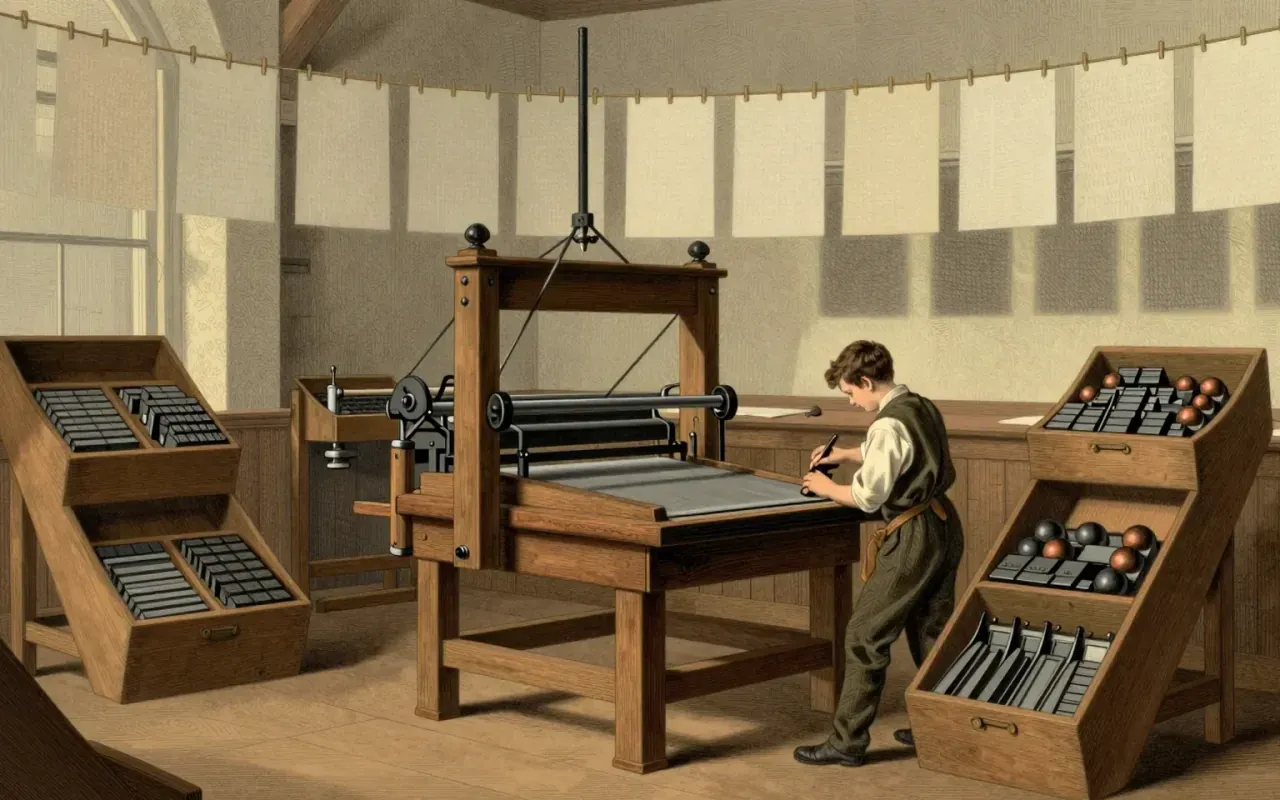
The clearest record of the drafting and approval comes from Congress’s own journals, which fix the sequence of votes and edits, and from the printed broadsides run off by John Dunlap immediately after 4 July, none of which carried any signatures. The famous parchment copy, handwritten by Timothy Matlack, was not ordered until 19 July and was signed by most delegates on 2 August, with a handful signing even later. Jefferson’s own account of the drafting and the debate over the slavery passage appears in an autobiography he wrote decades afterward, which is a source worth using carefully, since memory of a fight over wording tends to sharpen with distance rather than fade. John Adams left his own, sometimes conflicting, recollections written even later.
A quarter cut away
The sequence, vote first, then text, then signatures much later, reflects how Congress actually worked under pressure. Independence itself was the urgent political question, forced by escalating fighting since April 1775 and by the practical need to secure foreign help, particularly from France, which was far more likely once the colonies had formally separated from Britain. Once that vote passed, the declaration’s wording became a matter of building the broadest possible consent among delegates who did not agree on everything, which is why Congress cut about a quarter of Jefferson’s draft, most notably his passage blaming the king for the slave trade, a change driven by objections from delegates connected to slavery in both the North and South. The engrossed copy, ordered only after the text was set, was a formal record produced once the substance was already settled.
Signed later than remembered
Three points get muddled in popular memory. The first is the date itself: 4 July marks Congress’s approval of the wording, not the vote for independence, which came on 2 July, a distinction John Adams expected history to get right and which it mostly has not. The second is the signing, since the image of fifty-six men signing together on 4 July describes the parchment copy actually completed on 2 August and afterward. The third, and the more substantive argument, concerns the equality clause set against a Congress that struck out language condemning slavery and against Jefferson’s own status as a slaveholder, a contradiction historians describe rather than resolve, since the sources do not offer a tidy account of how the delegates squared the two.
Words that outgrew their moment
The Declaration’s immediate effect was to give the break with Britain a public, reasoned justification rather than leave it as an act of armed rebellion alone, which mattered for winning support at home and abroad, including from France after the American victory at Saratoga the following year. Its longer effect ran through how later Americans used its language rather than through anything it did in 1776 itself. Abraham Lincoln treated the equality clause as the moral standard the country had committed itself to, invoking it in the Gettysburg Address nearly a century later, and subsequent movements for civil rights repeated the same appeal to a text that had not, in its own moment, extended equality to the enslaved people some of its signers held.
A text worth rereading
The document is short enough to read in full in a few minutes, and doing so against the actual timeline, vote on the 2nd, wording on the 4th, most signatures on 2 August, is a useful corrective to how it gets taught. What makes it worth the time is not the prose, which is serviceable rather than beautiful, but the way the drafting and editing expose the compromises inside a text now treated as a single, settled statement of principle. Readers who want the founding period presented as untroubled will find the slavery-clause removal an uncomfortable detail; readers willing to sit with that discomfort will get more out of the document than the holiday version offers.